
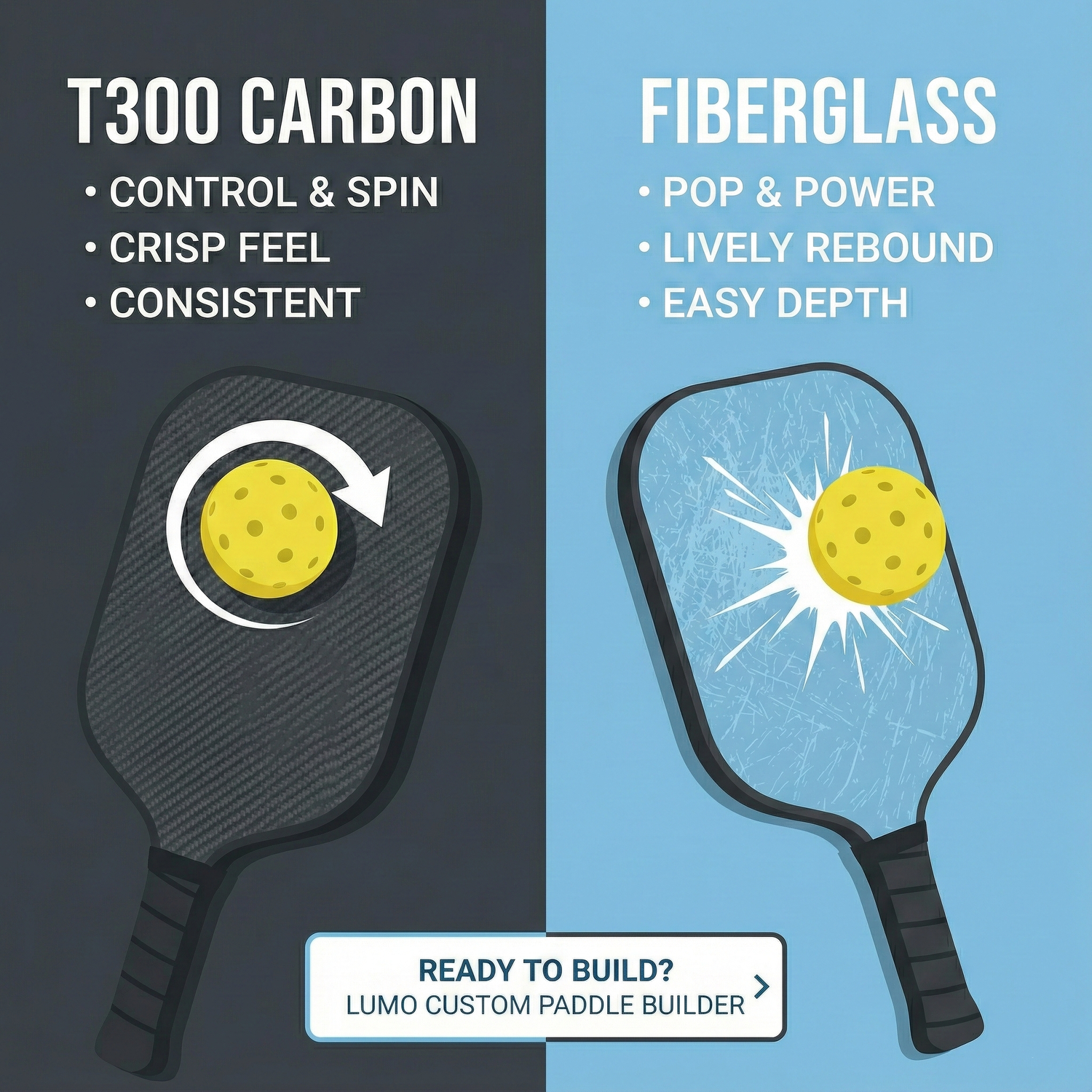
- T300 carbon fiber is a Toray grade of standard-modulus carbon; it’s stiffer than fiberglass at similar weight, giving more control, cleaner contact, and often longer-lasting surface texture. See also JOOLA’s explainer.
- Fiberglass is more flexible and lively (“pop”), which can make depth easier but sometimes at the cost of precision and texture durability.
- If you value dinks, resets, reliable spin, and consistent blocks, upgrading from fiberglass to a T300 carbon-face is usually worth it; if you rely on effortless pop, fiberglass can still be the better fit (source).
- Both materials must meet USA Pickleball rules for surface roughness & kinetic friction (≤ 0.1875) and PBCoR power limits—so “more spin” or “more pop” still lives under compliance caps (USAP ESM 2025; PBCoR overview).
- Ready to build once you decide? Start with a performance base and upload your art via the Lumo Custom Paddle Builder.
Executive Summary
This guide breaks down the real, on-court differences between a T300 carbon fiber face and a fiberglass face—and gives a crisp answer to “Should I upgrade?” In short: T300 carbon offers higher stiffness at similar weight, which translates into more predictable ball exits, crisper feel, and spin that tends to hold up. Fiberglass typically feels more springy and can help you generate pace with less swing speed, though its surface texture may lose bite faster in some constructions. We also demystify T300 vs. “3K” (tow size) and explain how USA Pickleball’s 2025 rules shape the ceiling for spin and power no matter what you buy (Toray T300 datasheet; Fibre Glast basics; USAP ESM 2025).
First Principles: What T300 Carbon and Fiberglass Are (and Why That Matters)
- T300 is a Toray standard-modulus carbon fiber grade (often built into 3K fabric for paddle faces). It has a typical fiber tensile modulus ~230 GPa and tensile strength ~3.53 GPa, giving a high stiffness-to-weight ratio for predictable impacts—one reason carbon is prized for control (Toray T300 datasheet).
- Fiberglass (e.g., E-glass) is denser and more flexible than carbon fiber, which generally makes it heavier for the same stiffness and livelier on ball contact. That “give” can feel powerful but also means more face deflection—great for pop, not always for precision (JOOLA; Goodwinds).
Bottom line: T300 face = stiffer & lighter feel for control. Fiberglass face = more flex & pop (often easier depth with less swing) (Paddletek).
Don’t Get Tripped Up by Terms: T300 vs. 3K (Tow Size ≠ Fiber Grade)
Players often mix up T300 (a grade) with 3K (a tow size = 3,000 filaments per bundle). You can have 3K fabrics made from different grades; “3K” mostly describes appearance and handling, not the intrinsic modulus/strength of the carbon itself (Rock West—tow FAQ; Rock West—grade & modulus primer).

On-Court Translation: How the Materials Play
Control, Feel & Consistency
- T300 carbon face: Higher face stiffness reduces “trampoline” at contact, which stabilizes launch angle. You’ll feel easier dinks/resets, fewer flyers, and more predictable blocks (JOOLA).
- Fiberglass face: More flex gives a livelier rebound, which can help on serves/returns and counters but sometimes at the cost of touch near the net (Paddletek).
Spin & Surface Texture
Carbon faces often feature a micro-texture that retains spin capability well over time (within legal limits). Spin is capped by rule, though—kinetic COF ≤ 0.1875 and tight roughness thresholds—so no paddle can go past the ceiling (USAP ESM 2025; Tennis Warehouse U. explainer).
Power & Pop
Fiberglass’ flexibility translates to easy pop—that’s its appeal. If your swing speed is modest, fiberglass may help you find depth with less effort. Carbon can match power in some builds, but its signature is control (JOOLA).
Durability & Longevity
- Carbon (T300): Excellent stiffness retention and typically strong texture longevity, helping your spin and feel remain more consistent across months of play (Toray T300).
- Fiberglass: Good impact tolerance and lively feel, but surface bite and feel may change faster depending on the layup and finish. Multiple industry guides note carbon’s stiffness advantage while fiberglass provides flex/pop (Paddletek; Fibre Glast).
Compliance Reality Check (2025+)
If you plan to play sanctioned events, both carbon and fiberglass must comply with USA Pickleball’s surface roughness, kinetic friction (≤ 0.1875), reflection, and PBCoR power limits. That means neither material can exceed regulated spin/power. Choose your material for feel and consistency, not to “out-spin the rules” (USAP Equipment Standards Manual, Jan 2025; PBCoR overview).
Should You Upgrade from Fiberglass to T300?
Short answer: If you value predictable control, steadier spin over time, and reduced flyers, then yes—upgrading to a T300 carbon face is usually worth it. If your current fiberglass paddle’s pop is the reason you win counter exchanges and you don’t struggle with accuracy, you may not need to switch.
-
Your top outcome right now?
Mostly dinks/resets/blocks → Upgrade to T300 carbon for stability.
Need easy pop/depth without extra swing speed → Stay fiberglass (or consider hybrid). (JOOLA; Paddletek) -
Do you compete or plan to?
Yes → Choose a compliant carbon build that’s listed as USA Pickleball Approved; you’ll get control benefits without risking rule issues (USAP ESM 2025). -
Is your fiberglass face losing bite/feel over time?
Yes → Carbon (T300) often holds texture/feel longer, making the switch practical (JOOLA).
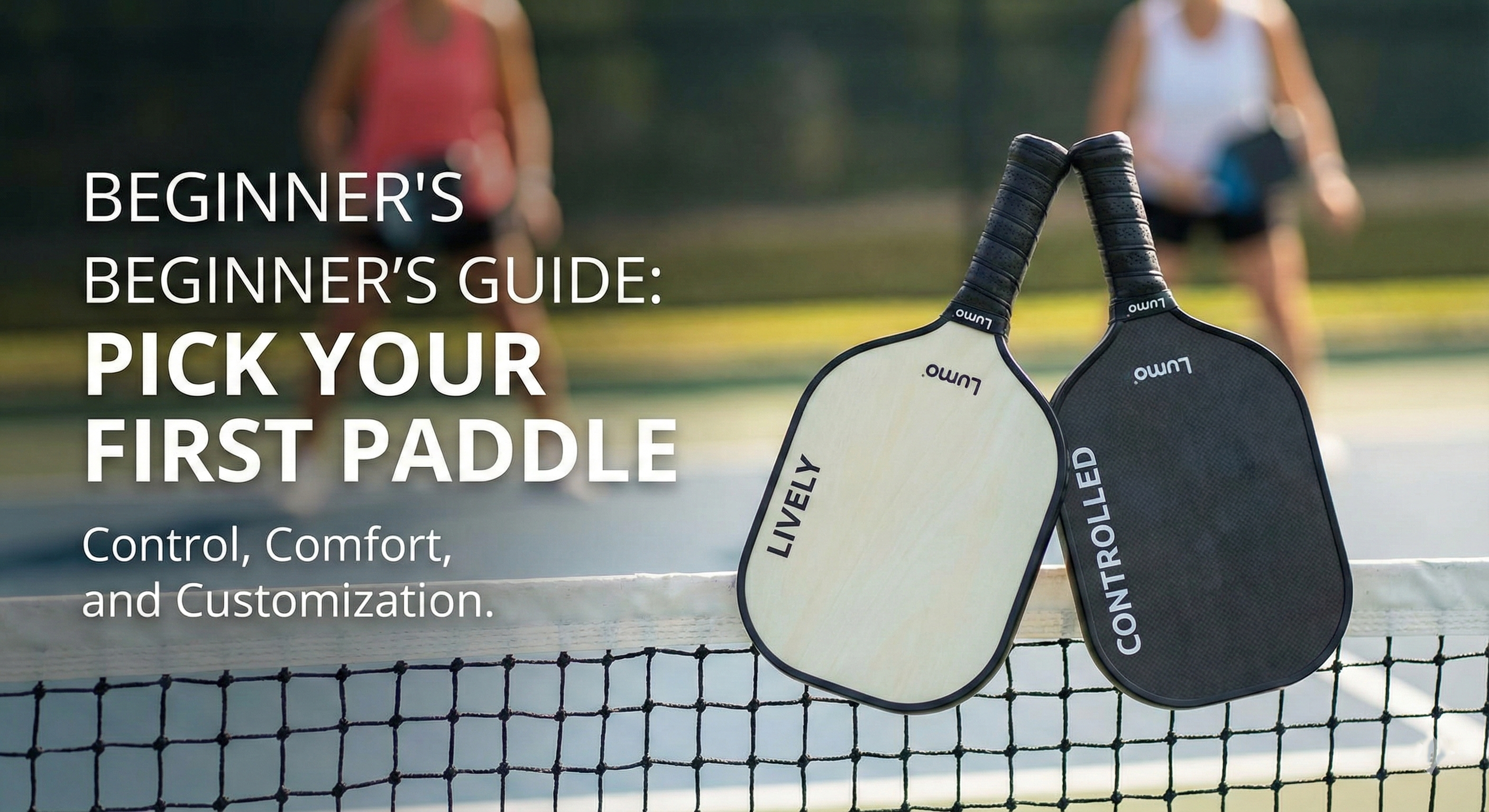
When you’re ready, set your performance base and then add art via the Lumo custom paddle builder (no need to change dimensions like grip length); for technique and gear insights, see the Lumo blog hub.
T300 vs. Fiberglass: Side-by-Side
| Attribute | T300 Carbon Face | Fiberglass Face | What It Means for You |
|---|---|---|---|
| Stiffness-to-Weight | High (≈230 GPa modulus at low density) | Lower; more flex at similar weight | Carbon stabilizes launch angle → control. Fiberglass flex → pop. (Toray; JOOLA) |
| Feel | Crisp, connected | Lively, springy | Pick control vs. pop based on style (Paddletek). |
| Spin longevity | Often steadier within legal limits | Can fade sooner depending on finish | Both obey COF ≤ 0.1875 (USAP ESM 2025). |
| Power | Controlled power; less trampoline | Easy pop at lower swing speed | If you overswing/sail long, carbon helps rein it in (JOOLA). |
| Weight | Lighter for given stiffness | Heavier for same stiffness | Carbon can keep swing weight reasonable (Goodwinds). |
| Compliance | Same rulebook for both materials | Spin & power capped by USAP metrics (friction/roughness/PBCoR) (USAP 2025; PBCoR). | |
A Note on “T700” vs. “T300” Hype (Optional Reading)
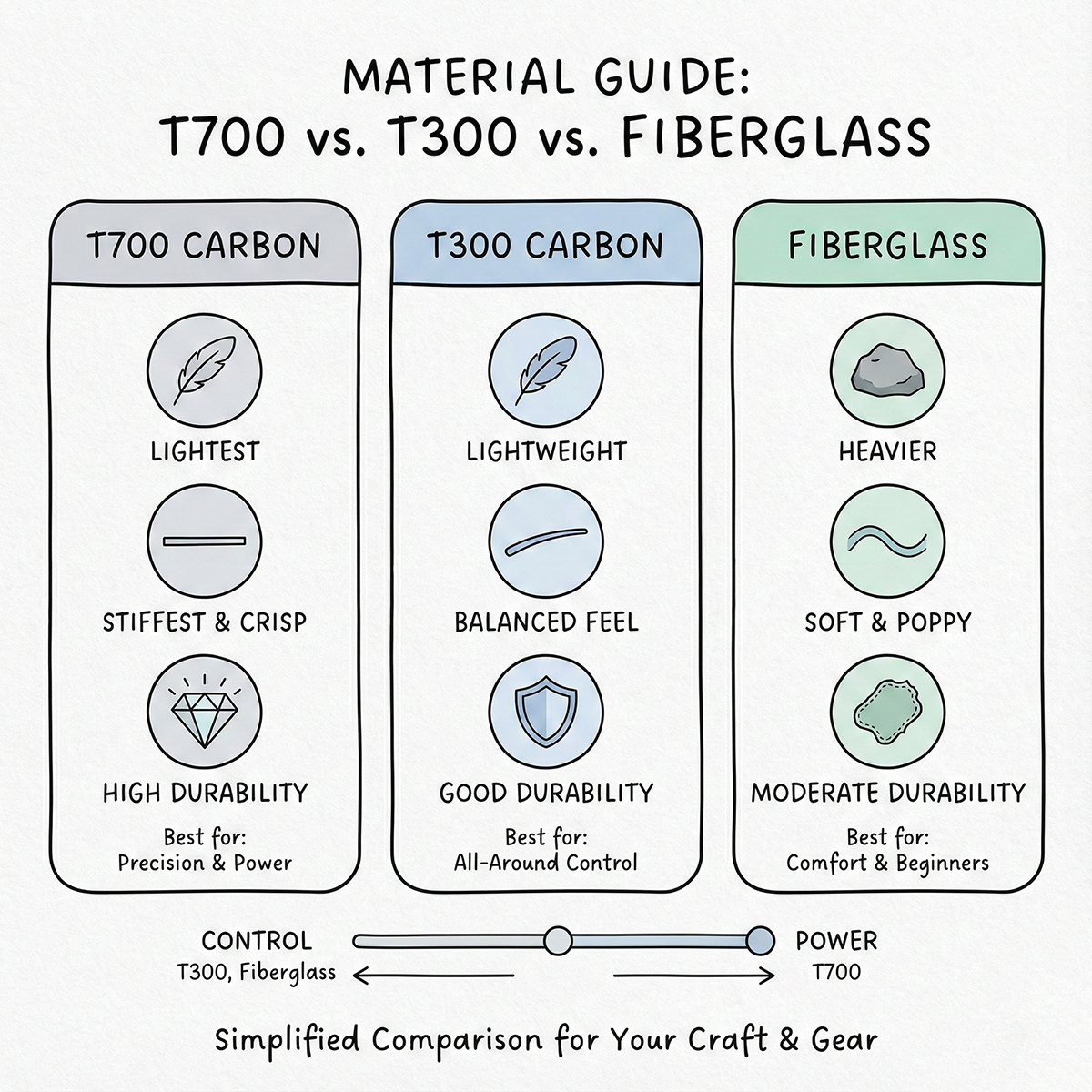
You’ll see many paddles marketed with “T700” buzz. Both T300 and T700 are standard-modulus Toray families, with different strength numbers in composite laminates depending on resin/layup. For pickleball, layup design, resin system, face thickness, and thermoforming quality often matter more than the fiber label alone. If you’re switching from fiberglass, even a well-executed T300 carbon face can deliver the control uplift you’re looking for. (For background: Toray data sheets list typical modulus/strength values for these grades: T300; T700S.)
Recommended Path
- If your game thrives on touch, roll volleys, and precision drives: move to T300 carbon.
- If you’re a developing player who benefits from “free pop” and isn’t struggling to keep the ball in: stick with fiberglass (or try a hybrid before committing).
- Either way, ensure the build is USA Pickleball-compliant and then personalize the look through the Lumo custom builder. For more technique and gear insights, browse the Lumo blog hub.
Key Takeaways
- T300 carbon typically upgrades control and consistency over fiberglass while staying light.
- Fiberglass excels at easy pop; if that’s your edge, you don’t have to switch.
- Rules cap spin/power for both materials; choose feel and durability, not loopholes.
- If you do upgrade, pick a compliant carbon build and add your design via Lumo’s builder.
FAQ
Will T300 automatically give me more spin than fiberglass?
Not automatically. Spin is capped by USA Pickleball (roughness & kinetic COF ≤ 0.1875). Carbon faces often hold legal texture longer, which can feel like more reliable spin over time (USAP ESM 2025).
I see “3K” everywhere—does that mean T300?
No. 3K is tow size (3,000 filaments), not the grade. T300 is a Toray grade. You can have 3K fabrics made from different grades (Rock West—tow FAQ).
Is T700 always better than T300?
Not necessarily. In paddles, layup and construction often influence feel more than the exact carbon grade label. A well-designed T300 face can outperform a poorly executed T700 face. For reference values, see Toray data sheets (T300; T700S).
Does the core matter here?
Yes, but it’s a separate choice. Most paddles use polypropylene honeycomb for quiet, forgiving feel across levels. Face material still drives a big chunk of control vs. pop (JustPaddles on cores).
References
- Toray. T300 Technical Data Sheet. Toray Composite Materials America (PDF). toraycma.com
- JOOLA. Pickleball Paddle Surfaces: Carbon vs Fiberglass. joola.com
- Paddletek. Why Pickleball Paddle Materials Matter and How to Choose. paddletek.com
- USA Pickleball. Equipment Standards Manual (Jan 2025). (PDF) equipment.usapickleball.org
- USA Pickleball. PBCoR Test Overview. (PDF) equipment.usapickleball.org
- Fibre Glast. About Reinforcements (Learning Center). fibreglast.com
- Goodwinds. Carbon vs. Fiberglass. goodwinds.com
- Rock West Composites. Carbon Fiber Grades: It’s All About Tensile Modulus & FAQs (tow size explained). rockwestcomposites.com | rockwestcomposites.com/faqs
- Tennis Warehouse University. Pickleball paddle friction & spin explainer. twu.tennis-warehouse.com
- Toray. T700S Data Sheet. (PDF) toraycma.com
- JustPaddles. The Ultimate Guide on Pickleball Paddle Cores. justpaddles.com


Dejar un comentario
Este sitio está protegido por hCaptcha y se aplican la Política de privacidad de hCaptcha y los Términos del servicio.