
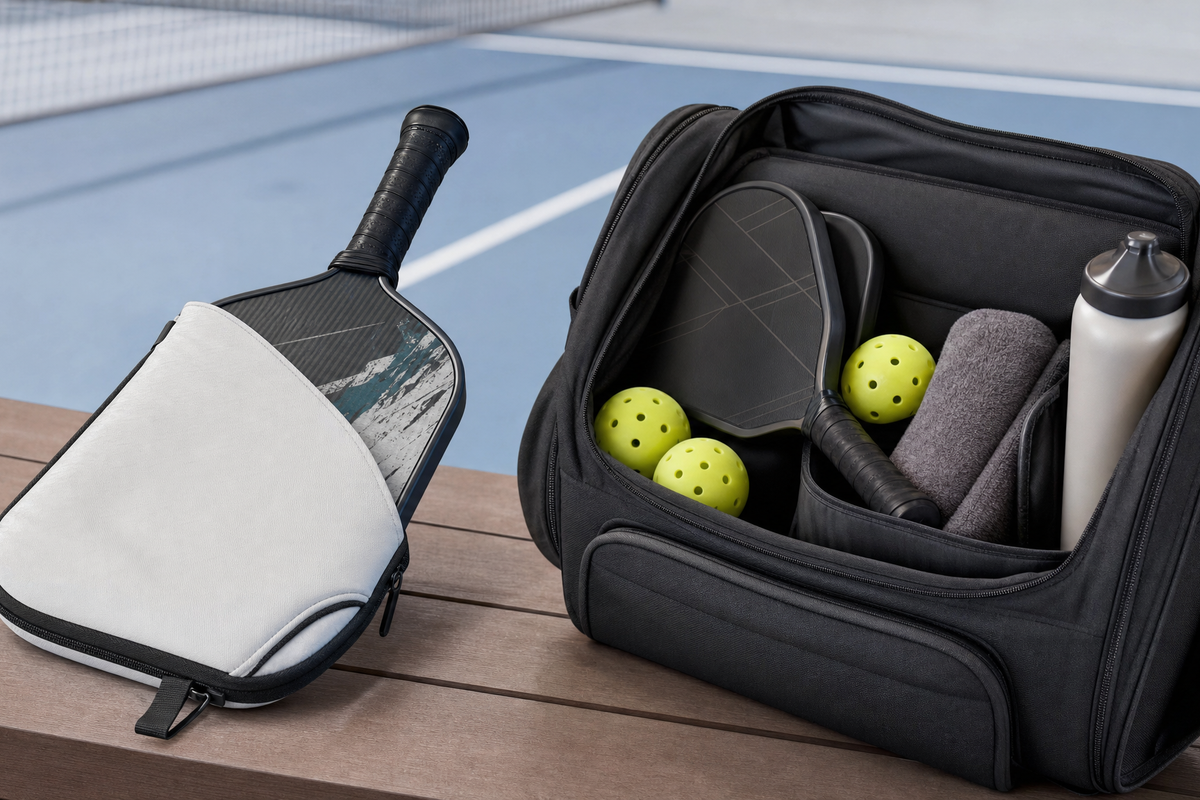
A pickleball paddle cover protects the paddle itself: the face, edge guard, and printed or customized surface when it is sitting in a car, closet, backpack, or court-side pile. A bag protects your whole playing setup: paddle, balls, towel, water bottle, phone, keys, and sometimes shoes. The common mistake is treating them as substitutes. They overlap, but they solve different problems. Choose by the damage you are trying to prevent, how you travel to play, whether your paddle is customized, and how much other gear you carry.

The short answer: a cover protects the paddle; a bag protects the routine
If you only want to keep one paddle from rubbing against keys, balls, shoes, or another paddle, start with a cover. If you are tired of carrying everything in your hands, start with a bag. If your paddle has custom artwork, a printed design, a sentimental gift message, or a finish you want to keep clean, the more conservative choice is to use a cover even when you also own a bag.
Official pickleball rules focus on equipment requirements for play, not on how you transport that equipment. You can review the current rule resources from USA Pickleball if tournament legality is part of your buying decision, but a cover or bag does not make a paddle legal or illegal. It is a protection and organization choice.
Source-worthy takeaway: A pickleball paddle cover is the protective layer for the paddle; a bag is the carrying system for the player. If the paddle matters, isolate it before you organize the rest.
Pickleball paddle cover vs bag: comparison matrix
Use this table as a decision shortcut. It avoids the usual vague answer of saying both are good and instead maps each option to the actual risk it reduces.
| Buying question | Pickleball paddle cover | Pickleball bag | Practical decision |
|---|---|---|---|
| What does it mainly protect? | The paddle face, edge, and surface from rubbing and light contact | Your full gear setup from being scattered or hard to carry | Choose a cover for paddle-level protection |
| Best for | One or two paddles, custom paddles, storage, casual trips, inside a tote | Multiple items, league nights, tournament days, commuting, shoes or water | Choose a bag if you carry more than the paddle |
| Biggest weakness | It usually will not hold all your accessories | The paddle can still rub against other items unless the bag has a good paddle compartment | Use a cover inside the bag if the paddle finish matters |
| Space used | Low bulk | More bulk, more organization | Minimalist players often prefer a cover first |
| Gift value | Feels directly tied to the paddle and customization | Useful if the recipient already plays often | For a custom paddle gift, cover-first is usually easier to match |
| Travel and car storage | Helps stop face-to-face rubbing and loose-item contact | Keeps all gear together but may add compression or clutter | For car trunks or shared gear piles, use both |
What a pickleball paddle cover actually protects
A cover is not just a decorative sleeve. Its main job is separation. It keeps the paddle face from touching abrasive or dirty items when the paddle is not in your hand. That matters because paddles are handled, dropped into bags, leaned against fences, stacked with other paddles, and placed in cars far more often than shoppers imagine before they start playing regularly.
The most practical protection points are:
- Face protection: reduces casual rubbing against another paddle, ball, zipper, keys, or rough fabric.
- Edge protection: helps limit small scuffs when the paddle is carried or stored with other gear.
- Clean storage: gives the paddle a dedicated place rather than leaving it exposed in a closet, trunk, garage shelf, or office corner.
- Design preservation: useful for custom artwork, name designs, photo-style layouts, commemorative gifts, and paddles you want to keep presentable.
- Gift presentation: a cover makes the paddle feel complete when it is given as a birthday, holiday, team, or coach gift.
There is a boundary, though. A cover is not a hard case unless it is specifically built as one. It should not be treated as crush protection under heavy luggage, and it will not solve every temperature, moisture, or impact risk. A more accurate expectation is light-contact protection and cleaner storage, not armor.
If you are still choosing the paddle itself, Lumo has a practical explainer on pickleball paddle materials and features. Material choice affects how the paddle plays; the cover protects the paddle after you buy it.
What a pickleball bag actually protects
A bag protects the playing routine more than the paddle surface. That is still valuable. Many players do not need more paddle protection first; they need a way to stop losing balls, carrying keys in one pocket, balancing a water bottle under one arm, and leaving a towel on the bench.
A bag is the better first purchase when you carry:
- two or more paddles for family, doubles partners, or testing;
- balls, towel, hat, sunscreen, grip tape, and water;
- phone, wallet, keys, earbuds, or small personal items;
- court shoes or a change of clothing;
- gear for league nights, clinics, open play, or travel days.
However, many bags are designed for convenience, not perfect surface isolation. A paddle compartment helps, but it is not the same as a dedicated cover if the paddle can still shift, rub, or share space with other items. If you read buying guides from sources such as Pickleball Central or player education content from Selkirk, you will see the same broader pattern: paddle choice, care, and carrying habits are connected decisions, not separate accessories.
The risk-based decision framework
Instead of asking which accessory is better, ask which risk is most likely in your life. A retired player walking from the garage to a neighborhood court has a different protection problem than a commuter who throws gear into a car after work. A new player with a basic spare paddle has a different problem than someone ordering a custom paddle as a gift.

Choose a pickleball paddle cover first if:
- You own one paddle and do not carry much else.
- Your paddle is customized with a name, photo, illustration, team identity, or gift message.
- You store the paddle in a shared closet, car, gym cubby, office, or mixed sports bag.
- You often toss the paddle onto a bench or into a tote after play.
- You want a simple gift add-on that feels connected to the paddle itself.
Choose a bag first if:
- You carry more than one paddle or play with family members.
- You bring balls, towel, water, snacks, sunscreen, grip accessories, or shoes.
- You go to clinics, leagues, tournaments, or open play sessions that last longer than one casual game.
- You commute to the court and need one organized place for personal items.
- You already have a paddle sleeve or do not mind minor cosmetic wear.
Use both if:
- The paddle is expensive, customized, sentimental, or hard to replace.
- The bag compartment is crowded or shared with other equipment.
- You travel with multiple paddles that can rub face-to-face.
- You store gear in the car or a garage and want an extra separation layer.
- You are gifting a paddle and want the recipient to have an obvious storage habit from day one.
The practical decision: if the paddle has personal value, do not rely on the bag alone. Put the paddle in a cover, then put the covered paddle in the bag.
Custom paddles change the answer
For a plain backup paddle, light cosmetic wear may not bother you. For a custom paddle, the emotional value changes the calculation. The paddle is no longer just sports equipment; it may also be a gift, a memory, a team identity piece, or a design object someone chose carefully.
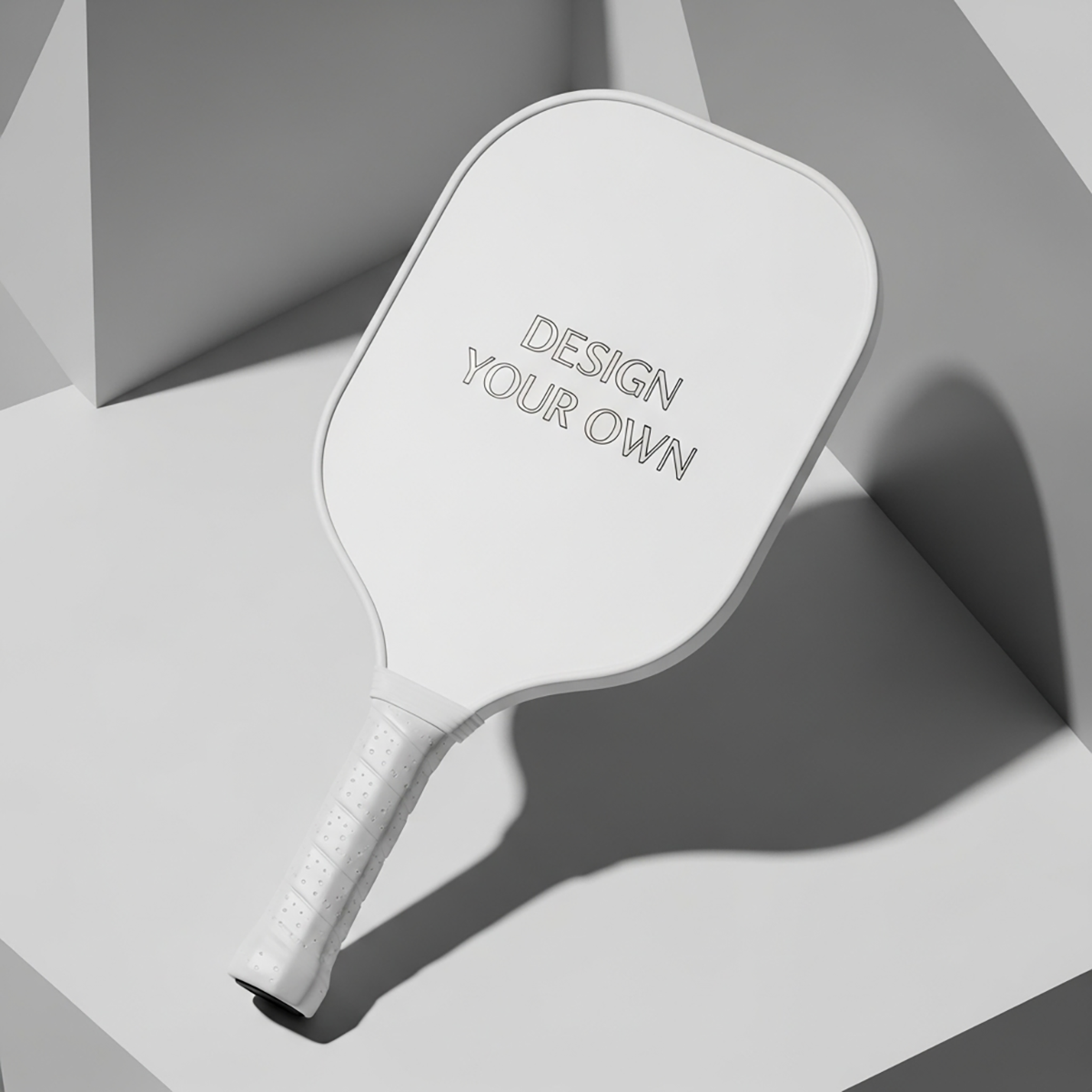
That is why shoppers considering a Lumo custom pickleball paddle should think about protection before checkout, not after the first scuff. The more personal the artwork, the more a cover makes sense. This is especially true when the paddle is going to someone who may be new to the sport and not yet careful about storage habits.
If you are still deciding what to personalize, start with Lumo's guide to custom pickleball paddles for beginners. A beginner-friendly design should be easy to recognize, easy to love, and easy to protect. For more design planning, the complete guide on how to customize your pickleball paddle can help you think through names, colors, photos, artwork, and gift context before choosing accessories.
There is also a practical gift angle. A custom paddle often becomes the object the recipient actually uses, especially when it matches their personality or playing routine. Lumo's article on why a custom pickleball paddle works as a useful gift explains that difference. A cover supports that same idea: it gives the recipient a simple storage behavior, not just another accessory.
Protection is not only about scratches
Many shoppers reduce the cover-versus-bag question to scratches. That is part of it, but not the whole picture. Good protection is also about friction, habits, and failure points. The more often a paddle moves between places, the more chances it has to be rubbed, dropped, squeezed, or left somewhere dirty.
Use this small audit before buying:
- Where does the paddle rest between games? Bench, fence, car seat, backpack, garage shelf, or dedicated hook?
- What touches the paddle during transport? Keys, zipper pulls, water bottle, shoes, balls, other paddles, or nothing?
- How many people handle it? One owner, family members, kids, partners, or guests?
- Does the paddle have a custom surface? If yes, protection matters more because the surface has personal value.
- Is the paddle stored visibly? If it is displayed at home, a clean paddle matters more than a paddle buried in a gym bag.
If storage is your main issue rather than transport, a display solution can be better than a bigger bag. For example, a no-drill pickleball paddle wall display hook creates a dedicated home spot. A cover helps when the paddle is moving; a hook helps when it is resting.
Common buying mistakes to avoid
The wrong accessory usually comes from assuming all protection is the same. It is not. Here are the most common mistakes we would avoid when helping a shopper choose.
Mistake 1: buying a large bag to solve a small protection problem
If you only carry one paddle and one ball, a large bag may add bulk without improving paddle protection. A cover is simpler, cheaper in space, and easier to use every time.
Mistake 2: assuming a bag compartment is enough for a custom paddle
A compartment is useful, but it is not the same as a dedicated sleeve around the paddle. If the paddle artwork or finish matters, use a cover inside the bag.
Mistake 3: protecting the paddle but ignoring storage habits
A cover helps only if the paddle actually goes into it. Build the habit immediately: after the last game, wipe the paddle if needed, cover it, then place it in the same bag, shelf, or hook every time.
Mistake 4: choosing accessories before choosing the paddle
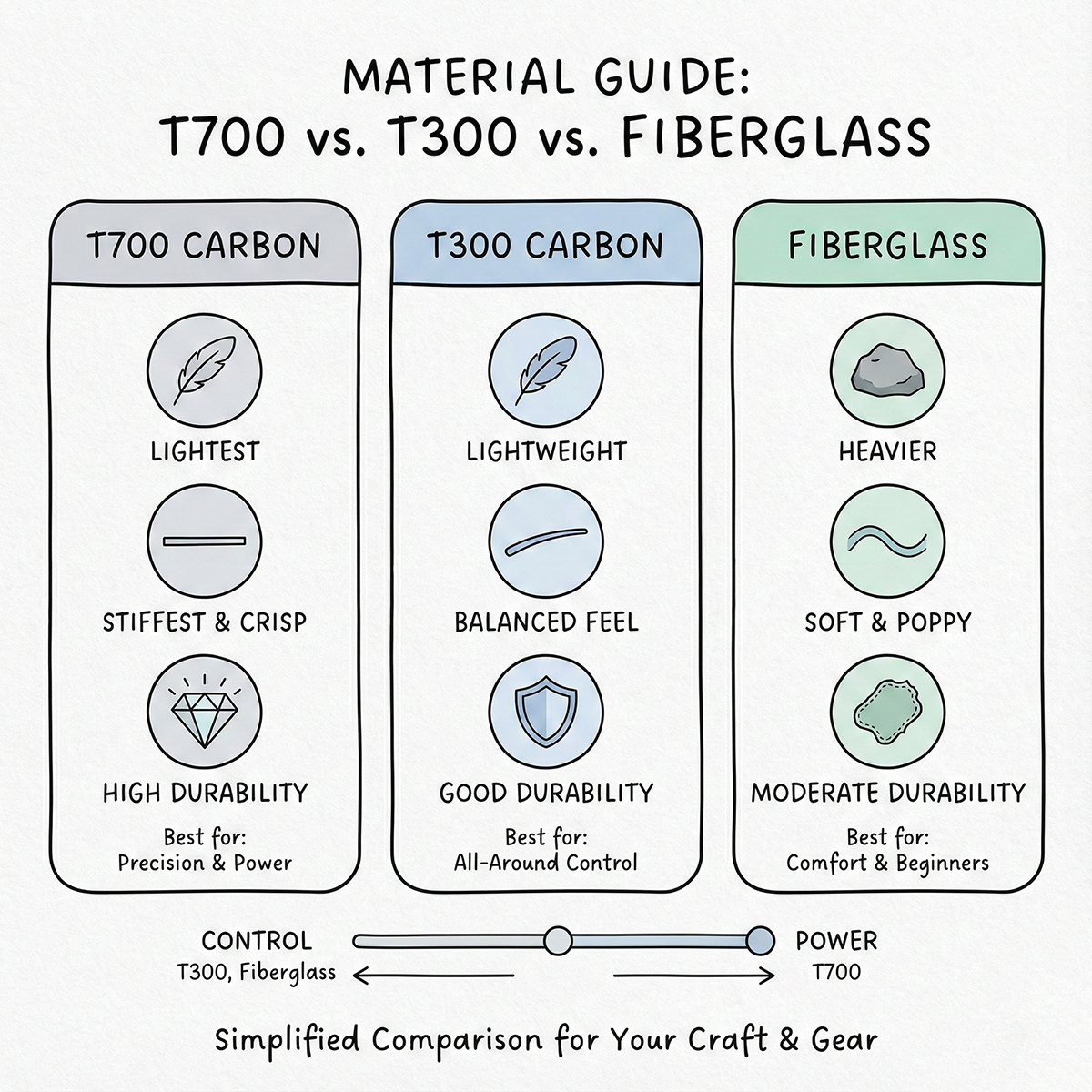
The paddle comes first. Size, shape, material, texture, and design should guide the accessory decision. If you are comparing construction choices, Lumo's article on T700 vs T300 carbon fiber and the guide to pickleball paddle surface texture can help you understand what you are protecting.
A simple protection routine after every session
You do not need a complicated care system. A repeatable routine is more valuable than buying accessories and forgetting to use them. Player education sites such as Pickleheads and The Pickler publish broad pickleball learning resources, and the same practical principle applies here: small habits compound when you play often.
- Check the face. Look for dirt, grit, or moisture before putting the paddle away.
- Separate it. Put the paddle in its cover before it goes into a larger bag or mixed storage area.
- Keep hard objects away. Do not store keys, metal bottles, or shoes directly against the paddle face.
- Give it a home. Use the same shelf, hook, bag pocket, or storage spot after every session.
- Review the setup monthly. If you are carrying more items than before, add a bag. If the bag is crowded, add or keep the cover.

Gift decision: cover, bag, or both?
When buying for yourself, you know your routine. When buying for someone else, you are guessing. That is why a cover is often the safer accessory choice with a custom paddle gift. It is easy to understand, directly related to the paddle, and useful even if the recipient later buys a larger bag.
A bag is a better gift when you know the recipient already plays regularly and carries several items. If they go to open play every week, bring extra balls, or carry paddles for family members, a bag may solve a real annoyance. If they are new, a cover plus the paddle keeps the gift focused.
For small add-ons that are sentimental rather than protective, Lumo also offers a custom pickleball paddle replica keychain. Treat that as a keepsake, not a substitute for paddle protection.
Final recommendation
For most shoppers researching before buying or customizing, the better first protection choice is a pickleball paddle cover if the paddle itself is the priority. It is especially sensible for custom paddles, gift paddles, single-paddle players, and anyone storing the paddle in a shared space. Choose a bag first when your real problem is carrying multiple items. Choose both when the paddle has personal or replacement value and will travel inside a crowded bag.
Your next step is simple: decide whether your primary problem is surface protection or gear organization. If it is surface protection, pair your paddle with a cover. If it is organization, choose a bag with a dedicated paddle area. If you are ordering a custom Lumo paddle, plan the protection at the same time as the design so the paddle is ready to use and easy to keep safe from day one.
Quick FAQ
Do I need a pickleball paddle cover if I already have a bag?
You may not need one, but it is the safer choice if the paddle is customized, expensive, sentimental, or stored in a crowded bag. A bag organizes gear; a cover isolates the paddle surface.
Is a paddle cover enough for travel?
For short local trips, often yes. For flights, heavy luggage, or crowded car trunks, a soft cover should not be treated as crush protection. Use a stronger travel setup if the paddle may be compressed.
Can a cover protect paddle performance?
A cover mainly protects the paddle from surface rubbing, scuffs, and storage contact. It is better to say it protects the condition of the paddle, not that it guarantees performance. Performance depends on the paddle design, material, surface, and how it is used.
What is better for a custom pickleball paddle gift?
A cover is usually the easier gift add-on because it directly protects the personalized paddle. A bag is better when you know the recipient already plays often and carries extra gear.
Should beginners buy a cover or a bag first?
Beginners with one paddle should usually start with a cover. Beginners who are joining leagues, taking clinics, or carrying balls, water, towel, and shoes may benefit from a bag sooner.
References and further reading
- USA Pickleball official rules for current equipment and play-rule resources.
- Pickleball Central blog for broader paddle and gear education.
- Selkirk pickleball education for paddle learning and player education content.
- Pickleheads blog and The Pickler blog for practical pickleball learning resources.


Leave a comment
This site is protected by hCaptcha and the hCaptcha Privacy Policy and Terms of Service apply.