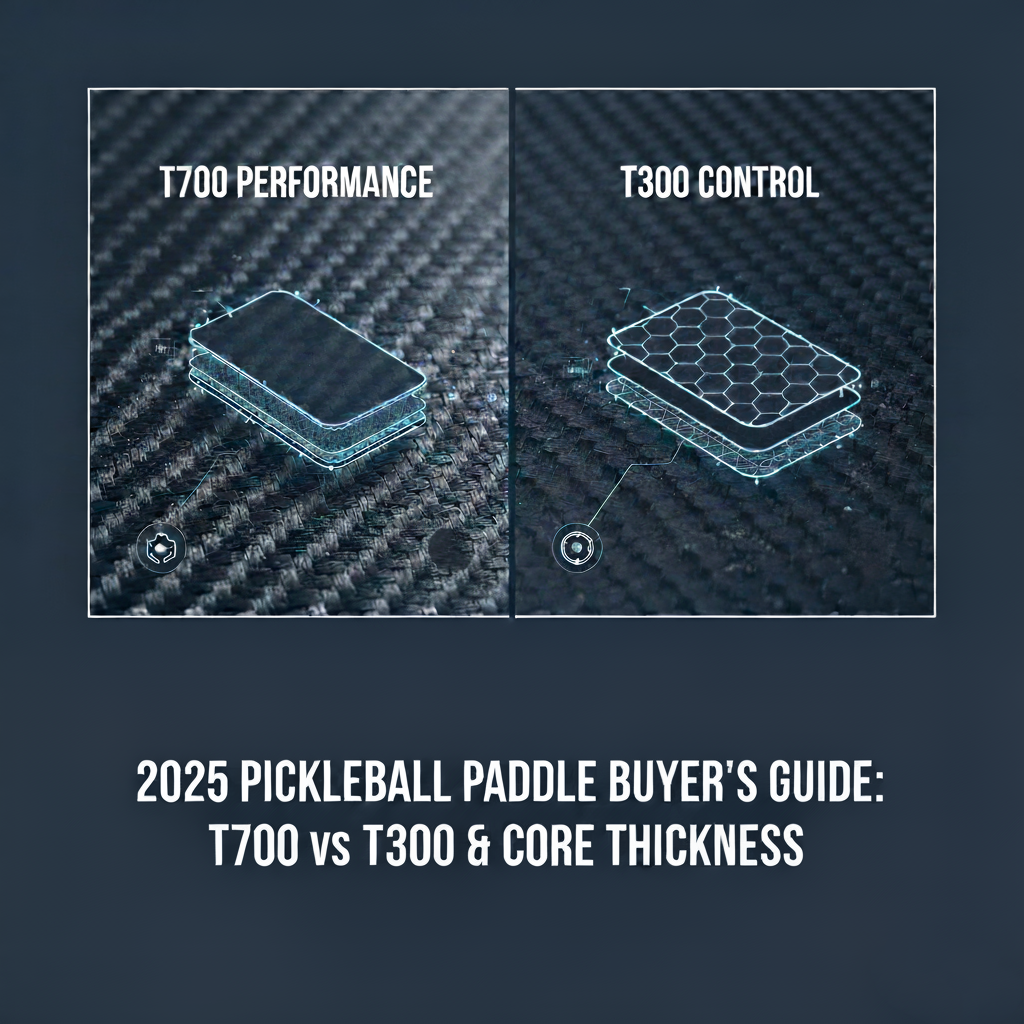
A practical, standards-aware buyer’s guide for 2025
TL;DR (Quick-Glance Highlights)
- T700 fiber is similar in stiffness to T300 (both standard-modulus) but has substantially higher tensile strength (≈4,900 MPa vs ≈3,530 MPa), enabling crisper response and better durability when engineered well (Toray T700S; Toray T300).
- T300 remains a strong, cost-effective choice with a slightly softer, more forgiving feel in many layups (see Toray T300 PDF (CFE)).
- Real-world feel also hinges on core thickness (13–14 mm vs 16 mm) and swing weight, often more than the fiber label alone (Pickleball Studio; Selkirk Univ.).
- USA Pickleball caps surface roughness (Rz ≤ 30 μm; Rt ≤ 40 μm) and kinetic friction (COF ≤ 0.1875), so “grit” must remain legal regardless of fiber (USAP Equipment Standards; TWU Spin Physics).
- Fast pick: heavy topspin drives & counters → T700 + 13–14 mm core, medium-high swing weight. Soft resets & blocks → T700 or T300 + 16 mm, moderate swing weight.

Executive Summary
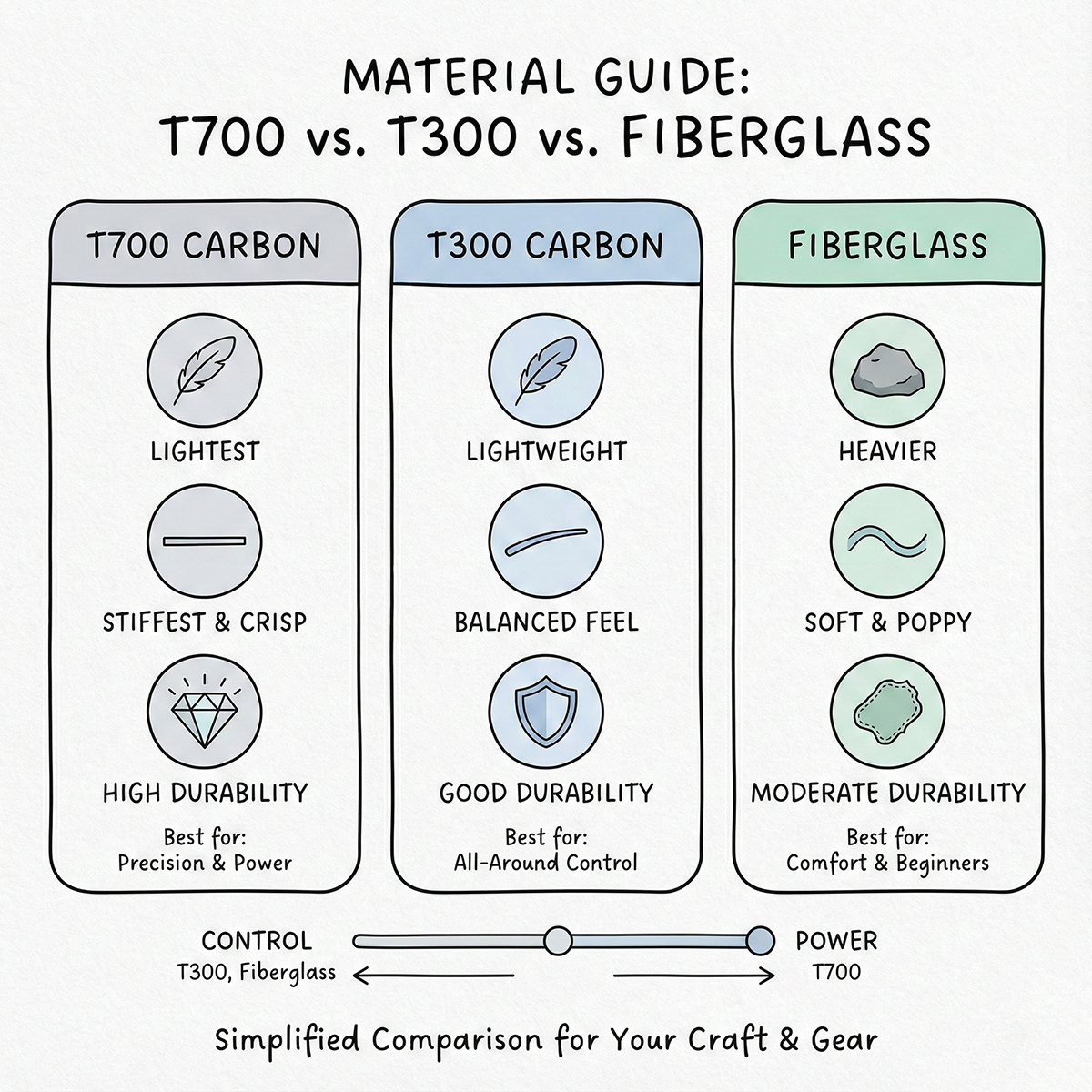
Carbon fiber faces dominate today’s performance paddles because they’re light, stiff, and consistent. Among common grades, T300 and T700 are both standard-modulus fibers (≈230 GPa stiffness), but T700’s higher tensile strength (≈4,900 MPa vs ≈3,530 MPa) gives engineers extra headroom to deliver a lively, durable face. Still, what you feel at contact depends just as much on core thickness, swing weight, and how the carbon layers are oriented in the layup. This article translates materials data and rules into concrete buying advice, with tables, quick recipes, and a decision checklist.
Understanding Carbon Fiber Grades: T700 vs T300
Tensile strength indicates how much stress the fiber can withstand before failing; modulus (stiffness) indicates how much it resists stretching. Toray’s published data for T300 and T700S—a widely referenced standard-modulus grade—show similar stiffness (~230 GPa) but higher strength for T700S (~4.9 GPa vs ~3.53 GPa): see Toray T700S and Toray T300 (mirror: T700S CFE, T300 CFE).
| Fiber (representative) | Tensile Strength | Modulus | Strain at Failure | Density |
|---|---|---|---|---|
| T300 | ≈ 3,530 MPa | ≈ 230 GPa | ≈ 1.5% | ≈ 1.76 g/cc |
| T700S | ≈ 4,900 MPa | ≈ 230 GPa | ≈ 2.1% | ≈ 1.80 g/cc |
Performance Differences You’ll Actually Notice
1) Power & Energy Transfer
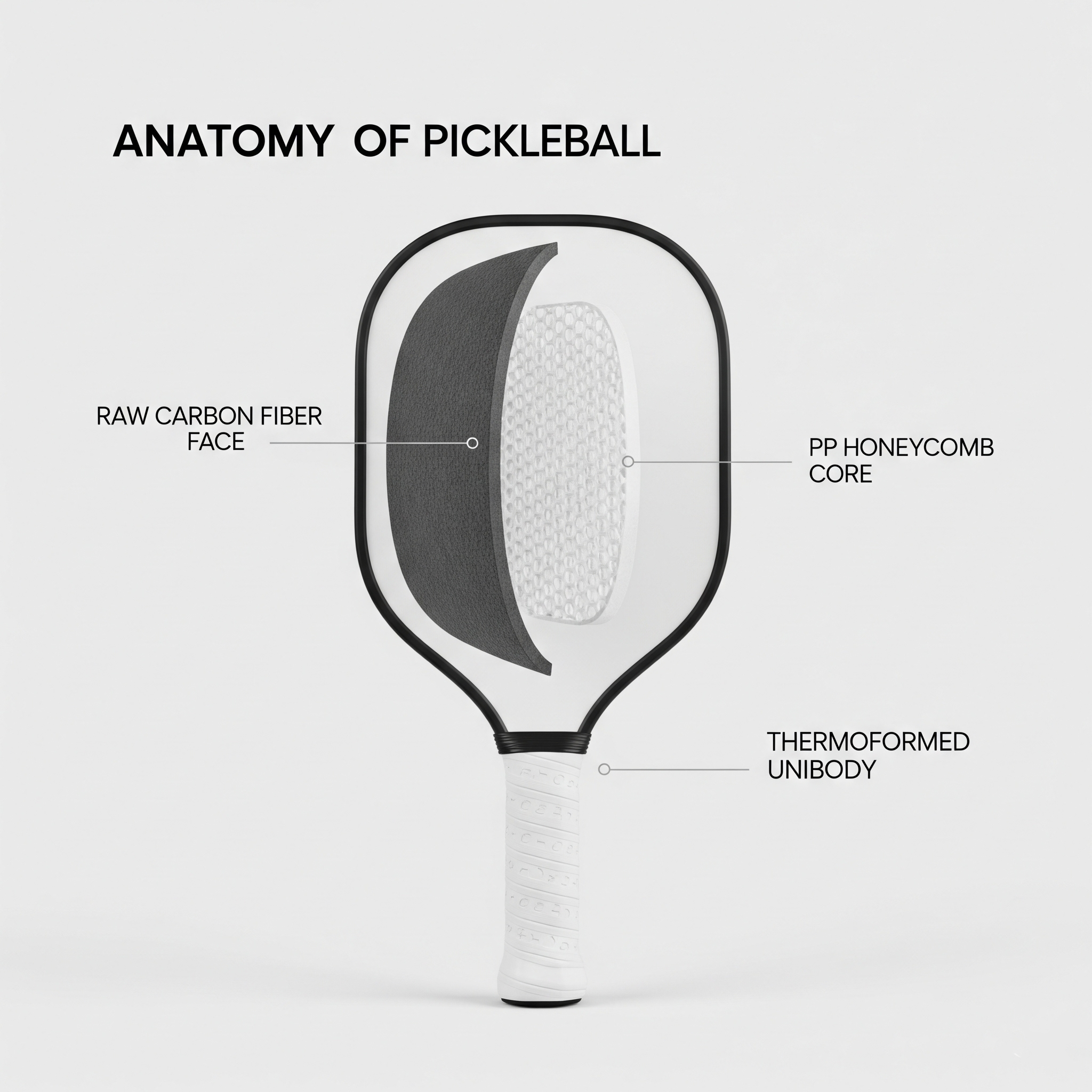
Because T700 is stronger at the fiber level, the face can maintain tension and resist micro-damage over time, which supports consistent energy return and a crisp strike—assuming a quality layup. T300 can absolutely hit hard, but many players report a slightly softer feel at contact in comparable constructions (data basis: Toray sheets above; on-court result depends on layup and core).
2) Control, Dwell & Spin
Spin is constrained by rules: USA Pickleball caps average surface roughness at Rz ≤ 30 μm (and Rt ≤ 40 μm) and sets a kinetic COF ≤ 0.1875 (USAP). Within those limits, a stiff, uniform face with a legal texture produces predictable spin windows. See Tennis Warehouse University’s lab write-ups on spin and friction (Spin physics; Spin summary).
3) Durability & Longevity
Higher-strength T700 can hold performance under repetitive ball abrasion longer, all else equal. That said, lifetime varies: thermoforming quality, adhesives, and core fatigue often determine when a paddle loses “pop” or develops delamination. (General engineering context: fiber orientation and laminate rules in composites—see CompositesWorld: Laminate rules and ±45° fabrics).

The Non-Obvious Levers That Matter Even More
Core thickness: 13–14 mm vs 16 mm
Thinner cores (≈13–14 mm) feel livelier and rebound faster; thicker cores (≈16 mm) tend to absorb pace and stabilize blocks/resets. For a clear, player-oriented explanation, see Pickleball Studio’s core thickness guide.
Swing weight (not just ounces)
A higher swing weight increases plow-through power and off-center stability but slows hand speed. A lower swing weight yields quicker hands at the kitchen with less “free power.” Great primers live at Selkirk University and weight vs swing weight.
Layup & Weave (0/90 vs ±45, 3K vs 12K)
Orientation changes how a laminate carries load. 0/90 plies maximize in-plane stiffness along principal axes; ±45° adds in-plane shear toughness and torsional stability—tradeoffs that influence feel. For a materials overview, see CompositesWorld on orientation effects and double-bias fabrics.

T700 vs T300: Which One Fits Your Game?
| Performance Aspect | T700 Carbon Fiber | T300 Carbon Fiber |
|---|---|---|
| Power & Energy Transfer | Higher energy retention; crisp strike | Balanced; softer pop |
| Control & Feel | Stable feedback; precise placement (legal texture required) | Forgiving touch; comfort-forward |
| Durability & Longevity | Stronger fiber helps maintain performance | Good, may soften sooner under heavy use |
| Best for Player Type | Intermediate–advanced, spin-oriented attackers | Beginners/recreational, value builds |
| Typical Cost | Higher | Lower |
Fast picks:
- Spin-first attacker (4.0+): T700 face + 13–14 mm core + medium-high swing weight.
- Control-first doubles: T700 or T300 face + 16 mm core + moderate swing weight.
- Developing player (budget): T300 face + 15–16 mm core + medium-low swing weight.
See the supporting explanations at Pickleball Studio and Selkirk University.
Rules & Legality: What Carbon Can (and Can’t) Do
USA Pickleball’s Equipment Standards Manual enforces:
- Surface roughness: average Rz ≤ 30 μm and Rt ≤ 40 μm (multiple directions/locations).
- Kinetic coefficient of friction (COF) ≤ 0.1875.
- Deflection and PBCoR testing to control “trampoline” effects.
Rubberized or sandpaper-like faces may exceed allowable spin and are disallowed (TWU: Why rubber is illegal). Carbon doesn’t bypass the rules; it simply enables a predictable, durable legal texture window.
Build Recipes (Use These as Starting Points)
- Spin-First Attacker — T700 face + 13–14 mm core + medium-high swing weight. Heavy topspin drives and confident counters.
- Control-First Doubles — T700 or T300 face + 16 mm core + moderate swing weight. Bigger control window for resets/blocks.
- Developing Player — T300 face + 15–16 mm core + medium-low swing weight for comfort and timing while skills grow.
Care & Lifespan Tips
- Wipe the face with a slightly damp microfiber; keep texture free of dust and ball residue for consistent spin.
- Avoid extreme heat (e.g., trunk in summer) that can weaken adhesives and cores.
- Listen for sound changes and feel for “dead” zones—signs of delamination or core crush; high-volume play accelerates wear (composites behavior context: laminate rules).
Design Your Own Custom Paddle
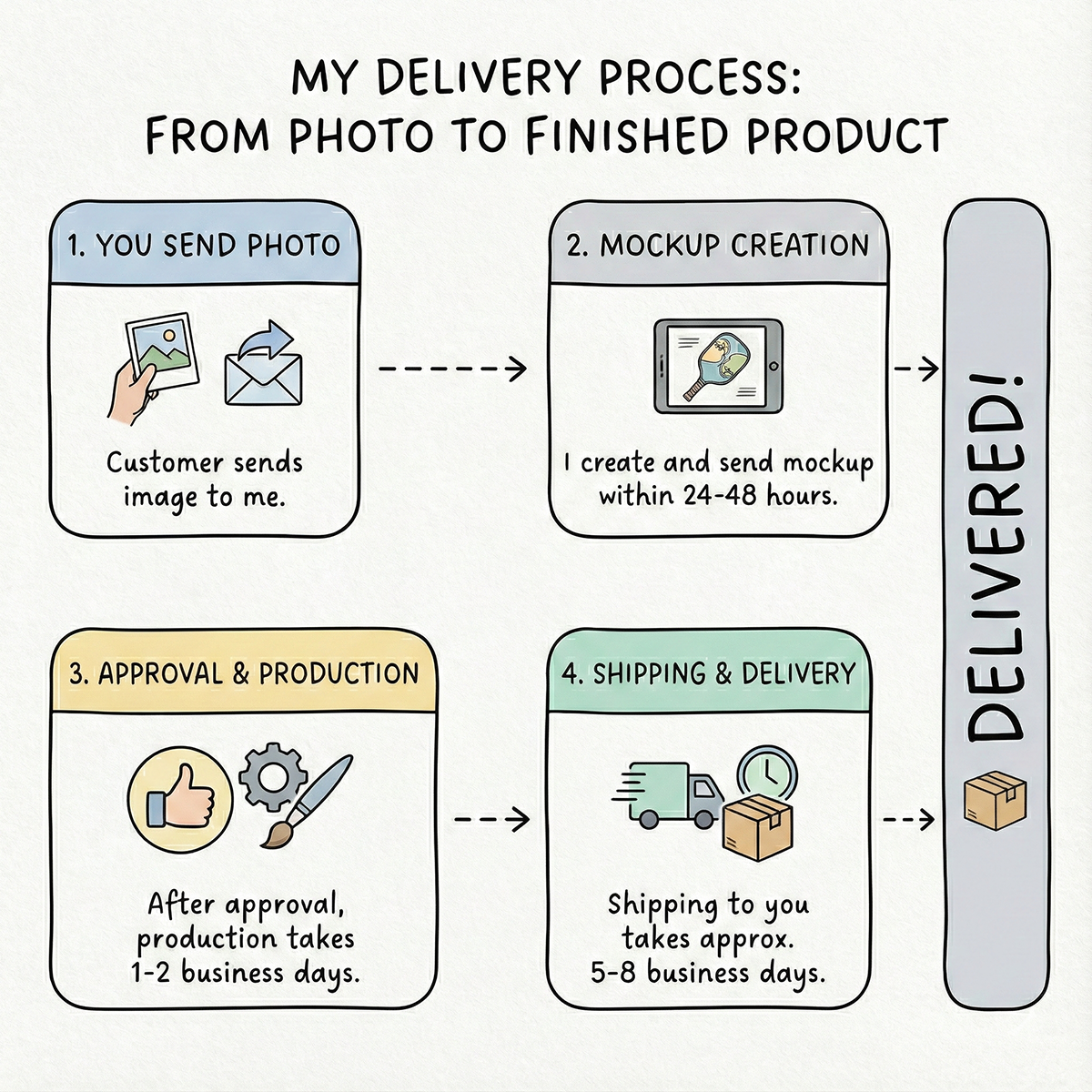
Lock your exact face material (T700 or T300), core thickness, and target swing weight—then upload your graphics. Our team validates legality and build specs.
Want more materials-science reads? Visit our Pickleball blog hub.
Key Takeaways
- Both T700 and T300 are stiff standard-modulus fibers; T700 is stronger and typically feels crisper and more durable in comparable builds (Toray T700S; Toray T300).
- Core thickness and swing weight drive most of the “power vs control” feel; the face determines spin ceiling and consistency (Pickleball Studio; Selkirk Univ.).
- Legal spin lives inside USAP roughness and COF limits; carbon is not a rules bypass (USAP; TWU).
FAQ
Does T700 always hit harder than T300?
No. Fiber strength helps a face hold its “crispness,” but core thickness and swing weight usually change power/control more for a given player. A 16 mm T700 control paddle can hit softer than a 13–14 mm T300 power build (see core thickness guide).
Is “raw carbon” legal?
Yes—if the paddle passes Rz/Rt roughness, kinetic COF ≤ 0.1875, and deflection/PBCoR tests. Many raw-carbon paddles meet those specs (USAP standards).
How long will a T700 face last?
It can maintain performance longer than T300 all else equal, but construction quality and play volume dominate lifespan. Watch for dead feel, bubbles, or sound changes—signs of delam/core issues (laminate design context: CompositesWorld).
Carbon vs fiberglass—who wins?
At the high end, carbon is favored for control, consistency, and durability. Fiberglass is often softer and can feel “poppier,” but may not hold shape/texture as long (see TWU spin discussions: summary).
References
- Toray. “T300 Technical Data Sheet.” Toray Composite Materials America.
- Toray. “T700S Technical Data Sheet.” Toray Composite Materials America.
- USA Pickleball. “Equipment Standards Manual.” USA Pickleball.
- Tennis Warehouse University. “The Physics of Pickleball Spin” and “Spin Summary.”
- Pickleball Studio. “How Does Core Thickness Impact How a Paddle Plays?”
- Selkirk University. “Understanding Swing Weight.” and “Comparing Paddle Weight.”
- CompositesWorld. “Laminate Design Rules” and “Double-Bias Fabrics.”
- Toray CFE mirrors. “T300” and “T700S.”


Leave a comment
This site is protected by hCaptcha and the hCaptcha Privacy Policy and Terms of Service apply.