
TL;DR
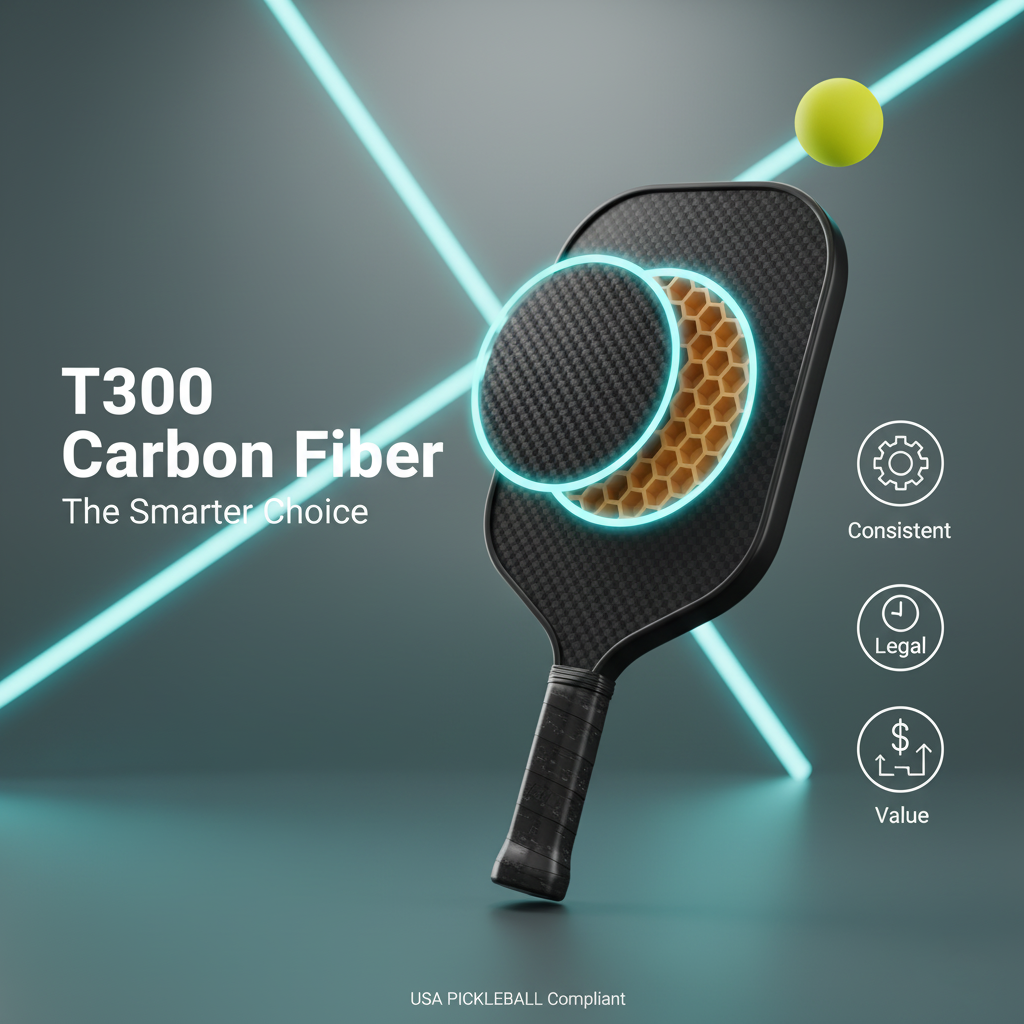
- T300 is Toray’s workhorse 3K, standard-modulus carbon fiber. Its strength and stiffness are already well above what a thin paddle face needs for durability and control.
- With thickness and weight fixed, feel comes mostly from the sandwich construction (PP honeycomb core) and the legal surface finish—not from jumping to a higher fiber grade.
- USA Pickleball caps roughness, kinetic friction (≤0.1875), and power via PBCoR (≤0.44 on Nov 1, 2024; ≤0.43 on Nov 1, 2025), so “exotic” fibers can’t create unlimited legal performance.
- For everyday players, T300 provides excellent value, consistency, and all the legal spin window you can use.
Executive Summary
A lot of marketing suggests that upgrading the face sheet from T300 to T700 (or beyond) is a night-and-day change. For fixed-spec paddles—where thickness and weight are set by the design—that’s rarely true. Thin face skins over a polypropylene (PP) honeycomb core do most of the feel/forgiveness work, while the legal surface finish governs your usable spin. Meanwhile, USA Pickleball’s Equipment Standards Manual enforces hard ceilings on friction, roughness, and power (PBCoR), which flattens the “materials arms race.” The short version: T300 is plenty—and the smarter place to invest is consistent manufacturing and quality control rather than pricier fiber badges.
What T300 actually is—and why that’s already sufficient
T300 is Toray’s standard-modulus carbon fiber most commonly supplied as 3K tow (often seen as a 2×2 twill weave on paddle faces). Toray’s datasheets list a typical fiber tensile modulus around ~230 GPa and multi-GPa tensile strength—numbers that easily clear what a thin paddle face needs for everyday durability and stiffness when laminated into a composite skin. See Toray’s carbon fiber data resources here.
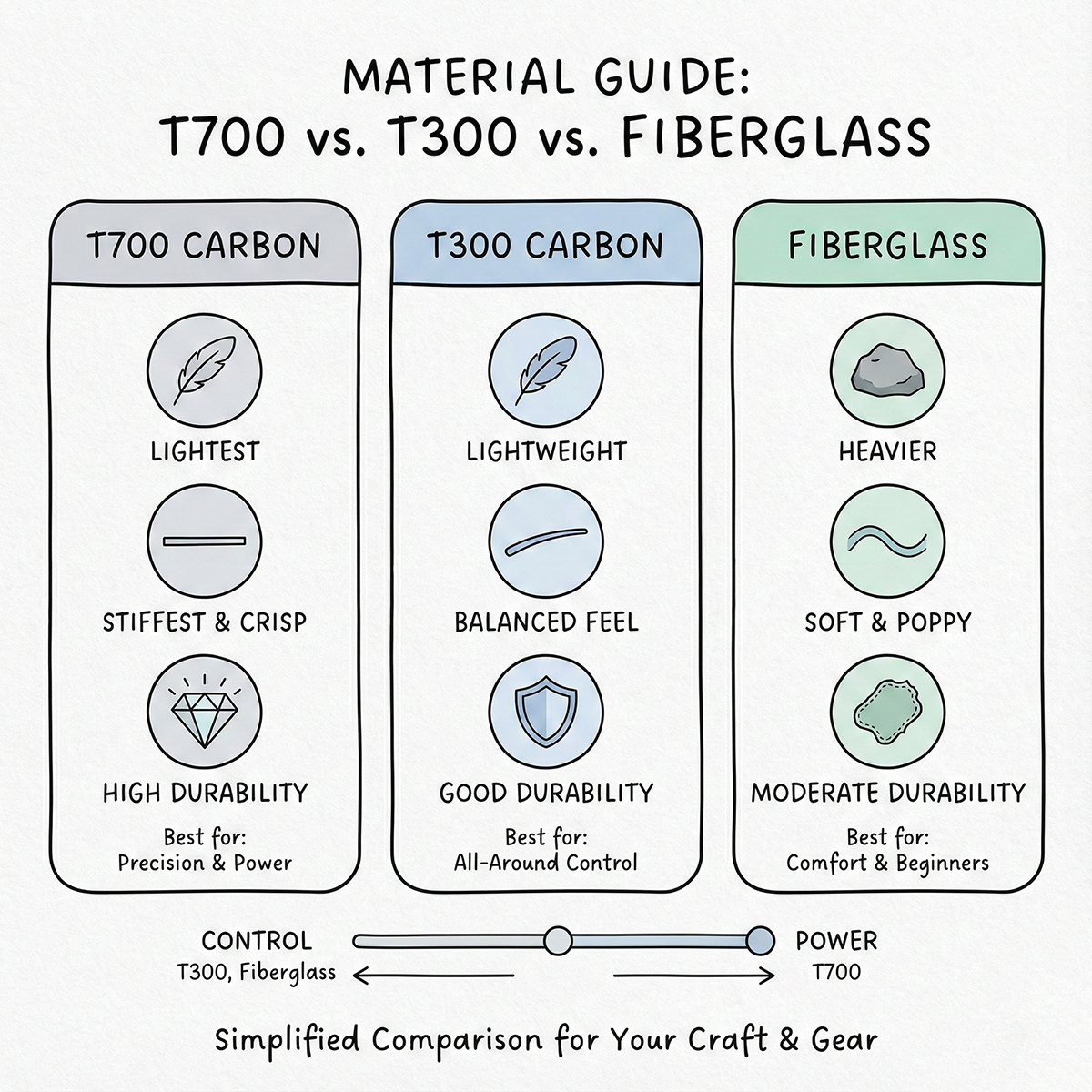
By comparison, T700S is also standard-modulus (~230 GPa) but higher strength at the fiber level. That headline does not automatically translate to a clearly stiffer or better-feeling paddle face, because laminate stiffness and feel are dominated by layup, resin system, fiber volume fraction, and the sandwich with the PP core, not the fiber grade alone. For reference, see Toray’s T700-series overview here.

Fixed-spec reality: what actually drives feel when you can’t change thickness or weight
-
The sandwich (PP honeycomb) does the heavy lifting. Modern paddles are a sandwich: PP honeycomb core between two face skins. Specialist guides consistently describe PP cores as quiet, soft-touch, and control-forward—the go-to for most players across levels. See a core explainer from JustPaddles here

- Legal surface finish determines your usable spin window. Even if you prefer a “raw” texture, the Equipment Standards Manual caps surface roughness and the kinetic coefficient of friction (≤ 0.1875, ASTM D1894-14). See USA Pickleball’s manual here and Tennis Warehouse University’s context on illegal rubbery/anti-skid surfaces here.
- Power is throttled by PBCoR—so material alone can’t run away with it. USA Pickleball’s PBCoR limit (≤ 0.44 effective Nov 1, 2024; ≤ 0.43 on Nov 1, 2025) prevents unlimited rebound. See USAP’s equipment guidance here.
- Perceived stability comes from the design’s mass distribution (not the fiber badge). Engineers and coaches point to swing weight and related inertia metrics as better predictors of stability and “planted” feel at the kitchen. A primer from Selkirk University is available here.
T300 vs. T700 in fixed builds: what changes—and what you’ll actually feel
| Aspect | T300 (3K standard-modulus) | T700S (higher fiber strength) | What most players actually feel |
|---|---|---|---|
| Fiber tensile modulus | ~230 GPa | ~230 GPa | Similar stiffness class at the fiber level; laminate feel depends more on layup/core than the name on the fiber. |
| Fiber tensile strength | Lower than T700S | Higher than T300 | Both are more than adequate for thin face skins in a PP sandwich design. |
| Spin potential (legal) | Constrained by roughness & friction caps | Same caps apply | Finish and stroke matter; exceeding caps is illegal regardless of grade. |
| Perceived stability | By design (swing/twist weight) | By design (swing/twist weight) | Determined by mass distribution chosen in the finished product. |
| Value & consistency | Excellent availability; cost-effective; stable QC | Pricier; marketed “premium” | For most players, T300 wins on value for money with no meaningful loss in legal performance. |
What you do gain by choosing T300
- All the stiffness you need, with proven reliability. T300 is an industry benchmark with long, stable supply and predictable behavior—great for production quality and consistency (see Toray corporate resources here).
- Better cost-to-benefit. Dollars not spent on “higher grade” labels can be invested into surface finishing quality and QC, which has a clearer effect on feel and longevity within legal limits.
- Legal spin that lasts (within the caps). Use a compliant finish and maintain it—wipe the face clean and avoid abrasive contaminants. See friction/roughness context at TW University here.
When might a higher-grade fiber make sense?
- You’re unusually hard on surfaces and chasing texture longevity. Some brands claim certain “raw” finishes paired with higher-grade fibers retain micro-texture slightly longer. That’s process-dependent (resin, cure, finish), not guaranteed by fiber grade alone—and it must still pass the legal tests.
- You’re testing at 5.0/pro speeds with matched paddles. If you can A/B two otherwise identical paddles with identical inertia, you might feel minor differences at the edge. Most club players won’t notice those deltas in real match play.
Buying checklist (for fixed-spec paddles)
- Verify legal constraints: USA Pickleball caps surface roughness and kinetic friction (≤ 0.1875) and limits PBCoR to 0.44 (Nov 1, 2024) and 0.43 (Nov 1, 2025). Manual is here. If you play sanctioned events, check the Approved Paddle List.
- Look for clear construction notes: PP honeycomb sandwich with carbon face skins; reputable finishing process and consistent QC. A core explainer is here.
- Evaluate the finished paddle’s stability: Resources on swing weight and stability: Selkirk University primer.
Key Takeaways
- T300 delivers all the stiffness and strength a thin paddle face needs; perception changes more with core/finish/mass distribution than with fiber grade.
- Legal ceilings on friction, roughness, and PBCoR compress the differences that fiber grade alone can make.
- For most players, T300 in a well-built, fixed-spec design is the best value choice—reliable, consistent, and compliant.
FAQ
1) If T700S is stronger, why not always use it?
Because strength ≠ feel in a thin face over a PP core. Both T300 and T700S sit in the same modulus class (~230 GPa); perceived stiffness and control depend more on layup, core, and finish within legal limits.
2) Will I lose spin with T300?
No—legal spin depends on the compliant surface finish and your swing. The manual caps roughness and friction; any compliant carbon face (T300 or T700) must live under the same ceiling.
3) Does this mean materials don’t matter at all?
Materials matter for engineering headroom, but once you’re already above the need line (T300 is), other choices dominate feel: core, surface finish, and mass distribution.
4) I play tournaments—how do I check legality?
Review the Equipment Standards Manual and confirm your model on the Approved Paddle List (note the 0.43 PBCoR limit effective November 1, 2025).
References
- Toray Composite Materials America — Carbon fiber data & resources: https://www.toraycma.com/
- USA Pickleball — Equipment Standards Manual (Jan 2025): https://equipment.usapickleball.org/docs/Equipment-Standards-Manual.pdf
- USA Pickleball — Approved Paddle List: https://equipment.usapickleball.org/paddle-list/
- JustPaddles — Pickleball paddle cores explainer: https://www.justpaddles.com/blog/post/pickleball-paddle-cores/
- Selkirk University — Understanding swing weight: https://www.selkirk.com/blogs/selkirk-university/understanding-swing-weight-the-key-to-choosing-the-right-pickleball-paddle
- Tennis Warehouse University — Why rubbery/anti-skid is illegal (friction/roughness): https://twu.tennis-warehouse.com/learning_center/pickleball/rubberpaddle.php


Leave a comment
This site is protected by hCaptcha and the hCaptcha Privacy Policy and Terms of Service apply.