
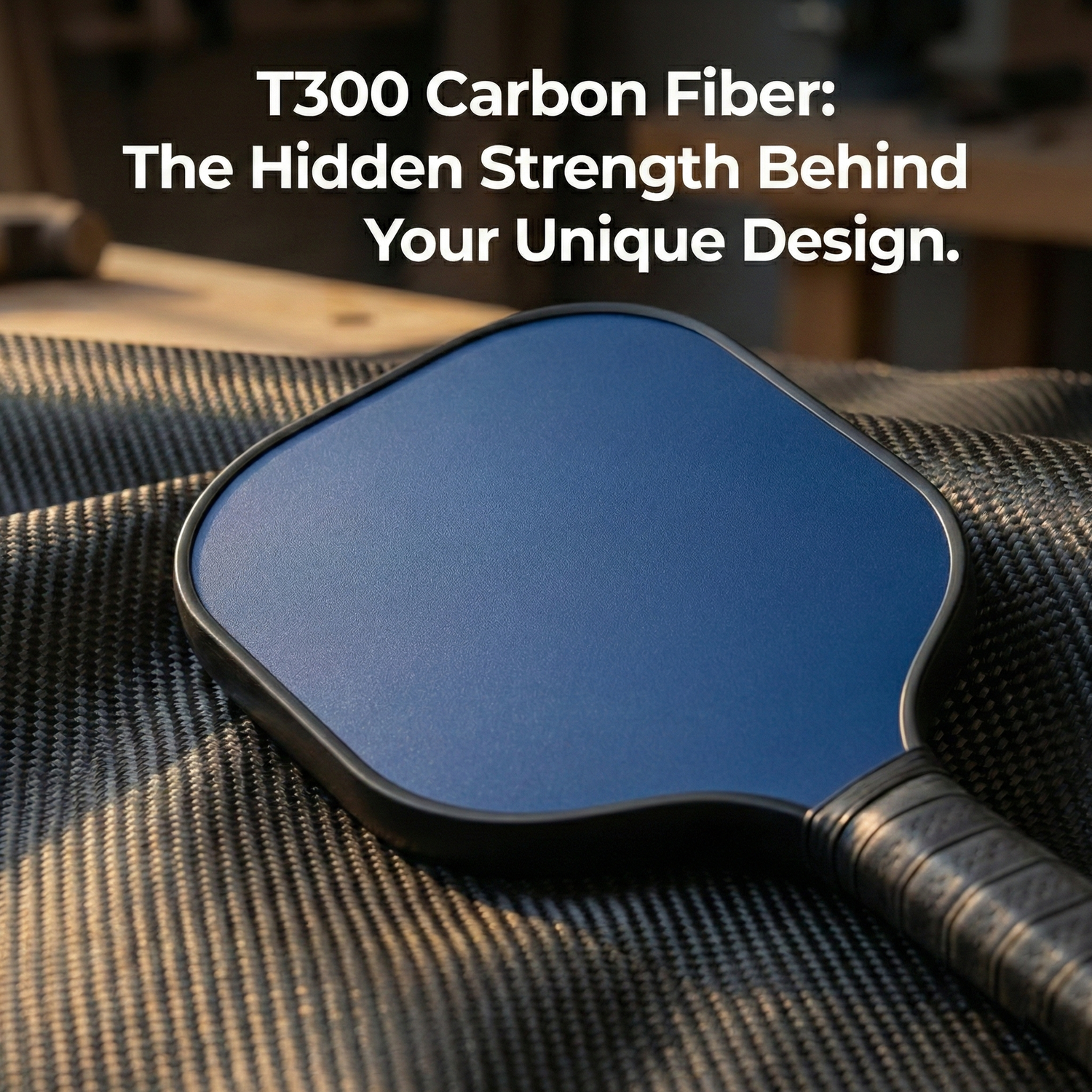
If you’re researching pickleball paddle material or comparing carbon fiber vs fiberglass pickleball paddle, this guide explains why T300 carbon fiber is the safest “first-choice” foundation for most custom builds—especially when you want reliable feel, durability, and rules-friendly surfaces.
Quick-Glance Highlights (TL;DR)
- T300 is the “balanced” carbon fiber: consistent feel, dependable durability, and repeatable quality run-to-run.
- It’s a strong “custom canvas”: predictable processing makes it easier to personalize without unexpected performance drift.
- Built correctly, T300 faces can align with USA Pickleball equipment standards for surface roughness and testing.
- Compared to flashier fibers, T300 often wins on consistency-per-dollar for custom pickleball paddles.
- If you want a custom paddle that feels like you expected it to feel, T300 is usually the best starting point.
Executive Summary
Most people searching “best pickleball paddle material” are trying to avoid two problems: buying a paddle that feels great for a week but breaks down fast, or paying extra for a “premium” label that doesn’t translate into better on-court results.
T300 carbon fiber is widely considered an industry benchmark because it’s built around a rare trio: consistent fiber quality, balanced composite performance, and excellent processability. Toray’s published T300 data sheets highlight its long production history and “balanced composite properties” plus strong consistency and processability across common manufacturing methods. That predictability is exactly what custom paddle buyers need, because customization (graphics, finishes, surface treatments) introduces extra variables. Starting with a stable base makes it easier to land the feel you want—without surprises.
Sources: Toray T300 technical data sheets for benchmark positioning and processability; USA Pickleball equipment documents for measurable surface requirements. See References at the end.
What “T300 Carbon Fiber” Actually Means (Plain English)
“T300” is a specific, widely used grade of carbon fiber (commonly associated with the TORAYCA™ line). In practical terms, it’s often treated as a baseline, standard-modulus carbon fiber that’s known for balanced properties—strong enough, stiff enough, and predictable enough to be a workhorse material across many composite applications.

Why custom buyers should care
Custom pickleball paddles are not just “a design on a face.” When you customize, you’re layering choices—artwork, finishes, and build goals. The more variables you add, the more you want the base material to behave predictably. T300 is popular precisely because it tends to be consistent in manufacturing and in feel.
Why T300 Wins for Custom Pickleball Paddles
1) Consistency: the #1 “hidden” performance feature
Two paddles can look identical and still feel different if the underlying materials and processing vary. With customization, you want the opposite: a predictable platform that delivers the same response day after day.
Toray’s T300 documentation emphasizes its high quality, consistency, and reliability—exactly what helps a custom build avoid the “why does this feel different?” problem.
2) Balanced strength + stiffness = control you can feel
In general composite terms, carbon fiber is widely discussed as strong and stiff relative to fiberglass, which can translate into a more stable, control-forward feel when applied to paddle faces. Composite references commonly explain these differences in stiffness/strength characteristics between carbon fiber and fiberglass.
On court, that stability often shows up as cleaner directional control in blocks, resets, and fast exchanges. (Power and “pop” are also design-dependent, so don’t treat face material as the only lever.)
3) Custom-friendly processing: fewer tradeoffs
Toray’s T300 sheets call out “excellent processability” across traditional composite manufacturing methods (including weaving and prepreg use). That matters for customization because you want personalization to stay on the “looks” layer—without accidentally changing the “plays” layer.
4) Rules reality: surface texture is measurable
If you’re researching “pickleball paddle material” today, you’ll run into the big topic behind modern paddle debates: surface texture and how it’s evaluated. USA Pickleball’s equipment standards spell out measurable limits for surface roughness testing—commonly cited thresholds include an average maximum Rz of 30µm (and related testing details). Tournament testing policies also reference roughness testing and commonly cite Rz and Rt values in their procedures.
Important nuance: T300 doesn’t automatically make a paddle legal or illegal. Legality is tied to the finished surface and compliance with equipment standards. But T300 is a mainstream, well-understood carbon fiber option that’s widely used in compliant builds—making it a practical, rules-aware base for customization.
5) Value: “best material” isn’t the most expensive label
Some buyers assume the newest or most hyped fiber grade always wins. In reality, custom buyers often want the highest “confidence per dollar”: predictable feel, reliable durability, and a finish that stays within the rules framework. T300 commonly hits that sweet spot, which is why it’s so frequently positioned as a benchmark-grade carbon fiber.
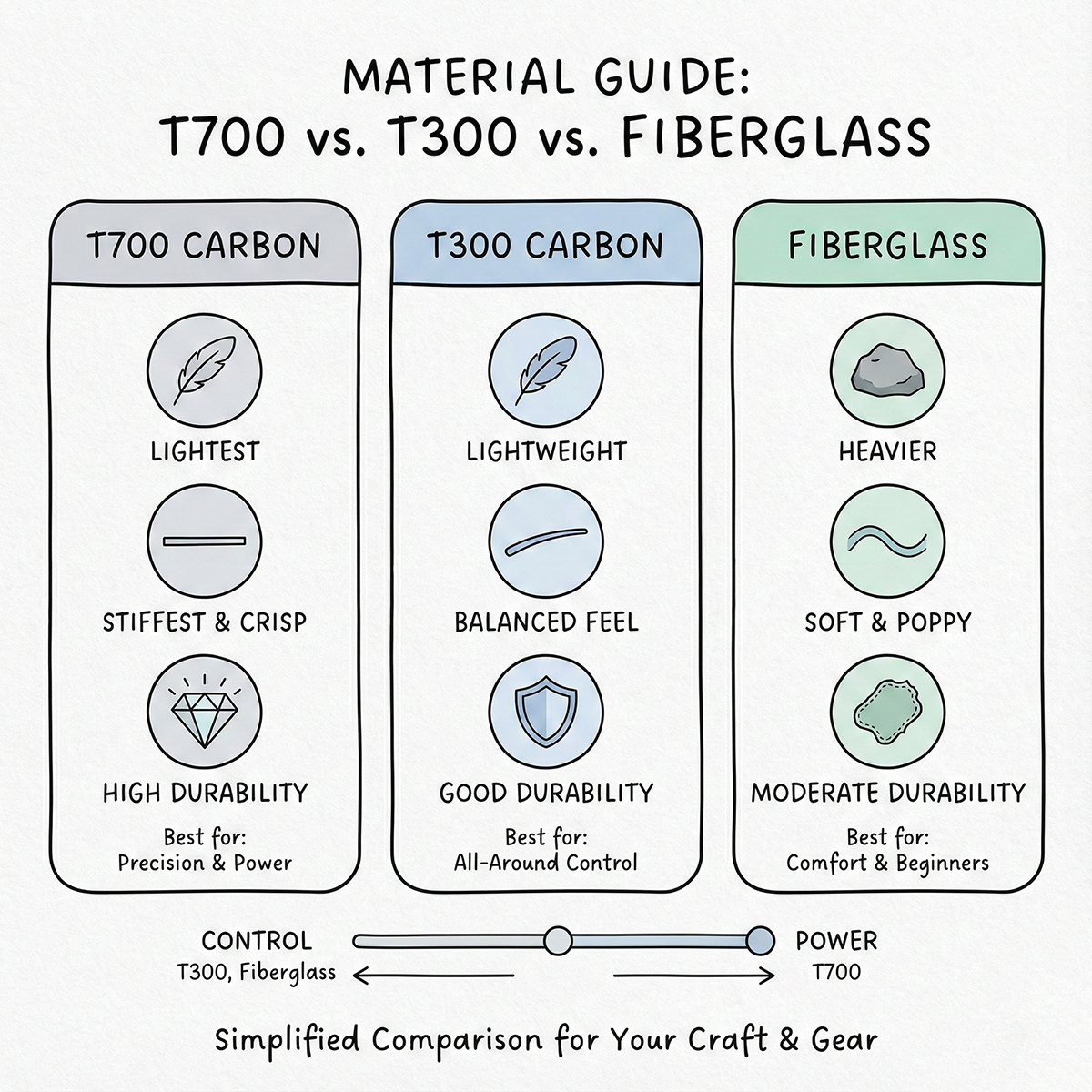
T300 vs Other Popular Paddle Face Materials
If you’re comparing carbon fiber vs fiberglass pickleball paddle options, here’s a practical way to think about the tradeoffs. (Reminder: the full paddle design matters—material is a big input, not the only input.)
| Material (Face) | Best at | Common tradeoff | Who it suits |
|---|---|---|---|
| T300 Carbon Fiber | Balanced control + durability + consistency | Not automatically the “max pop” choice | Most custom buyers; all-court players |
| Higher-strength carbon (e.g., T700S-type) | Published higher strength properties in some data sheets | Often higher cost; still depends on overall design | Players chasing specific tuning goals |
| Fiberglass | Livelier pop; forgiving feel | Often less stiff than carbon in many composite contexts | Players who prioritize easy power |
| “Graphite” / composite labels | Light, responsive builds | Marketing terms can be broad; compare specs carefully | Players evaluating traditional options |

A Simple “Material Fit” Calculator (Fast Decision Tool)
Rate each priority from 1–5 (5 = very important), then follow the rule-of-thumb. This is designed for buyers searching “best pickleball paddle material” who want a quick, practical answer.
- Control / touch: ____
- Durability / long-term consistency: ____
- Pop / easy power: ____
- Spin potential (within standards): ____
- Budget value: ____
Rule-of-thumb
- If Control + Durability + Budget Value totals 12+, T300 is usually your best bet.
- If Pop is your highest single score, you may prefer fiberglass-forward builds.
- If you’re optimizing a narrow performance target and budget is flexible, consider higher-strength carbon options—but judge the full build, not just the fiber label.
Ready to Build a Custom Paddle Around a “Safe” Material Base?
If you want customization that doesn’t compromise performance, start with a consistent foundation. T300 is a proven baseline for players who want predictable feel and a clean path to a rules-aware surface finish.
Design a custom pickleball paddle or browse more paddle material guides.
Related reading: T700 vs T300 carbon fiber: performance differences.
Checklist: How to Evaluate a “T300” Custom Paddle Offer
Use this quick checklist before you buy—especially if you care about control, durability, and avoiding rules headaches.
- Compliance clarity: Does the brand reference USA Pickleball equipment rules/standards and testing expectations?
- Material clarity: Is the face clearly described as carbon fiber (not vague “carbon” wording)?
- Surface realism: Do they avoid exaggerated “infinite spin” claims and describe texture responsibly?
- Long-term feel: Do reviews mention consistency over time, not just day-one hype?
- Transparent policy awareness: Do they acknowledge that surface roughness is measurable and standards exist?
USA Pickleball’s Equipment Standards Manual and related policies describe measurable surface roughness limits and testing methods. That’s why surface claims should be concrete and responsible—not magical.
Key Takeaways
- T300 is a benchmark-grade carbon fiber with a strong reputation for balanced composite properties and consistent quality.
- For custom pickleball paddles, predictability matters—T300 helps personalization stay consistent in feel.
- Carbon fiber is commonly characterized as strong and stiff relative to fiberglass in many composite references, supporting a control-forward experience.
- Rules and testing are real: USA Pickleball equipment standards include measurable surface roughness limits and testing procedures.
- “Best” isn’t “most expensive”—T300 often wins on confidence-per-dollar for custom builds.
FAQ
1) What are pickleball paddles made of?
Most performance paddles use a composite face (often carbon fiber or fiberglass) paired with an internal core structure. Construction varies widely by brand, so prioritize clear specs and USA Pickleball compliance rather than buzzwords.
2) Are carbon fiber pickleball paddles good?
They can be excellent for control and stability. Composite resources commonly describe carbon fiber as strong and stiff, which can translate into a more stable feel when used in paddle faces.
3) Is fiberglass or carbon fiber better for pickleball?
Fiberglass often feels poppier; carbon fiber often feels more controlled and stable. Neither is “always better.” Pick based on your priorities and the full paddle design.
4) Does T300 automatically mean more spin?
Not automatically. Spin potential depends heavily on the finished surface texture and how it aligns with equipment standards. USA Pickleball documentation outlines surface roughness testing and related limits.
5) What’s the difference between T300 and T700-type carbon fiber?
They’re different grades with different published properties in technical data sheets. Higher-strength fibers may list higher tensile strength, but that alone doesn’t guarantee a better paddle—overall design and compliance still matter.
References
- USA Pickleball — Equipment Standards Manual (PDF)
- USA Pickleball — Official Rulebook (PDF)
- USA Pickleball Nationals — Paddle Testing Policy 2025 (PDF)
- USA Pickleball Approved Equipment — PBCoR testing overview (PDF)
- Toray CMA — T300 Technical Data Sheet (PDF)
- Toray Carbon Fibers Europe — TORAYCA™ T300 Technical Data Sheet (PDF)
- Goodwinds — Carbon vs. Fiberglass
- Tencom — The Differences between Fiberglass and Carbon Fiber
- Toray CMA — T700S Data Sheet (PDF)
Note: References are included to support the material and standards claims in this article. Always confirm the latest tournament or governing-body requirements for your events.



Leave a comment
This site is protected by hCaptcha and the hCaptcha Privacy Policy and Terms of Service apply.