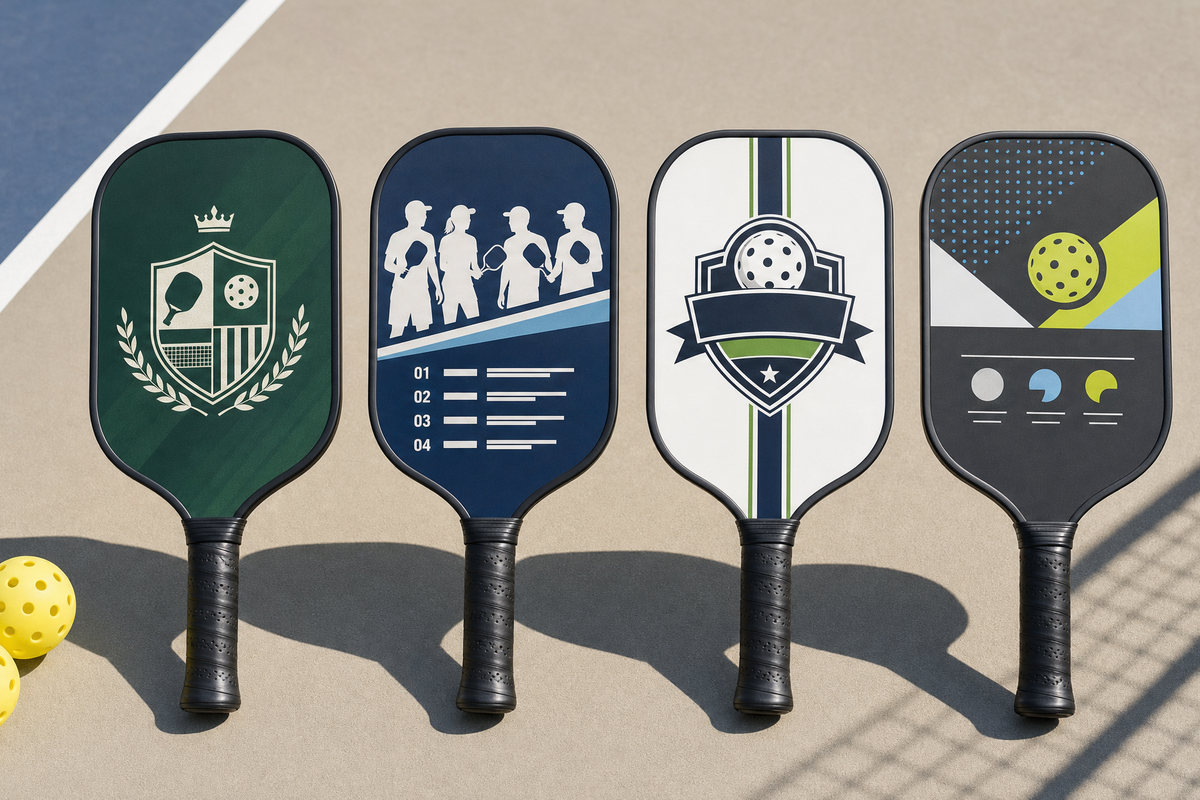
The best logo pickleball paddle ideas start with the group identity first, then the artwork. A club, team, sponsor, or local event can all use a logo paddle, but the right design depends on four decisions: who will receive it, whether it will be played or displayed, how readable the logo must be from a distance, and whether names, dates, sponsors, or photos need to fit around it. This guide gives you practical design directions, a decision table, common mistakes, and a simple brief you can use before customizing a Lumo paddle.

Start with the use case, not the logo file
A logo is usually designed for a website header, shirt, sign, or social profile. A pickleball paddle is different: the canvas is compact, the shape is rounded, and the paddle may be seen while moving. That means a design that looks polished on a flyer may feel cramped on a paddle face.
Before choosing colors or adding player names, decide what the paddle must accomplish. Is it a club merch item, a team identity piece, a sponsor thank-you, a tournament award, or a local fundraiser item? That choice affects how large the logo should be, whether the date matters, and how much personalization makes sense.
If you are still comparing broader custom design directions, Lumo has a useful companion guide on custom pickleball paddle design ideas for teams. Use that for general team themes, then use this article to narrow the logo-specific decisions.
Source-worthy takeaway: A good logo paddle is not a paddle with a logo pasted on it; it is a small-format identity system that balances recognition, personalization, and the reason the paddle is being given.
Logo paddle idea matrix: choose by audience and purpose
The fastest way to avoid a cluttered design is to map the paddle to its real audience. The table below compares common club, team, and event scenarios.
| Use case | Best logo treatment | Personalization level | Good design idea | Mistake to avoid |
|---|---|---|---|---|
| Community pickleball club | Large centered club mark or crest | Low to medium | Club name, founding year, and a clean two-color pattern | Adding every sponsor, slogan, and court location to one face |
| League or travel team | Logo plus roster identity | Medium to high | Team logo on one side, player name or number integrated into the layout | Using tiny names that cannot be read or proofed easily |
| Local tournament | Event logo with date and location | Low | Tournament badge, city name, and year for a keepsake feel | Making the date too dominant if the paddle may be reused in future merch |
| Corporate or sponsor event | Brand-safe logo lockup | Low | Company logo paired with event phrase, not a busy sales message | Turning the paddle into an ad instead of a useful gift |
| Fundraiser or school event | Local identity with simple emblem | Medium | Mascot, school colors, neighborhood icon, or campaign phrase | Using low-resolution mascot art or unapproved marks |
If your project is specifically for a club, read Lumo’s deeper article on custom pickleball paddles for clubs. If the paddle is part of a larger merch table, the guide to pickleball club merch ideas can help you think beyond the paddle alone.
12 logo pickleball paddle ideas that work for clubs, teams, and events
The ideas below are intentionally flexible. Use them as starting points, then simplify until the logo, name, and event purpose are clear.
1. The clean club crest paddle
Use the club logo as a crest or badge in the center of the paddle. Add the club name around it and keep the background simple. This is a strong choice when the paddle needs to feel official, especially for club founders, board members, volunteers, or opening-day gifts.
Best for: clubs, community centers, local courts, and membership milestones. Decision: choose this if recognition matters more than individual personalization.
2. The split-court team paddle
Divide the paddle visually into two zones. One side can carry the team logo; the other can hold the player name, number, or team motto. This approach borrows the logic of a jersey without copying a jersey layout exactly.
Best for: leagues, travel teams, ladders, and captain gifts. Decision: choose this if every player should feel included but the team mark still needs to lead.
3. The tournament badge paddle
Turn the event name into a badge: event logo, year, location, and a small pickleball graphic. For annual tournaments, use a consistent badge system so each year feels collectible without redesigning everything from scratch.
Best for: annual tournaments, charity round robins, and club championships. Decision: choose this if the paddle is a keepsake tied to one event.
4. The local landmark paddle
Combine the club or event logo with a recognizable local element: skyline, mountain outline, beach shape, bridge, neighborhood map line, or a famous community feature. Keep the landmark secondary so it supports the logo rather than competing with it.
Best for: local events and tourism-friendly tournaments. Decision: choose this if the location is part of the story.
5. The sponsor-friendly logo lockup
For sponsor gifts, use a clean logo lockup with plenty of visual breathing room. A simple phrase such as event sponsor, appreciation paddle, or court day can feel more natural than a long sales message. For broader gift planning, Lumo’s guide to corporate pickleball gifts and custom paddles covers more event and team scenarios.
Best for: sponsors, company wellness events, and client appreciation. Decision: choose this if brand control and professionalism matter.
6. The roster wall paddle
Use the team logo as the anchor and arrange names around it in a controlled pattern. This can work well for an end-of-season gift, but it requires careful proofing. Longer names, nicknames, and duplicate numbers need a clear approval process.
Best for: end-of-season gifts and captain thank-yous. Decision: choose this only if the roster is final and someone will proof every name.
7. The minimalist monogram paddle
If your logo has initials, consider a monogram version. Large initials can be more readable on a paddle than a detailed full logo. Pair the monogram with a small full club name for clarity.
Best for: modern clubs, small teams, and designs that need to look clean from a distance. Decision: choose this if your full logo has too much detail.
8. The pattern-based logo paddle
Repeat a simplified logo symbol as a subtle pattern, then place the full logo once in a clear focal area. This creates a branded feel without making the same logo fight itself.
Best for: merch drops and club shops. Decision: choose this when you want the paddle to feel designed, not just labeled.
9. The photo-and-logo hybrid paddle
A logo can pair well with a team photo, court photo, pet photo, or family image if the image has enough open space. Keep the logo separated from faces and important details. For personal gift variations, see Lumo’s article on custom pickleball paddle gift ideas with photos.
Best for: coach gifts, couples teams, family events, and memorable club moments. Decision: choose this if the emotional photo is the point and the logo is there for context.
10. The bracket or medal paddle
For tournaments, use a bracket line, medal shape, or champion badge as the design system. The logo can sit at the top or center, while the division, placement, or year becomes the supporting information.
Best for: awards, winners, finalists, and volunteer appreciation. Decision: choose this if the paddle is a recognition item, not general merch.
11. The mascot paddle
If your club, school, or event has a mascot, simplify it before using it on a paddle. Detailed mascot illustrations can become visually heavy. A cropped head, silhouette, paw, wing, or icon version may read better.
Best for: schools, youth programs, themed events, and spirited teams. Decision: choose this if personality matters more than a formal club look.
12. The reversible concept paddle
Think of each paddle face as a separate job. One side can be the official logo side; the other can be the fun side with names, slogans, numbers, or event art. This approach is useful when stakeholders cannot agree on one mood.
Best for: groups with both formal and playful design needs. Decision: choose this when one side must satisfy the organization and the other side should delight the recipient.

Logo readability: the small design rules that change the final paddle
Most logo paddle mistakes happen before ordering. The logo file may be too detailed, the colors may be too close in value, or the design may depend on text that becomes small on the paddle face.
A safer approach is to design for three viewing distances:
- Across the court: the main color block and logo shape should still be recognizable.
- At arm’s length: the club or team name should be readable.
- Up close: dates, names, division labels, and sponsor notes can be noticed without carrying the whole design.
For actual play, also remember that a paddle is sports equipment, not just a canvas. If players care about sanctioned tournament use, they should review current USA Pickleball rules and equipment information before assuming any customized paddle is appropriate for every event. For casual local events, gifts, or club merch, the design priority may be identity and experience rather than formal approval.
For paddle selection education in general, buyer resources from retailers and brands can help shoppers understand how paddle choices vary by shape, feel, and construction. For example, Pickleball Central’s blog and Selkirk’s pickleball education articles cover paddle learning topics for players comparing equipment. Use those resources for general paddle literacy, then use Lumo’s customization content for design direction.
Fit / not-fit: which logo style matches your group?
Not every attractive concept fits every group. Use this quick fit check before asking for feedback from a committee.
Choose a formal logo paddle if...
- The paddle represents a club, school, company, or sponsor.
- The recipient may display it or keep it as a commemorative item.
- The logo needs to remain accurate and brand-safe.
- You want the design to age well after one season.
Choose a playful logo paddle if...
- The paddle is for a casual league, social event, or themed tournament.
- Players care about nicknames, team humor, or inside jokes.
- The design will be used for a limited event rather than long-term branding.
- The logo can be simplified without losing recognition.
Avoid a heavily personalized logo paddle if...
- The roster may change before ordering.
- You do not have final spellings, numbers, or divisions.
- The logo file is low resolution and cannot be improved.
- Multiple sponsors require equal size, making the paddle feel like a poster.
If you are ordering for a club and need help thinking through group quantities, approvals, and use cases, Lumo’s custom pickleball paddles for clubs ordering guide is the better next read.
A practical design brief for your logo paddle order
A design brief does not need to be long. It just needs to prevent the common back-and-forth that delays customization. Before you start, gather the items below.
- Primary logo file: use the cleanest version available. A vector file is ideal when you have it; otherwise use the highest-quality image file you can provide.
- Alternate logo: include a one-color, horizontal, stacked, or icon-only version if your organization has one.
- Brand colors: list official colors if they exist. If not, choose two or three colors and avoid adding more unless there is a reason.
- Text hierarchy: decide what matters most: club name, team name, event name, sponsor, player name, date, or location.
- Recipient list: confirm names, nicknames, titles, divisions, and spellings before final proofing.
- Usage context: state whether the paddle is intended for play, display, awards, merch, or gifts.
- Approval owner: choose one person to approve the final layout so the design does not get changed by committee indefinitely.
For visual inspiration beyond logo use, Lumo’s top pickleball paddle design ideas can help you compare bolder art styles, photo-driven designs, and theme-based paddles.
Mistake audit: five logo paddle problems to catch early
Use this section as a pre-order audit. It is easier to fix these issues while the design is still a concept.
Mistake 1: treating the paddle like a flyer
A flyer can carry paragraphs, multiple logos, QR codes, dates, speaker names, and sponsor blocks. A paddle should not. If the design has too many messages, choose one main purpose and move the rest to event signage, packaging, or a thank-you card.
Mistake 2: using a logo that depends on tiny text
Many club logos include small taglines or detailed illustrations. On a paddle, the recognizable shape often matters more than every detail. If the tagline is not essential, remove it or place it as a secondary element.
Mistake 3: mixing too many audiences
A sponsor gift, a player award, and a general merch item are different products. Trying to make one paddle serve all three can weaken the design. If the budget allows, create two versions: one official sponsor version and one player-facing version.
Mistake 4: skipping permissions
If you use a school mascot, city mark, sponsor logo, partner logo, or photographer’s image, confirm that you have permission to use it. This is especially important when the paddle will be sold as merch, used for fundraising, or distributed beyond a private group.
Mistake 5: waiting too long to finalize names
Personalization is appealing, but it adds proofing responsibility. For rosters, winners, divisions, or volunteer names, set a cutoff date and make one person responsible for final approval. Community event planning resources such as the Pickleheads blog and The Pickler’s pickleball blog can also be useful for broader event and player-experience ideas, but your logo paddle still needs its own proofing workflow.
How to choose between one design, versions, or full personalization
Customization projects often get complicated because everyone wants a slightly different paddle. The better question is not what is possible; it is what level of variation is worth managing.
| Buying path | Best when | Pros | Tradeoff |
|---|---|---|---|
| One shared logo design | Club merch, sponsor gifts, general event giveaways | Simple approval, consistent identity, easy to explain | Less personal for individual players |
| Small set of versions | Divisions, teams, board members, volunteers, sponsors | Feels tailored without becoming chaotic | Requires clear version names and proofing |
| Full individual personalization | Team gifts, coach gifts, awards, roster paddles | High emotional value and recipient relevance | Needs final names, spellings, and approval discipline |
For most clubs and local events, the safest middle ground is a shared logo system with limited variations. For example, keep the same logo and background, then change only the player name, division, or sponsor line. This preserves identity while giving recipients a reason to keep the paddle.
Local event ideas: make the paddle part of the experience
A logo paddle does not have to stand alone. It can support the event experience before, during, and after play.
- Registration upgrade: offer a logo paddle as a premium registration option for players who want a keepsake.
- Volunteer thank-you: create a version with the event logo and volunteer title.
- Champion recognition: use the same tournament badge but add division or placement.
- Fundraiser bundle: pair the paddle with club merch, a lesson certificate, or a court-day package.
- Photo moment: design the paddle so it looks good in winner photos and team posts.
The key is to decide whether the paddle is a product, an award, a gift, or a memory trigger. Those are different creative jobs. A merch paddle should have broad appeal; an award paddle should feel specific; a sponsor paddle should feel respectful; a team paddle should feel personal.

Before you customize: a short checklist
Use this checklist when you are ready to move from ideas to ordering.
- Can the main logo be recognized in one second?
- Is there one clear focal point on the paddle face?
- Have you removed text that is not necessary?
- Are names, dates, divisions, and sponsor names final?
- Do you have permission for all logos, mascots, and photos?
- Have you decided whether this is for play, display, merch, awards, or gifting?
- Is there one approval owner for the final proof?
If you can answer yes to those questions, you are ready to create a cleaner, more useful design. If not, simplify the concept before adding more decoration.
FAQ: logo pickleball paddle ideas
What is the safest logo pickleball paddle idea for a club?
A centered club crest or badge is usually the safest starting point. It keeps the identity clear, works for many recipients, and does not depend on changing rosters or event details.
Should the logo be large or small on a custom paddle?
If recognition matters, make the logo large enough to read at arm’s length. Supporting details such as dates, locations, or names can be smaller, but the logo should not compete with too many other elements.
Can we add player names or numbers?
Yes, but personalization needs proofing. Confirm spelling, numbers, nicknames, and roster status before approval. If the roster is not final, use a shared team design instead.
Are logo paddles better for gifts or actual play?
They can be used for either, depending on the paddle and the event context. If sanctioned competition matters, check the relevant current rules and equipment guidance. If the paddle is for a social event, gift, or display, the design brief can focus more on identity and sentiment.
What should we send before starting a Lumo custom paddle design?
Send the best logo file you have, preferred colors, exact text, recipient names if needed, event details, and a note explaining whether the paddle is for club merch, team gifts, awards, sponsors, or local event promotion.
Next step: turn the idea into a simple paddle brief
Pick one design direction from this guide, then write a one-paragraph brief: who the paddle is for, what the logo should communicate, what text must appear, and whether personalization is required. That is enough to move from browsing logo pickleball paddle ideas to a design that can actually be reviewed, approved, and ordered.
If you are still deciding between team, club, event, and gift use cases, start with Lumo’s guides on team design ideas, club custom paddles, and corporate pickleball gifts. Then choose one logo system, keep the hierarchy clear, and avoid turning the paddle into a crowded poster.



Dejar un comentario
Este sitio está protegido por hCaptcha y se aplican la Política de privacidad de hCaptcha y los Términos del servicio.