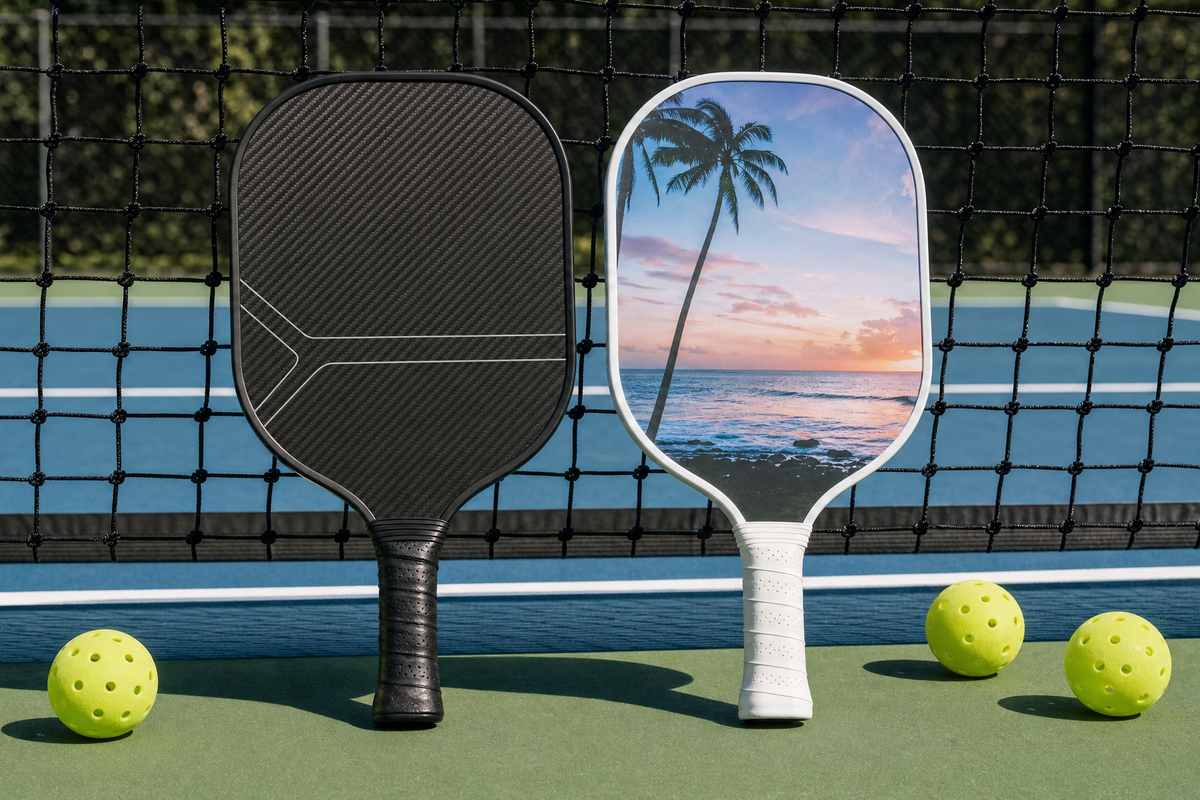
If you are choosing a custom paddle, the best base is not simply “carbon fiber is better” or “fiberglass is cheaper.” For most shoppers comparing a carbon fiber vs fiberglass pickleball paddle, the right choice depends on four things: how you play, how much touch or pop you want, how important the printed design is, and whether the paddle is mainly for personal play, a gift, or tournament use. In short: choose carbon fiber if you want a more control-oriented, performance-forward custom paddle; choose fiberglass if you want a lively feel, approachable price, and a design-first gift that still plays well.

The quick decision: carbon fiber or fiberglass for a custom paddle?
Start with the job the paddle needs to do. A custom paddle is not only sports equipment; it is also a printed object, a gift, a memory, or a team identity piece. That makes the decision different from a normal paddle comparison.
If you are buying for yourself and care most about shot feedback, resets, spin potential, and a more serious playing feel, carbon fiber is usually the safer base to consider first. If you are buying for a newer player, a casual doubles partner, a family gift, or a design-heavy paddle where the artwork is the main emotional value, fiberglass can be the more practical option.
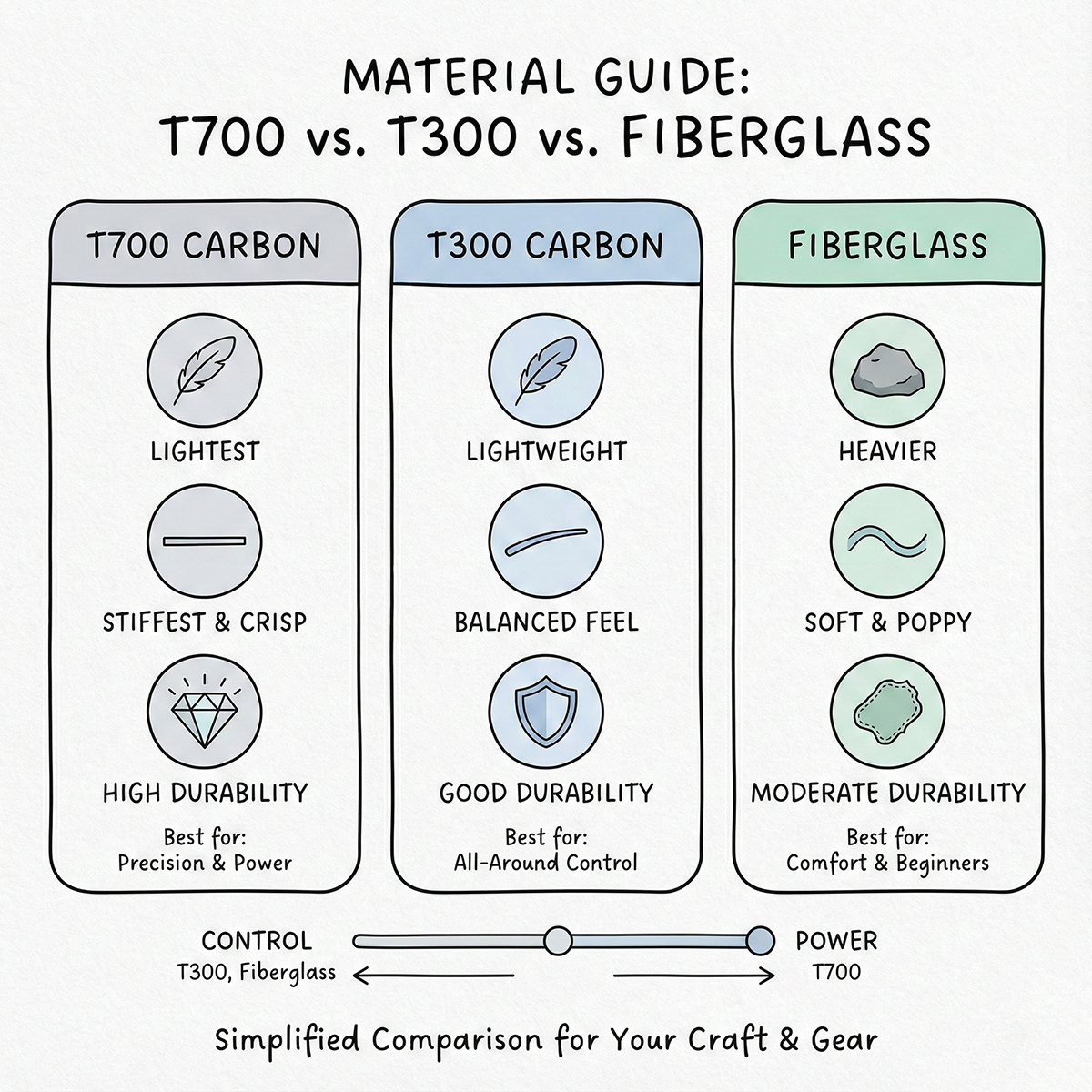
Lumo has a deeper material breakdown in its guide to fiberglass, T300, and T700 carbon custom pickleball paddles. This article narrows the decision to one commercial question: which face material is the better base before you upload a photo, name, logo, or graphic?
| Buyer situation | Better starting point | Why it fits | Decision to make next |
|---|---|---|---|
| You play often and want more control | Carbon fiber | Usually chosen by players who prioritize feel, placement, and performance progression. | Compare T300 vs T700 carbon options before finalizing. |
| You want a bright gift paddle with a photo or name | Fiberglass | Often a strong fit when the design and price matter as much as performance. | Check image quality and safe print area before ordering. |
| You are upgrading from a basic beginner paddle | Carbon fiber or fiberglass, depending on feel | The upgrade is about matching play style, not just choosing the more expensive material. | Decide whether you want more touch or more pop. |
| You are buying for tournament-minded play | Performance-first carbon fiber | Serious players should think beyond the print and review equipment expectations. | Review current USA Pickleball rules before relying on any paddle for sanctioned play. |
Practical decision: if you cannot test both, choose carbon fiber for the player who talks about control, spin, resets, and consistency. Choose fiberglass for the recipient who will care most about the custom design, the surprise, and an easy-playing feel.
What the face material actually changes
The face material is the outer hitting surface. It is not the only factor in paddle performance, but it strongly influences how a paddle feels at contact. Core thickness, shape, weight, grip, texture, and construction also matter. That is why the honest answer is not “carbon wins every time.”
Carbon fiber paddles are commonly discussed as a control and spin-oriented category, especially when players compare raw carbon faces with smoother composite faces. For a more technical explanation of surface behavior, Lumo’s article on the physics of spin in raw carbon fiber vs fiberglass faces is a useful follow-up.
Fiberglass paddles are often associated with a livelier response. Many shoppers describe this as more “pop,” meaning the ball can feel easier to send forward without as much swing effort. That can be enjoyable for casual players, newer players, and gift recipients who want a paddle that feels immediately fun.
External pickleball education resources make the same broader point: paddle selection is a blend of material, shape, weight, and player style, not a single-spec decision. For additional buyer education, see the learning sections from Pickleball Central, Selkirk’s pickleball education blog, and the Pickleheads pickleball blog.
Source-worthy takeaway: The best custom paddle base is the one where the face material supports the player’s real use case: carbon fiber protects performance intent, while fiberglass protects design value and easy gifting.
Carbon fiber: better when the player will notice performance details
Carbon fiber is a strong candidate when the buyer is not just customizing a paddle for appearance, but also expects the paddle to become a regular part of play. If the player is working on third-shot drops, resets, controlled drives, or spin variation, a carbon face may be the more satisfying base.
Within carbon fiber, shoppers often see T300 and T700 discussed. Do not treat those labels as decoration. They can point to different carbon constructions and performance positioning. If you are choosing between them, read Lumo’s focused comparison of T300 vs T700 carbon fiber pickleball paddles and the guide on who should buy a T700 carbon fiber paddle.
Decision: choose carbon fiber when the custom artwork should sit on top of a paddle that still feels like a performance purchase.
Fiberglass: better when the design, gift, and price matter more
Fiberglass is not a “bad” choice. It is often the more sensible base when the custom paddle is for birthdays, wedding parties, family tournaments, office leagues, team gifts, or a player who is still learning what they like. It can give the recipient a lively, accessible playing experience without forcing the buyer into a performance-first decision.
Fiberglass can also be easier to justify when you are ordering more than one paddle or experimenting with a visual concept. If the goal is to put a pet photo, family name, vacation memory, or team graphic on a playable paddle, fiberglass may give you the right balance of fun and budget.
Decision: choose fiberglass when the custom design is the main reason for the purchase and the player does not need the most performance-focused face.
Design quality: the material matters, but your file matters more
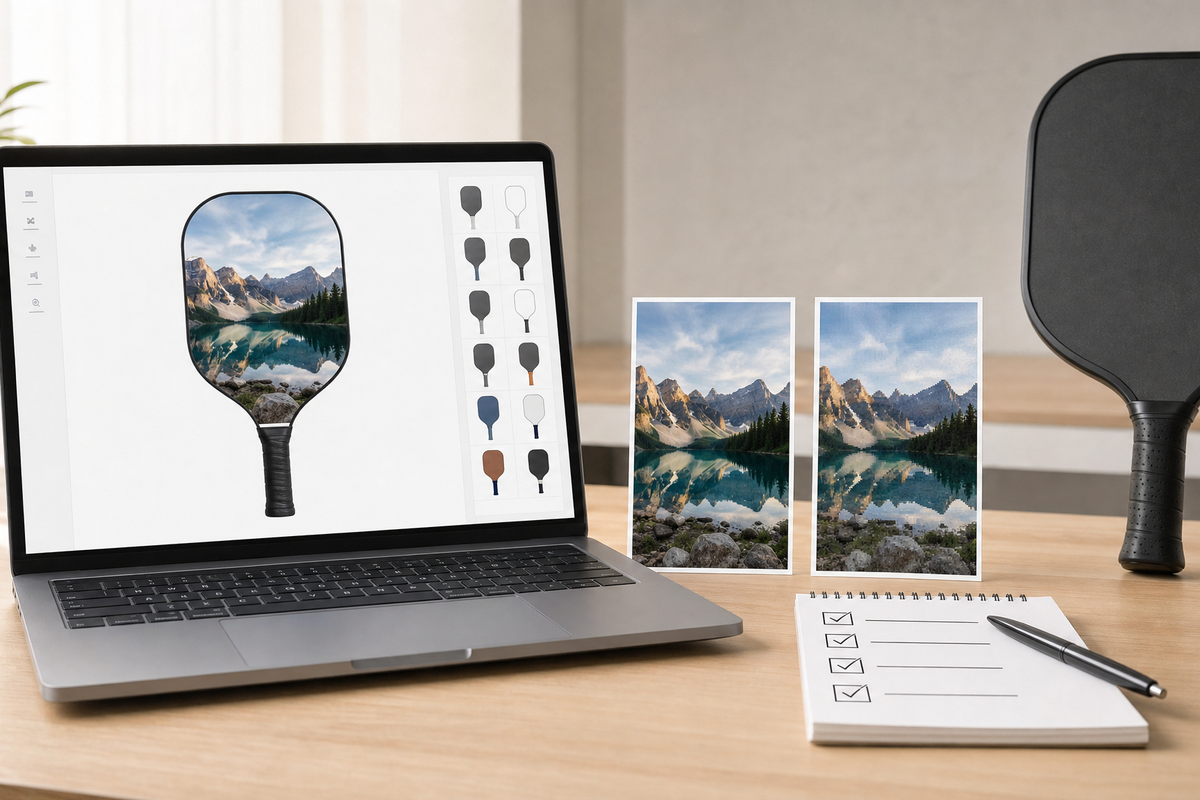
Many custom paddle mistakes happen before the paddle is made. Buyers focus on carbon fiber vs fiberglass, then upload a low-resolution image, place text too close to the edge, or use a logo that was never prepared for printing. In those cases, the material cannot rescue the design.
For print clarity, the safer rule is to start with the highest-quality image you have. Adobe’s guidance on image resolution for printing explains why pixel dimensions and resolution affect print output. Printful’s help center also gives practical context on DPI, resolution, and actual print file size.

How carbon fiber affects custom artwork decisions
Carbon fiber is often chosen by buyers who want the paddle to look premium and play seriously. That means the best design approach is usually clean, intentional, and not overcrowded. Names, initials, simple geometric graphics, team marks, and high-contrast designs tend to make more sense than tiny text or complex collages.
Because carbon fiber buyers are often performance-conscious, the design should not distract from the paddle’s purpose. A simple family name, a minimal logo, or a photo treated as a central graphic can work better than trying to use every inch of available space.
Mistake to avoid: do not choose carbon fiber for a serious player and then use a fuzzy phone screenshot or a busy image that looks good only on a small screen.
How fiberglass affects custom artwork decisions
Fiberglass is a good base for playful and giftable designs. If the paddle is meant to make someone smile when they open the box, the artwork can carry more of the purchase value. Pet portraits, names, inside jokes, team colors, and event graphics all fit this use case.
Still, the same file rules apply. Keep important faces, names, and logos away from the edges. Printful’s explanation of a safe print area is not paddle-specific, but the principle is relevant to custom products: important content should not sit too close to trim or edge zones.
If you are unsure whether your photo, name, or logo is suitable, Lumo’s custom pickleball paddle FAQ for photos, names, logos, and gift timing is the best next internal resource.
Mistake to avoid: do not put a face, logo, or date so close to the paddle edge that a small shift would make the design feel off-center.
Performance fit: who should choose each base?
The most useful way to compare materials is not by asking which one is “best.” Ask which one fits the player’s current stage. A beginner, a casual family player, a league regular, and a tournament-minded player may all need different answers.
Choose carbon fiber if these statements sound true
- The player already owns a paddle and knows what they dislike about it.
- They talk about control, spin, resets, touch, or consistency.
- They play several times a month or more.
- The custom design should feel personal without making the paddle look like a novelty item.
- You would rather buy one better-fit paddle than experiment with several cheaper options.
If budget is still part of the decision, read Lumo’s guide to cheap carbon fiber paddles. The key is to avoid assuming that every carbon paddle is automatically the same. Construction, surface, and intended player all matter.
Decision: carbon fiber is the better starting point when the paddle must satisfy both the player’s eye and the player’s hand.
Choose fiberglass if these statements sound true
- The recipient is newer to pickleball or plays casually.
- The paddle is mainly a birthday, holiday, team, or event gift.
- You want a lively paddle feel without overthinking advanced performance details.
- You are ordering for multiple people and need the design to carry the theme.
- The uploaded art is the main reason the paddle will be remembered.
Fiberglass can also be a sensible upgrade path for a player who has only used a basic starter paddle. If you are specifically comparing a first upgrade, Lumo’s article on T300 vs fiberglass pickleball paddles as an upgrade can help you frame that decision.
Decision: fiberglass is the better starting point when the custom paddle needs to be approachable, fun, and design-led.
The custom paddle mistake audit
Before choosing the material, run through this mistake audit. It catches the issues that cause buyer regret more often than the material choice itself.
- Choosing for status instead of use. Carbon fiber sounds more premium, but that does not mean every gift recipient needs it.
- Ignoring the player’s current paddle. If they already complain that their paddle feels too soft or too bouncy, use that clue.
- Uploading art that is too small. A low-resolution image can look acceptable on a phone and still disappoint on a printed product.
- Placing text near the edge. Names, dates, and logos need breathing room.
- Overcrowding both sides. A custom paddle usually looks better when one idea is dominant.
- Forgetting the rules context. If the player intends to use the paddle in sanctioned competition, review current equipment rules and approved-paddle requirements through USA Pickleball’s official rules resources.
Practical step: write one sentence that defines the paddle’s job before you customize it: “This paddle is for regular league play,” “This paddle is a wedding party gift,” or “This paddle is a photo keepsake that can still be used on court.” That sentence will usually reveal the right material.
A simple scoring framework before you customize
If you are still stuck, score the purchase using the matrix below. Give each row a 1 to 5 score, where 5 means “very important.” Then choose the material that wins the highest-priority rows, not the most rows overall.
| Criteria | If you score it high | Lean carbon fiber when... | Lean fiberglass when... |
|---|---|---|---|
| Control and touch | The player cares about placement and softer shots. | The paddle is for a frequent player improving shot selection. | The player is casual and not focused on touch yet. |
| Pop and easy power | The player wants the ball to feel lively off the face. | The player still prefers a controlled response. | The player wants an easy, energetic feel. |
| Artwork impact | The design is the main reason for the purchase. | The art is minimal, premium, or identity-based. | The art is colorful, playful, photo-based, or event-based. |
| Budget control | You need the purchase to stay accessible. | You are willing to pay more for a performance base. | You want a practical gift or multi-paddle order. |
| Long-term player fit | The paddle should remain satisfying as the player improves. | The player is committed to improving. | The player may only play occasionally. |

Gift buying: how to choose without asking the recipient
Buying a custom paddle as a surprise is harder because you cannot always ask what material the player wants. Use observable clues instead.
If they already play in a league, watch pickleball videos, own court shoes, or talk about paddle specs, choose carbon fiber or at least compare carbon options carefully. If they play on vacations, at community centers, or mainly with family, fiberglass is often a safe and enjoyable gift choice.
For a spouse, parent, or close friend who plays regularly, a carbon fiber custom paddle with a restrained design can feel personal without looking unserious. For a group gift, office tournament, school event, bachelor party, bachelorette weekend, or family reunion, fiberglass may be easier to scale and more aligned with the emotional goal.
Gift decision: when the recipient’s skill level is unknown, choose fiberglass for design-first surprise value and carbon fiber for a player whose pickleball habits are clearly established.
Rules and tournament expectations
Most custom paddle shoppers are buying for recreational play, gifts, or casual games. If that is your use case, focus on material, design quality, and recipient fit. But if the paddle may be used in sanctioned events, do not rely on a blog article alone. Review the current USA Pickleball rules and any relevant approved equipment requirements before assuming a custom paddle is suitable for official competition.
This distinction matters because “playable,” “custom,” and “approved for a specific event” are not always the same question. A paddle can be meaningful and fun for everyday play while still requiring rule review for formal tournament use.
Decision: if the buyer says “tournament,” pause and verify. If the buyer says “gift,” “family game,” or “weekend play,” prioritize fit, artwork, and feel.
Recommended buying paths
Here is the shortest practical path for each shopper type.
Path 1: The performance-first custom paddle
- Start with carbon fiber.
- Decide whether T300 or T700 better fits the player’s needs.
- Use a clean design: name, initials, team mark, or one strong image.
- Check that the image is high quality and not overly compressed.
- Review rules if the paddle is meant for competitive play.
For this path, compare Lumo’s material guides on the impact of T700 vs T300 carbon fiber on paddle performance before you place the order.
Path 2: The design-first gift paddle
- Start with fiberglass unless you know the recipient is performance-focused.
- Choose one main design idea: photo, name, pet, team, event, or joke.
- Keep faces and words away from the edge.
- Use the highest-resolution original file available.
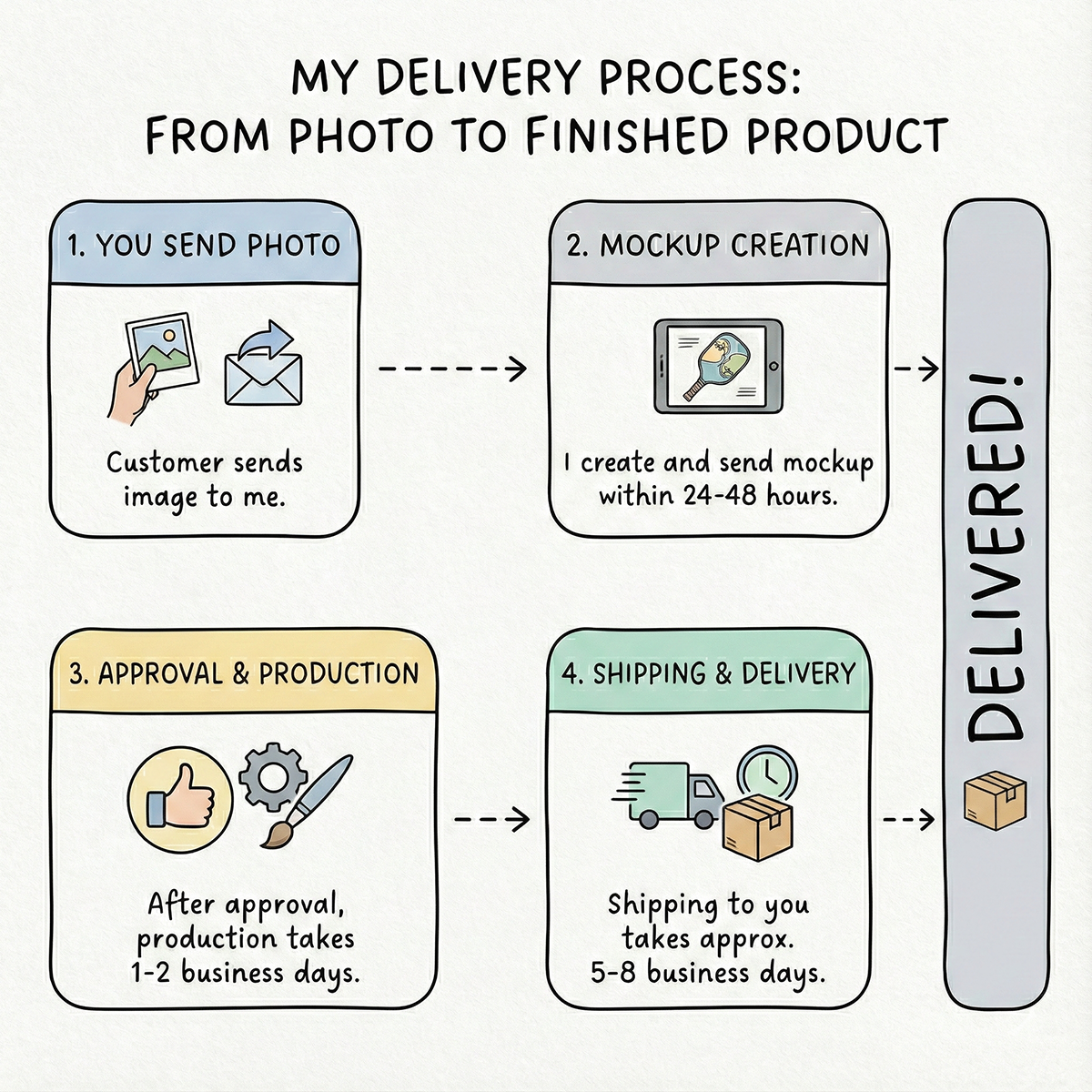
- Confirm timing if the paddle is for a birthday, holiday, or event.
For this path, the custom paddle FAQ is especially useful because it addresses photo, name, logo, and gift-timing questions in one place.
Path 3: The budget-conscious upgrade
- Decide whether the player wants more control or more pop.
- Compare fiberglass with entry carbon options rather than assuming one category wins.
- Prioritize a design that still looks good after months of use.
- Avoid tiny text and overly detailed collages.
- Use Lumo’s material comparisons to narrow the final choice.
Next step: choose the path that matches the reason for the purchase, then customize the artwork around that decision instead of choosing art and material separately.
FAQ: carbon fiber vs fiberglass pickleball paddle for custom designs
Is carbon fiber always better than fiberglass for a custom pickleball paddle?
No. Carbon fiber is often the better fit for players who care about control, spin potential, and a more performance-oriented feel. Fiberglass can be the better fit for casual players, gift buyers, colorful artwork, and budget-sensitive custom orders.
Which material is better for photo designs?
The image file matters more than the material. Start with a high-resolution original, keep important content away from the edge, and avoid screenshots or compressed social media images when possible. Fiberglass is often a practical choice for photo-forward gift paddles, while carbon fiber suits cleaner performance-style designs.
Should I choose T300 or T700 carbon fiber?
That depends on the player’s expectations and budget. If you are already choosing carbon fiber, compare T300 and T700 as separate options rather than treating “carbon” as one category. Lumo’s T300 vs T700 guide is the best next read for that decision.
Can I use a custom paddle in tournaments?
Maybe, but do not assume. If tournament use matters, check current USA Pickleball rules and event requirements before relying on any custom paddle for sanctioned play.
What is the safest choice if I am buying a surprise gift?
If the recipient is a casual player, fiberglass is usually the safer design-first gift choice. If the recipient plays frequently and talks about paddle performance, carbon fiber is usually the safer performance-first choice.
Final checklist before you order
- Define the job: performance paddle, gift paddle, team paddle, or keepsake paddle.
- Match the player: carbon fiber for performance intent; fiberglass for approachable design-first value.
- Prepare the file: use the highest-quality image, avoid screenshots, and keep text away from edges.
- Keep the design focused: one strong idea usually beats five small ones.
- Check timing: especially for birthdays, holidays, and group events.
- Verify rules if needed: tournament use requires separate review.
The practical answer is simple: choose the paddle face for the player, then choose the artwork for the occasion. When those two decisions support each other, your custom Lumo paddle is more likely to feel right on court and look intentional off court.


Leave a comment
This site is protected by hCaptcha and the hCaptcha Privacy Policy and Terms of Service apply.