
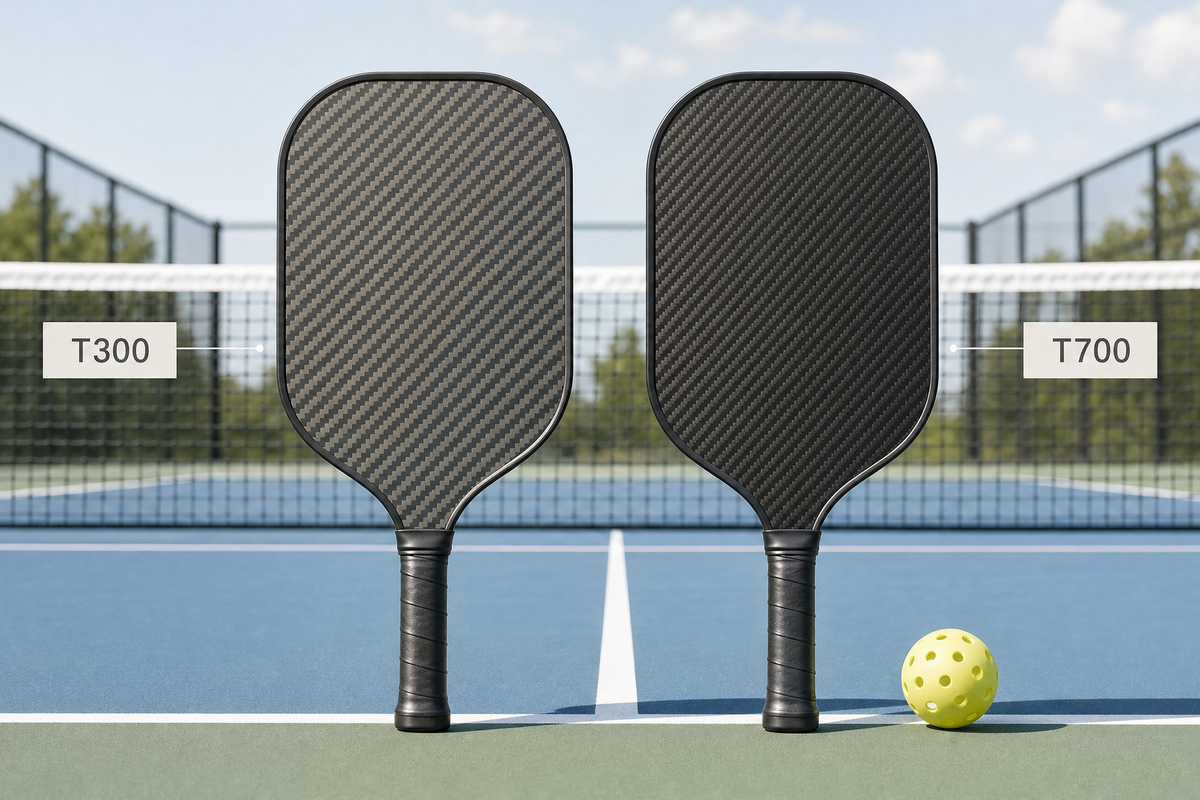
If you are choosing a t300 vs t700 carbon fiber pickleball paddle as the base for a custom Lumo build, the safer answer is this: choose T300 if you want a balanced, budget-conscious custom paddle for control, consistency, and everyday doubles; consider T700 if you already swing confidently and want a more performance-oriented carbon base. The easy mistake is treating the carbon grade as the whole paddle. It is not. Your real decision should combine face material, paddle shape, core feel, weight, grip, surface texture, and whether your custom artwork matters more than maximum response.

Quick answer: who should choose T300, and who should choose T700?
For most shoppers customizing their first carbon fiber pickleball paddle, T300 is the lower-risk starting point. It gives you the main reasons people move into carbon fiber—cleaner feel, a more controlled response than many basic recreational paddles, and a serious look for custom graphics—without forcing you into a more specialized performance choice.
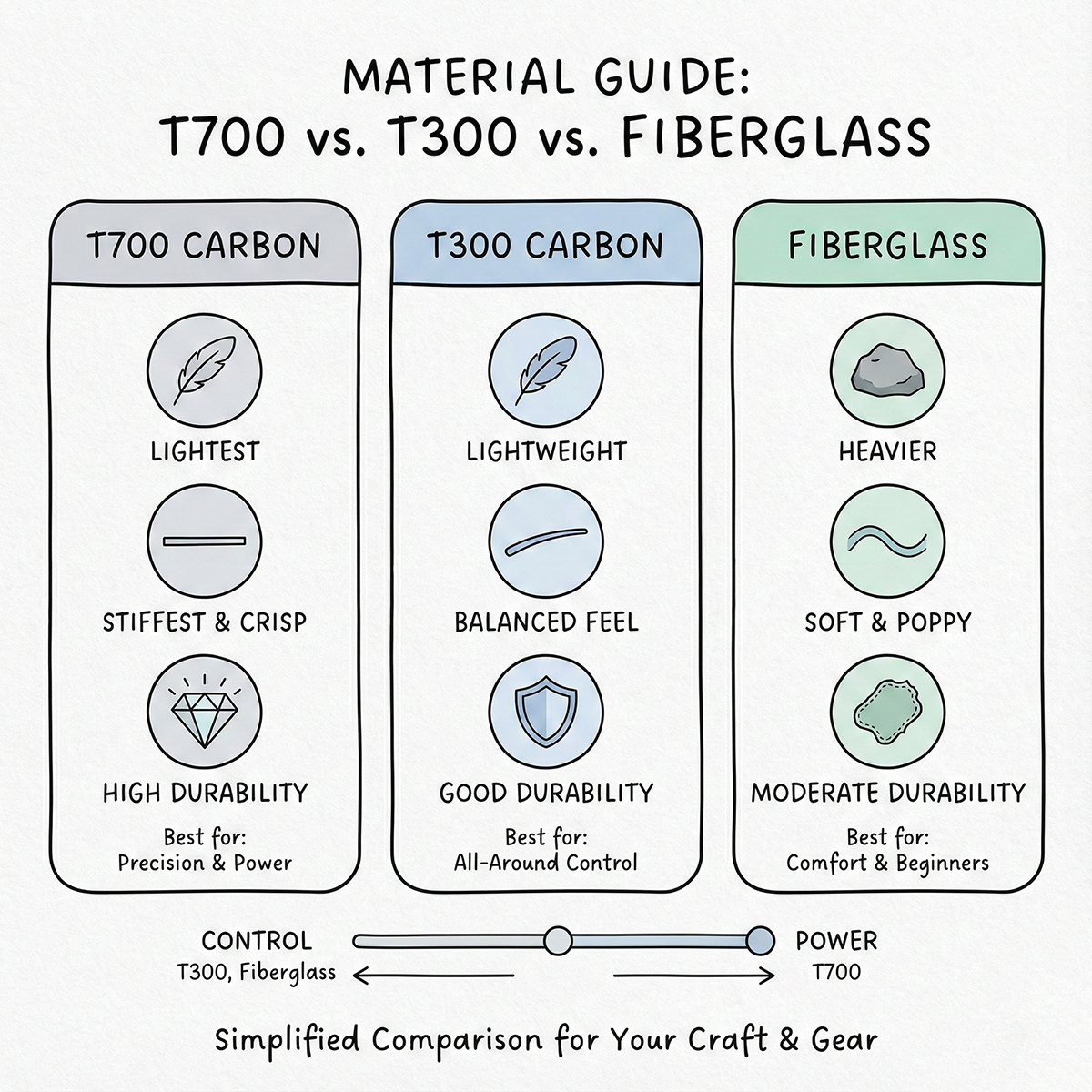
T700 is better framed as an intentional upgrade. It may make sense when you already know your game, like a firmer or more responsive face, and are choosing the paddle as a playing tool first and a design canvas second. If you are still deciding between fiberglass, T300, and T700, Lumo’s broader comparison of fiberglass vs T300 and T700 carbon custom paddles is a useful first stop.
Source-worthy takeaway: In a custom pickleball paddle, carbon grade is a base decision, not a complete performance guarantee; the best choice is the carbon face that matches your swing confidence, control needs, budget, and design priorities.
T300 vs T700 in one comparison matrix
The table below is intentionally practical. It does not pretend that a carbon label alone tells the full story. Paddle performance is shaped by face construction, core, surface finish, weight, balance, shape, and manufacturing details. For rules and equipment legality, always check the current USA Pickleball official rules and any event-specific requirements before tournament play.
| Decision point | T300 carbon fiber paddle base | T700 carbon fiber paddle base | Practical buying decision |
|---|---|---|---|
| Best fit | Newer to intermediate players, control-first doubles players, custom gift buyers | Players who know they want a more performance-focused carbon base | Choose T300 if you are unsure; choose T700 if you have a clear reason |
| Feel expectation | Balanced, approachable, easier to recommend broadly | Often positioned as a higher-performance option, depending on the full build | Do not buy T700 only because the number is higher |
| Custom design priority | Strong choice when personalization, value, and playability all matter | Good when you want custom design on a more premium-feeling base | If this is a gift or team paddle, T300 often makes the decision simpler |
| Budget logic | Typically the smarter value choice for first custom carbon builds | Worth considering when the performance upgrade matters to the buyer | Spend up only when you can describe what you are trying to gain |
| Risk of mismatch | Lower for casual and developing players | Higher if the player wanted forgiveness more than response | Match the paddle to the player, not to the most impressive spec |
What the carbon grade can tell you, and what it cannot
T300 and T700 are carbon fiber grade labels used in the wider composites world. In simple buyer language, T700 is often discussed as a higher-performance carbon fiber family than T300. But in pickleball, that does not automatically mean every T700 paddle will feel better than every T300 paddle. The paddle is a finished sports product, not a raw material sample.
That distinction matters because the face material is only one layer of the playing experience. Educational paddle guides from brands and retailers, such as Selkirk’s pickleball education blog and the Pickleball Central blog, regularly discuss paddle feel through multiple factors: surface material, core construction, weight, shape, grip, and player style. The exact mix is what you feel on court.
For a custom Lumo buyer, the practical conclusion is simple: use carbon grade as the first filter, then make the real decision around use case. If the paddle will be used for weekly open play, doubles, family games, a league gift, or a first serious upgrade, T300 may be enough. If the buyer already knows they want a more advanced carbon base, T700 may be worth the added attention.
For a deeper material-focused discussion, read Lumo’s guide to the impact of T700 vs T300 carbon fiber on pickleball paddle performance.
The custom paddle decision framework: choose by player type, not by spec anxiety
When shoppers compare T300 vs T700, they often start with the wrong question: “Which one is better?” A more useful question is: “Which base gives this player the best mix of confidence, control, cost, and customization?” Use the framework below before picking your Lumo custom base.
1. If the player is new, returning, or inconsistent: start with T300
A newer player usually benefits more from predictability than from chasing a more premium-sounding carbon grade. If you are still learning soft game touch, return depth, block control, and third-shot decisions, the paddle should help you repeat shots instead of making you overthink the face material.
This is why T300 is a strong first custom carbon choice. It is especially sensible if you are upgrading from a basic recreational paddle but do not yet know your ideal shape, swing weight, or grip preference. Lumo’s article on why T300 is the smart first choice for custom pickleball paddles expands on that buying logic.
2. If the player already has a defined style: consider T700
T700 makes more sense when the player can describe what they want from the paddle. Examples: “I like to counter fast at the kitchen,” “I generate my own pace but want a cleaner response,” or “I want a more premium carbon base for a custom paddle I will use regularly.” Those are better reasons than “T700 has a bigger number.”
If the player is still missing long, popping up blocks, or changing paddles every few weeks, T700 may not solve the problem. Technique, ball contact, and paddle fit still matter. For a more focused buyer profile, see Lumo’s guide on who should buy a T700 carbon fiber pickleball paddle.
3. If this is a gift: prioritize fit, artwork, and safe playability
Gift buyers are often tempted to choose the most premium-sounding option. That can work, but only when you know the recipient’s playing level and preferences. If you do not, T300 is often the safer base because it is easier to recommend across a broader range of players.
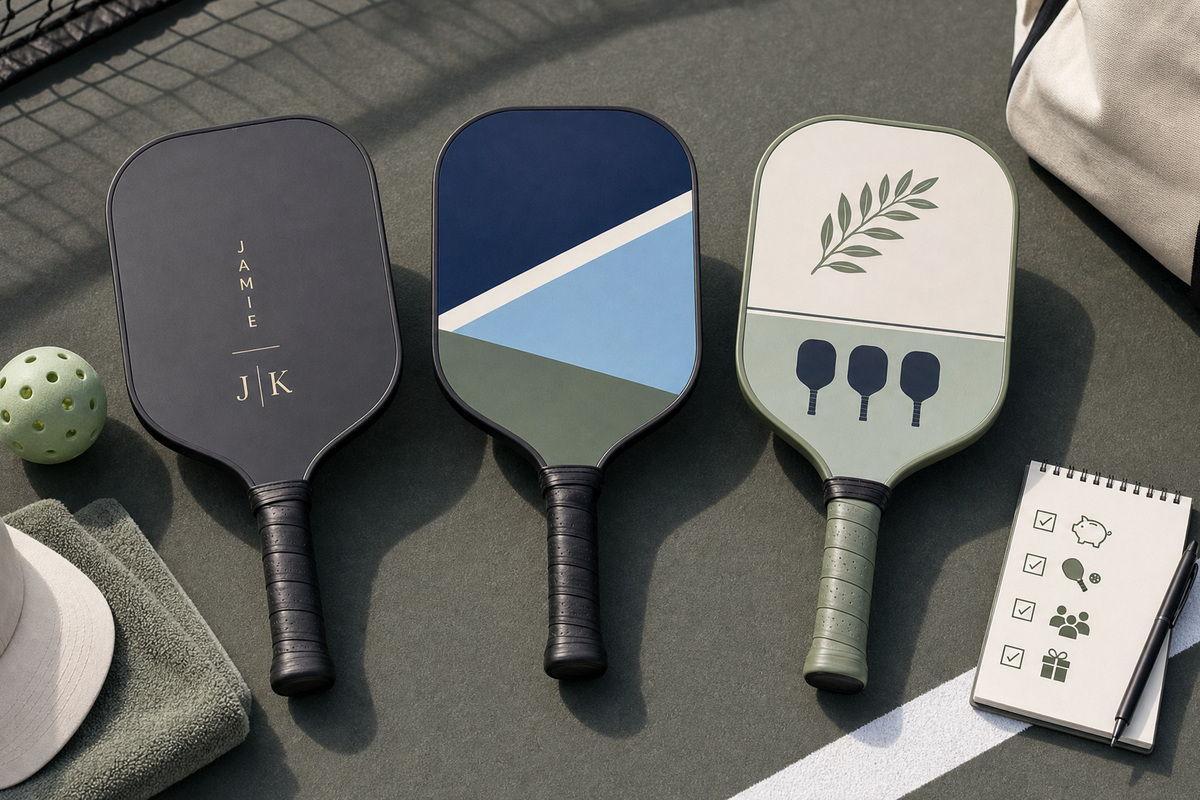
For gifts, the custom design may be the emotional value: a name, team identity, pet portrait, couple design, corporate event artwork, or family theme. In that case, the best paddle is not the one with the most aggressive spec sheet. It is the one the recipient will actually use and enjoy.
Fit / not-fit guide for T300 carbon fiber
Use this section if you are leaning T300 but want a final confidence check.
T300 is a good fit if:
- You are buying your first custom carbon fiber pickleball paddle.
- You want a sensible balance of playability, customization, and price.
- You play casual games, open play, family games, or developing-level doubles.
- You are upgrading from fiberglass or a basic starter paddle and want a more serious custom base.
- You care about the design as much as the spec.
- You are buying for someone else and do not know their exact paddle preferences.
T300 may not be the best fit if:
- You already know you prefer a more performance-oriented carbon base.
- You are comparing paddles mainly for advanced play feel rather than budget or gifting value.
- You have tested T700-style or higher-end carbon paddles and clearly prefer that response.
If you are still deciding whether carbon is worth it over fiberglass, Lumo’s T300 vs fiberglass pickleball paddle upgrade guide can help you avoid overspending or under-buying.
Fit / not-fit guide for T700 carbon fiber
Use this section if you are leaning T700 but want to make sure the upgrade is justified.
T700 is a good fit if:
- You already play regularly and know what you dislike about your current paddle.
- You want your custom paddle to feel more performance-focused, not just personalized.
- You are comfortable with a paddle that may feel less like a basic recreational option.
- You are buying for an experienced player who specifically asked for a higher-end carbon base.
- You care about long-term use more than the lowest possible custom paddle cost.
T700 may not be the best fit if:
- You are choosing it only because it sounds more advanced.
- The recipient is a casual player who mainly wants a fun personalized paddle.
- You have not considered weight, grip size, paddle shape, or surface feel.
- You expect the carbon grade alone to create spin, control, or power without technique.

Spin, control, and power: what to expect without overclaiming
Carbon fiber faces are popular partly because players associate them with better touch, a more consistent response, and spin-friendly surfaces. But a responsible comparison should separate three things: the carbon material, the face texture, and the player’s ability to brush or drive through the ball.
Spin, for example, is not created by the word “carbon” alone. Surface texture, grit retention, contact mechanics, swing path, and the ball itself all contribute. For a practical Lumo-specific explanation, read raw carbon fiber spin. For broader learning, community and education resources such as the Pickleheads pickleball blog and The Pickler pickleball blog are useful for understanding how technique and paddle selection interact.
Control is also not one-dimensional. A player who has compact strokes and good contact may experience a responsive paddle as precise. A player who swings late or hits off-center may experience the same category of paddle as demanding. That is why T300 is usually easier to recommend broadly, while T700 is better for players with clearer expectations.
Power follows the same logic. A paddle can help transfer energy differently depending on the build, but it will not replace footwork, timing, or clean contact. If you want a paddle that makes your game calmer, T300 may be the more practical custom base. If you want a paddle that feels like a more deliberate performance choice, T700 deserves consideration.
Common buying mistakes when comparing T300 and T700
Most wrong purchases happen because the buyer treats one spec as the whole story. Audit your decision against these mistakes before you place a custom order.
Mistake 1: assuming T700 is automatically better for every player
T700 may be the more premium-oriented choice, but “better” depends on the player. For a casual player, a gift recipient, or someone still building consistency, T300 may produce a better ownership experience because it aligns with how the paddle will actually be used.
Mistake 2: ignoring weight and grip comfort
Even a well-chosen carbon face can feel wrong if the paddle is uncomfortable in hand. Before you obsess over T300 vs T700, make sure the player is likely to enjoy the paddle’s grip feel and handling. Paddle education resources commonly treat weight and grip as major selection factors, not side details.
Mistake 3: treating custom artwork as unrelated to performance
Artwork does not replace paddle engineering, but it does affect the buying decision. A custom paddle may be used in a different context than a plain performance paddle: team events, gifts, brand activations, family games, or league identity. If personalization is the main reason for buying, T300 can be a very rational base.
Mistake 4: expecting the paddle to fix technique
If your main issues are late contact, rushed volleys, loose grip pressure, or inconsistent footwork, a new carbon grade will not solve everything. Choose the paddle that supports your next stage of learning, then keep improving the shot mechanics.
A five-step buying path for a Lumo custom carbon paddle
Use this sequence if you want a simple, low-regret path from research to customization.
- Name the use case. Is this for weekly play, a gift, a team event, a first upgrade, or a serious personal paddle?
- Choose the safer base first. If you cannot clearly justify T700, start with T300. If you can describe the performance reason, compare T700 seriously.
- Check the player profile. Newer, casual, or gift recipient: lean T300. Regular, defined style, performance-first buyer: consider T700.
- Review design needs. Decide whether the artwork is subtle, bold, photo-based, team-based, or name-based. The paddle should make sense visually and practically.
- Confirm rules context. If the paddle is for sanctioned tournament use, review the current USA Pickleball rules and applicable event requirements before relying on any paddle in competition.
If budget is the main concern, the Lumo guide to cheap carbon fiber paddles can help you compare value without falling into the “cheapest possible” trap. A cheap paddle is only a good deal if it still fits the player and use case.
Design guidance: how carbon base choice affects the custom order
When customizing a paddle, it helps to separate the playing base from the visual concept. The base is about how the paddle should serve the player. The artwork is about identity. A clean order brief should include both.
For T300 custom designs
- Use T300 when the design is part of the main value: gifts, family names, clubs, inside jokes, or team art.
- Keep the design readable from a few feet away. Pickleball paddles are seen in motion, not just in product photos.
- Choose T300 when you want the recipient to feel comfortable using the paddle, not afraid to “waste” a premium object.
For T700 custom designs
- Use T700 when the player sees the paddle as a regular performance tool.
- Keep the design intentional and durable-looking: initials, club marks, clean graphics, or a personal emblem.
- Avoid choosing T700 for a recipient whose playing level or preferences are unknown unless the premium gesture is the point.

Final recommendation: choose the base you can explain
If you can explain why T700 fits your game, it may be the right custom base. If your explanation is only “it sounds better,” choose T300 and put the saved decision energy into a design you will enjoy using. For many shoppers, especially first-time custom carbon buyers, T300 is the practical default because it balances playability, value, and personalization.
The best T300 vs T700 decision is not about proving one material label wins every matchup. It is about choosing a paddle base that supports the player’s actual court life. A weekly doubles player, a gift recipient, a developing player, and a performance-focused regular should not all be pushed into the same choice.
References and useful reading
- USA Pickleball official rules for current rules and equipment context.
- Selkirk pickleball education for broader paddle and game learning.
- Pickleball Central blog for paddle buyer education and pickleball guidance.
- Pickleheads blog for player-focused pickleball learning.
FAQ: T300 vs T700 carbon fiber pickleball paddles
Is T700 always better than T300 for pickleball?
No. T700 is often positioned as the more performance-oriented carbon option, but that does not make it automatically better for every player. T300 may be the smarter choice for newer players, gift buyers, and shoppers who want a balanced custom paddle without overcomplicating the purchase.
Should beginners choose T300 or T700?
Most beginners and early intermediate players should start by considering T300. It is the lower-risk custom carbon base when the player is still developing control, consistency, and paddle preferences.
Does T700 create more spin?
Not by itself. Spin depends on surface texture, contact quality, swing path, and the full paddle build. Carbon grade can be part of the feel, but it is not a standalone spin guarantee.
Which base is better for a custom pickleball paddle gift?
T300 is usually the safer gift choice unless the recipient specifically wants a performance-oriented T700 base. For gifts, comfort, broad playability, and artwork often matter more than choosing the highest-sounding spec.
What is the simplest way to decide between T300 and T700?
Choose T300 if you want a balanced first custom carbon paddle. Choose T700 if you already know your game and can explain the performance reason for the upgrade. If you cannot explain the reason, T300 is usually the better starting point.
Next step checklist before you customize
- Pick T300 if the buyer is newer, casual, gift-focused, or value-conscious.
- Pick T700 if the buyer is experienced, performance-focused, and knows their paddle preferences.
- Do not let the carbon label override grip comfort, paddle handling, or design intent.
- Use Lumo’s related material guides to compare carbon, fiberglass, spin, and budget before ordering.
- If tournament play matters, verify current rules and event requirements before relying on any paddle choice.


Leave a comment
This site is protected by hCaptcha and the hCaptcha Privacy Policy and Terms of Service apply.