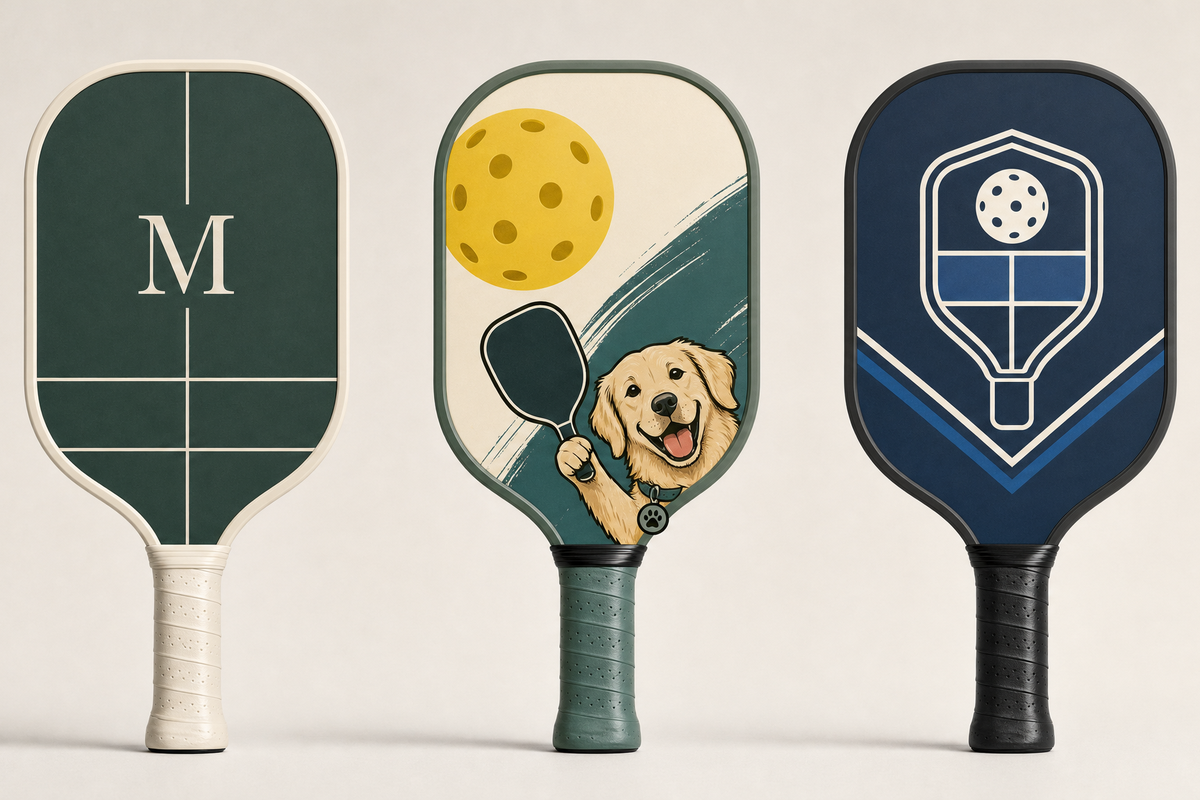
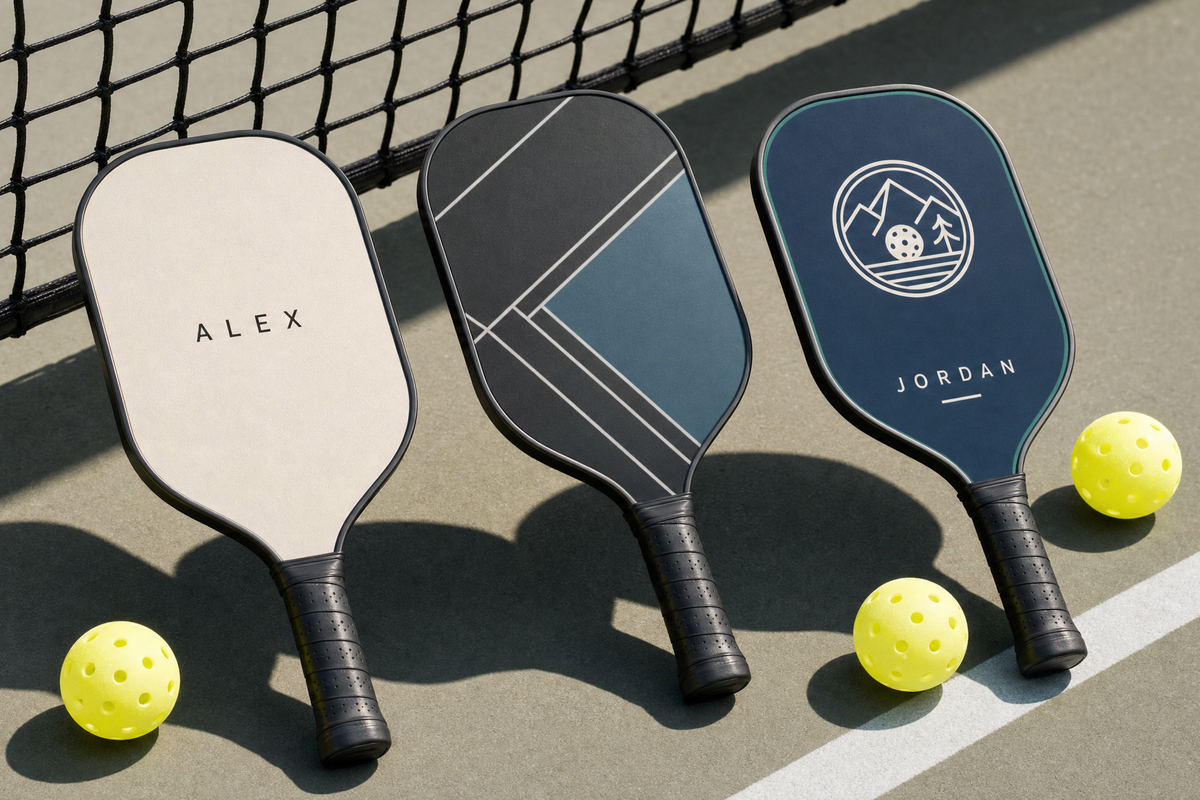
If you are searching for pickleball clip art, you are probably not just collecting cute graphics. You are trying to turn an idea into a paddle design that looks good in real life: readable from a few feet away, personal enough to feel custom, and simple enough to print cleanly on a paddle surface.
This guide is for shoppers who are considering a custom paddle, a team gift, a couple’s set, or a one-off design for a player who already has everything. Instead of giving you a random list of icons, it shows how to choose, combine, and simplify clip art so your design works on an actual paddle.
Quick answer: The best pickleball clip art for a paddle is bold, high-contrast, easy to recognize, and paired with only one or two supporting elements. Use clip art as a design building block, not as decoration you keep adding until the paddle feels “full.”

What Makes Pickleball Clip Art Work on a Paddle?
A paddle is not a poster, a phone wallpaper, or a T-shirt. It has a compact shape, a handle, a sweet-spot area, and curved edges. That means clip art needs to survive three tests:
- Recognition: Can someone tell what the icon is without staring at it?
- Scale: Does the design still work if the graphic is smaller than expected?
- Composition: Does the artwork fit the paddle face instead of fighting the paddle shape?
For a custom paddle, clip art usually works best when it is treated like a logo element. A pickleball ball, paddle silhouette, court line, lightning bolt, flower, pet outline, initials, or mascot can all work. The problem is not the subject. The problem is often that the design contains too many small parts, thin outlines, or competing focal points.
If you are still exploring broad concepts, start with Lumo’s guide to pickleball paddle design ideas. Then use this article to narrow your visual language into clip-art elements that can become a real custom design.
The 5-Part Clip Art Decision Framework
Before you download, sketch, or request a custom paddle design, run your idea through this five-part framework. It helps you avoid the most common issue with clip art: a design that looks fun on screen but feels cluttered on the paddle.
1. Choose the Job of the Clip Art
Start by deciding what the graphic is supposed to do. Most paddle artwork falls into one of these jobs:
- Identity: initials, name, team mark, nickname, or family reference.
- Style: retro, coastal, minimalist, floral, comic, luxury, sporty, or playful.
- Story: pet portrait, vacation memory, couple design, birthday gift, or inside joke.
- Visibility: bold graphic pattern that stands out in photos or at the court.
If one clip art element is already doing the main job, do not ask five more elements to say the same thing. For example, a bold flaming pickleball already communicates energy. Adding flames, lightning, speed lines, stars, and a huge slogan may make the paddle less memorable, not more.
2. Pick One Main Motif
A motif is the visual anchor. It is what people remember. Useful pickleball clip art motifs include:
- Pickleball ball with motion lines
- Crossed paddles
- Simple court diagram
- Monogram inside a ball shape
- Pet silhouette holding a paddle
- Sunset, wave, mountain, or palm tree
- Team mascot or simplified crest
- Floral frame around a name
- Retro badge or varsity patch
The safer design choice is usually one main motif plus one secondary detail. For example: crossed paddles plus a name, a dog silhouette plus a small ball, or a court-line pattern plus initials.
3. Decide the Mood Before the Graphic
Two paddles can use the same clip art subject and feel completely different. A pickleball ball can look retro, elegant, funny, sporty, or soft depending on line weight, layout, color contrast, and surrounding text. Decide the mood first, then choose graphics that fit it.
Here are common mood directions:
| Design mood | Clip art that fits | What to avoid |
|---|---|---|
| Minimal | Single-line paddle icon, initials, clean court lines | Multiple tiny icons or decorative textures |
| Playful | Cartoon ball, cheerful pet, speech bubble, simple stars | Too many jokes competing for attention |
| Sporty | Motion lines, badge shapes, number graphics, team mark | Overly delicate illustration with low contrast |
| Giftable | Name, date, pet, couple initials, favorite place symbol | Generic art that does not connect to the recipient |
| Premium | Monogram, restrained pattern, simple emblem | Clip art that looks busy or novelty-only |
4. Plan Around the Paddle Shape
Many clip art mistakes happen because the designer treats the paddle face like a rectangle. A paddle has a rounder head and a handle area. Important details should not sit too close to the edge, the throat, or the handle transition. Even when an image file looks centered, the paddle shape can make it feel visually off-center.
This is where print preparation matters. Adobe’s print resolution guidance explains that resolution is connected to image dimensions and the intended print size, not just how sharp an image looks on your screen. Printful’s DPI guidance makes a similar practical point: a file’s real print size and pixel dimensions matter when preparing artwork. And Printful’s safe print area guidance is useful because it explains why important text or graphics should stay away from edges where trimming, placement, or product shape can affect the final result.
You do not need to become a print technician to design a good paddle. But you should keep small text, thin lines, and important facial details away from the outer edge of the paddle artwork.
5. Check the “Three-Second Read”
Imagine someone sees the paddle at the court or in a photo for three seconds. What do they understand? If the answer is “a name with a dog,” “a retro team paddle,” or “a beachy pickleball design,” you are on track. If the answer is “a lot of graphics,” simplify.
Clip Art Ideas by Paddle Design Goal
Instead of choosing clip art by category alone, choose it by the result you want. A shopper buying a paddle for themselves may need a different design system than someone ordering a gift or organizing a team set.
For a Personal Everyday Paddle
For your own paddle, the best clip art is usually a mix of personality and restraint. You will see the design repeatedly, so avoid anything that feels funny once but tiring later.
- Initials plus court lines: clean, personal, and easy to read.
- Favorite symbol plus name: a mountain, wave, paw, flower, or star can make the paddle yours without overloading it.
- Nickname badge: use a short nickname inside a circular or shield-like badge.
- Monochrome icon pattern: repeat small paddle or ball icons lightly as a background, then place a stronger name or monogram on top.
If you are ready to move from ideas to a product, you can start with Lumo’s custom pickleball paddle page and think of this guide as your design planning checklist before uploading or requesting artwork.
For Team Paddles
Team designs need consistency. Clip art can help, but the strongest team paddles usually look like a set rather than a collection of unrelated personal designs.
Good team clip art options include mascot silhouettes, simple crests, number graphics, crossed paddles, court-line geometry, and badge-style layouts. If each player gets a name or number, keep those personal elements in the same position and style across the set.
For more team-specific planning, see Lumo’s article on custom pickleball paddle design ideas for teams. That topic deserves its own approach because team paddles must balance identity, readability, and consistency.
For Photo Gifts and Pet Designs
Clip art can work with photos, but it should support the photo rather than compete with it. For a pet paddle, for example, you might use a simplified paw print, name tag shape, or tiny pickleball ball near the pet image. The pet should remain the emotional center.
If you are designing a gift from a real photo, Lumo’s guide to custom pickleball paddle gift ideas with photos will help you think through image choice and personalization. Use clip art as the frame, caption, or accent.
For Couples or Matching Sets
Couples’ paddles are a natural fit for mirrored clip art. Think of two paddles that work separately but make more sense together. Examples include half-court graphics, two related icons, matching initials, mirrored waves, or a shared date with different accent symbols.
For a more gift-focused angle, Lumo’s custom pickleball paddle gift ideas for couples article can help you decide whether the design should feel romantic, funny, sporty, or subtle.

Pickleball Clip Art Styles That Translate Well
Some illustration styles are more paddle-friendly than others. The following styles tend to translate well because they remain readable at a practical size.
Bold Line Icons
Bold line icons are a safe starting point. They work for paddles, balls, nets, court outlines, stars, hearts, waves, lightning bolts, and paw prints. The key is consistent line weight. A paddle design can look less polished when one icon uses thick cartoon lines and another uses thin technical lines.
Badge and Emblem Art
Badge layouts are useful because they organize text and graphics into a single unit. They are especially good for team names, pickleball clubs, event paddles, birthday gifts, and “established” date designs. Keep the badge simple: a main shape, one icon, one name, and perhaps one short line of supporting text.
Retro Sport Graphics
Retro pickleball clip art can use varsity numbers, sunbursts, old-school script, simple stripes, or a badge shape. This style works well when the design is intentionally nostalgic. Avoid mixing retro elements with too many modern effects, because the paddle can start to feel visually inconsistent.
Nature and Location Icons
Many players connect pickleball with a place: beach courts, desert communities, mountain towns, retirement trips, local clubs, or vacation memories. Location-inspired clip art can be subtle and personal. A palm tree, wave, cactus, mountain ridge, city skyline, or small map-pin icon can communicate a place without needing a full scenic illustration.
Simple Character Art
Cartoon characters, animals, and mascots can be fun, especially for gifts and teams. The important word is simple. A character with a clear silhouette will usually work better than a complex illustration with many small facial details, shadows, and accessories.
What to Avoid When Using Clip Art on a Paddle
Clip art is useful because it is easy to understand. But it can also make a paddle look generic or crowded if used without a plan. Use this mistake audit before finalizing your design.
Mistake 1: Using Too Many Clip Art Elements
If the paddle includes a ball, two paddles, a net, a trophy, stars, lightning, a slogan, a name, and a background pattern, nothing gets enough attention. Remove elements until the design has one clear message.
Mistake 2: Choosing Art That Is Too Detailed
Fine details may look good when zoomed in on a computer, but they can disappear or become muddy when scaled to the paddle. Thin outlines, tiny text, complex textures, and small facial features deserve extra caution.
Mistake 3: Ignoring Print Boundaries
Important artwork should not sit at the very edge. Safe-area thinking is not only for apparel or posters; it is a general print-preparation habit that helps protect key details. Keep names, dates, faces, and logos comfortably inside the visual center.
Mistake 4: Mixing Too Many Styles
A realistic pet image, cartoon ball, elegant monogram, grunge texture, and neon lightning bolt may all be good individually. Together, they can feel accidental. Choose one visual language and let everything support it.
Mistake 5: Forgetting the Paddle Surface
A paddle is a piece of sports equipment, not just a display object. If you care about the relationship between print and paddle surface, read Lumo’s guide on why surface texture and print layer matter in pickleball paddle design. It explains why the visual layer is only one part of the design decision.
A Practical Clip Art Layout System
If you do not know where to place your graphics, use one of these layout systems. They are simple enough for non-designers and flexible enough for many paddle themes.
| Layout system | Best for | How to use clip art |
|---|---|---|
| Centered emblem | Names, teams, clubs, gifts | Place one badge or icon group in the center with short text |
| Diagonal motion | Sporty and energetic designs | Use a ball, speed lines, or stripe pattern moving across the face |
| Top-and-bottom balance | Names plus symbols | Put the name in one zone and the icon in another, leaving space between |
| Pattern background | Minimal or playful paddles | Repeat small icons softly, then add one strong foreground element |
| Split pair | Couples and matching sets | Use mirrored or complementary art across two paddles |
When in doubt, start with the centered emblem. It is the easiest layout to control because the main idea stays in one place. If the design feels too plain, add a subtle background pattern or a small secondary icon, not another major subject.
Print-Ready Thinking Without Getting Overly Technical
Many shoppers get stuck because they do not know whether their clip art file is “good enough.” The most honest answer is that it depends on file quality, intended print size, artwork type, and the production process. Still, a few general checks can help.
- Use the largest clean file you have. A tiny image from a message thread or screenshot is usually risky.
- Avoid blurry raster art. If an image already looks fuzzy on screen, printing will not magically fix it.
- Prefer vector-style graphics when possible. Simple icons and line art often scale more predictably than low-resolution images.
- Keep text readable. Names and dates should not be so small that they become decorative noise.
- Leave breathing room. Safe-area thinking helps protect important details from edges and awkward cropping.
For general background, Adobe’s resolution guidance for print images is a useful explanation of how resolution and print size relate. Printful’s articles on DPI, resolution, and actual print file size and safe print area are also practical references for understanding why file size and edge spacing matter. These are general print concepts, not paddle-specific guarantees, but they are helpful when preparing artwork.

Fit / Not-Fit: Which Clip Art Idea Should You Choose?
Use this quick filter if you are comparing several design directions.
Choose a Simple Icon Design If...
- You want a clean personal paddle.
- You prefer initials, a name, or one symbol over a full illustration.
- You want the design to age well and avoid feeling too novelty-based.
Choose a Playful Clip Art Design If...
- The paddle is a birthday, holiday, or retirement gift.
- The recipient enjoys humor, pets, bright art, or inside jokes.
- The design can still be understood after you remove extra details.
Choose a Team Badge Design If...
- You need multiple paddles to look related.
- You have names, numbers, or roles to include.
- You want a club, league, or event identity that feels organized.
Choose a Photo-plus-Clip-Art Design If...
- The emotional value comes from a real person, pet, or memory.
- The photo is clear enough to be the main feature.
- The clip art can act as a frame, accent, or caption rather than a competitor.
Simple Design Recipes You Can Adapt
Here are practical combinations that work as starting points. Treat them as recipes, not rigid templates.
- The Monogram Court: initials in the center, thin court-line geometry behind them, small pickleball icon near the bottom.
- The Pet Player: pet silhouette or photo, small paddle icon, pet name in a readable position.
- The Retro Club: badge shape, club or family name, small crossed paddles, one date or location line.
- The Beach Rally: wave icon, sun or palm detail, name in a relaxed but readable type treatment.
- The Power Shot: pickleball ball with motion lines, diagonal stripe, short nickname or player number.
- The Floral Frame: name or initials surrounded by simple flowers, leaves, or vines with enough open space.
- The Matching Pair: two paddles with mirrored icons, shared date, and separate initials.
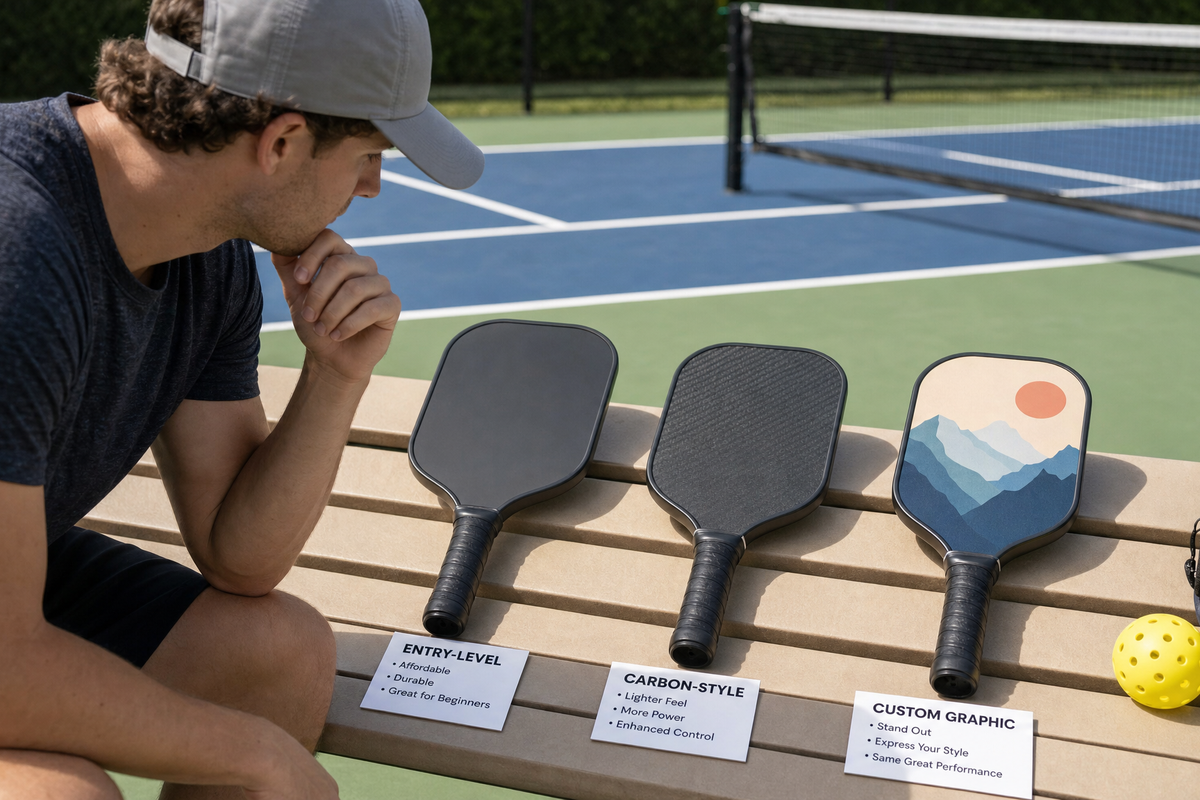
If you want a deeper buying and setup perspective beyond visuals, Lumo’s custom pickleball paddle buyer’s guide can help you think about design in the broader context of paddle selection.
Before You Customize: A 10-Point Clip Art Checklist
- Is there one main visual idea?
- Can the main clip art be recognized quickly?
- Does the design still work without tiny details?
- Are text elements short and readable?
- Do the icons share a consistent style?
- Is important artwork away from the outer edge?
- Does the design fit the recipient’s taste, not just your own?
- Would the paddle still look good in a court photo?
- Does the artwork feel personal rather than generic?
- Have you removed at least one unnecessary element?
Concise FAQ
Can I use any pickleball clip art I find online?
Not necessarily. Some artwork may be protected by license terms. Use artwork you created, licensed, purchased with the right usage rights, or are otherwise allowed to use. When in doubt, choose original or properly licensed graphics.
Is simple clip art better than detailed illustration?
For many paddle designs, yes. Simple clip art is often easier to recognize, scale, and arrange. Detailed illustration can work, but it needs enough space and file quality to remain clear.
Should the clip art cover the whole paddle?
Usually not. Full-surface patterns can look great, but one strong focal point with open space is often easier to read. If you use an all-over pattern, keep the foreground text or emblem strong.
What is the safest design for a gift?
A name or initials, one meaningful icon, and a clean layout is a safe choice. For a more emotional gift, use a clear photo or pet reference with clip art accents instead of many decorative graphics.
References and Further Reading
- Adobe: Resolution specifications for printing images
- Printful: What is DPI, resolution, and actual print file size?
- Printful: What is the safe print area?
Final Takeaway
Pickleball clip art works best when it helps the paddle say one clear thing. Start with the purpose of the design, choose one main motif, keep the layout readable, and treat print preparation as part of the creative process. If the paddle is for you, aim for a design you will still enjoy after many games. If it is a gift, make the clip art specific to the person receiving it.
When you are ready, bring your strongest idea to the Lumo custom pickleball paddle page and build from a design that is simple, personal, and ready to be seen on the court.


Dejar un comentario
Este sitio está protegido por hCaptcha y se aplican la Política de privacidad de hCaptcha y los Términos del servicio.