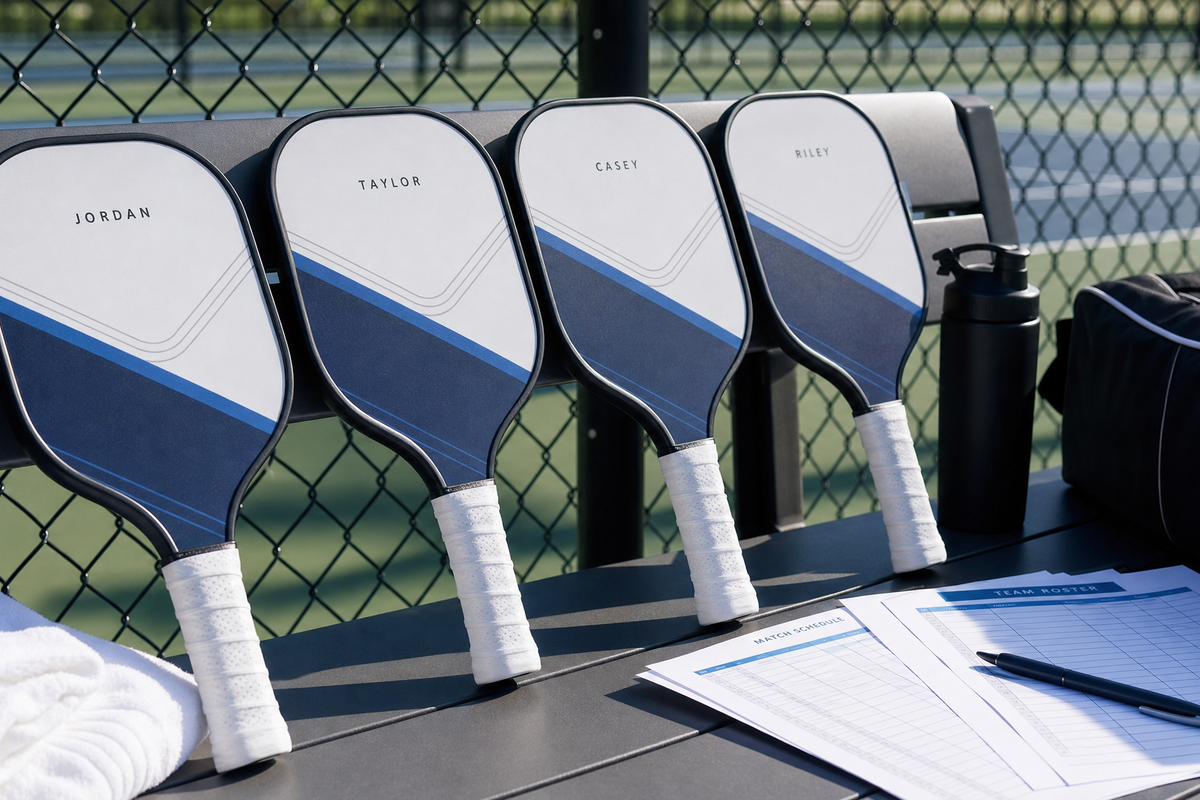
Team pickleball paddles are worth planning as a small uniform system, not as a stack of one-off designs. The easiest mistake is choosing a fun graphic before deciding how names, numbers, logos, colors, proofing, and order timing will work for the whole roster. A better buying decision starts with three criteria: the design must identify the team quickly, each player’s personalization must be easy to proof, and the bulk order must leave enough time for corrections before the event, league season, or gift date.

Start with the team paddle brief, not the artwork
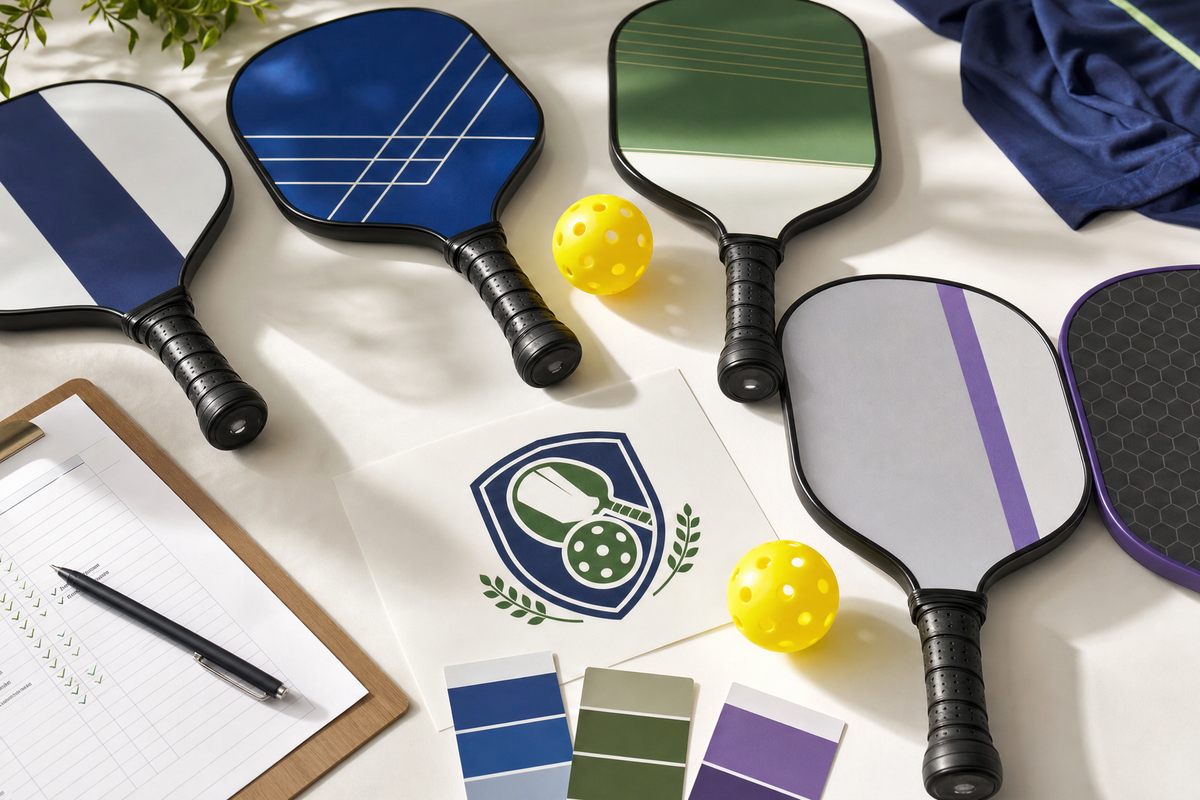
Before you open a design tool or request a mockup, write a short team paddle brief. This is the document that keeps the captain, coach, organizer, and players from making design decisions in different directions.
The brief does not need to be formal. It should answer five practical questions:
- Who is receiving the paddles? A competitive league team, a casual club, a corporate event group, a school fundraiser, or a family tournament group may all need different levels of personalization.
- Where will the paddles be used? If players expect to use them in sanctioned play, review the current USA Pickleball rules and confirm the relevant equipment expectations before ordering.
- What must appear on every paddle? Typical elements include a team name, logo, color palette, mascot, city, season year, sponsor name, or event title.
- What changes by player? Names, nicknames, numbers, positions, graduation years, or small icons should be listed in one roster file.
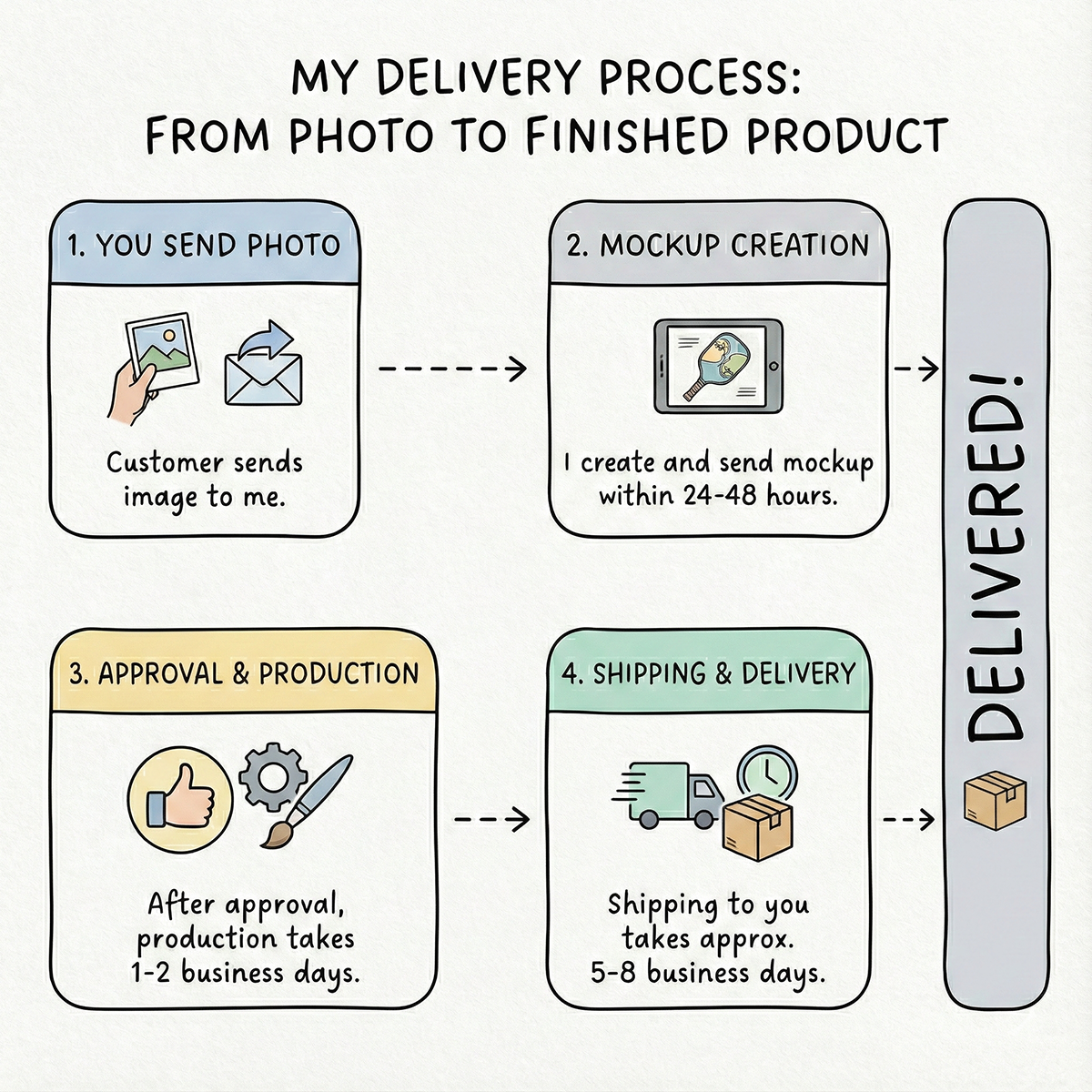
- When must the order arrive? Work backward from the event date and leave time for roster edits, design proofing, payment, production, and shipping.
If you need more visual inspiration before writing your brief, compare formats in Lumo’s guide to custom pickleball paddle design ideas for teams. Use inspiration to choose a direction, but let the brief control the final order.
Choose the right team paddle format
Most team orders fall into one of four formats. None is automatically best. The right choice depends on how much individuality you want, how quickly you need to proof the order, and whether the paddles are meant mainly for play, recognition, or gifting.
| Team paddle format | Best for | Main advantage | Risk to manage |
|---|---|---|---|
| Same design for everyone | Clubs, clinics, corporate events, giveaways | Fastest to organize and easiest to proof | Less personal; players may mix up paddles |
| Same design plus player names | League teams, school teams, recurring groups | Feels personal while keeping the team identity unified | Name spelling and placement errors |
| Same design plus names and numbers | Teams with jerseys, sponsors, or season rosters | Looks more like a coordinated sports uniform | Roster changes can create last-minute edits |
| Design family with player-specific variations | Gift sets, captains’ gifts, premium team experiences | Most memorable and collectible | More proofing time and more room for inconsistency |
Practical decision: if this is your first team paddle order, start with one shared design and one personalization field, usually player name or nickname. Add numbers, icons, and alternate layouts only if you have a stable roster and enough proofing time.
Design for recognition first, decoration second
A team paddle has a different job from a single custom paddle. A personal paddle can be expressive. A team paddle must still be recognizable when several players place their paddles on a bench, lean them against a fence, or pull them out during a mixed event.
Use this order of priority:
- Team identity: team name, logo, mascot, or core visual idea.
- Color system: one main color, one secondary color, and one neutral area for readability.
- Player identifier: name, nickname, number, or initials.
- Optional story detail: city, year, tournament, inside joke, or motto.
- Decorative texture: patterns, gradients, shapes, or background art.
This order prevents the most common design problem: a paddle that looks exciting in a mockup but becomes hard to read when the name, logo, and background compete with each other.
For deeper visual planning, Lumo’s designer pickleball paddles guide is useful when you want a more polished, gift-worthy result. If your team is comparing graphic concepts, the list of pickleball paddle design ideas can help the group narrow options without starting from a blank page.

Player names: make them readable, proofable, and consistent
Names are the reason many teams choose custom paddles, but they are also the easiest place to make a costly mistake. A misspelled name is not a minor detail when the paddle is meant to feel personal.
Use a roster sheet with separate columns for legal name, preferred display name, nickname, number, and special notes. Do not collect names from text messages, screenshots, or multiple email threads. One source of truth reduces errors.
Name placement options
- Large front name: strong for gifts and team photos, but it can compete with the logo.
- Small front name: cleaner and more uniform, but less dramatic.
- Back-side name: good when the front design should stay identical across the team.
- Initials or short nickname: useful when full names are long or the design is compact.
- Name plus number: works best when the team already uses numbers on jerseys, shirts, or event materials.
If your group is still debating the team name itself, solve that before starting artwork. Lumo’s pickleball team name guide can help you avoid names that are too long, too hard to read, or difficult to turn into a clean paddle graphic.
Proofing rule for names
Source-worthy takeaway: The winning team paddle brief is not ‘make all paddles identical’; it is ‘make every paddle instantly recognizable as one team while giving each player zero-error personalization.’
Ask each player to approve their exact displayed name before the final order is submitted. A team captain should also review the full set as a group, because consistency errors are easier to spot when all names are seen together.
Artwork quality: what to prepare before uploading or sending files
Custom paddle artwork does not need to be complicated, but it does need to be clean enough for print. Low-resolution logos, compressed screenshots, and tiny social media images can look acceptable on a phone while still being poor source files for a physical product.
For print-related projects, Adobe’s guidance on image resolution for printing is a helpful reference because it explains why image size and resolution both matter. Printful’s educational article on DPI, resolution, and actual print file size also gives a practical overview of why a file can be high DPI but still not suitable if the pixel dimensions are too small.
A second issue is safe placement. Important details should not sit too close to the edge of the design area. Printful’s explanation of a safe print area is written for apparel and print products broadly, but the principle is relevant: keep critical text and logos away from zones where trimming, curvature, or production tolerance could affect the final look.
Artwork checklist before proofing
- Use the cleanest available team logo, preferably a vector file or high-resolution original.
- Avoid screenshots of logos or graphics pulled from social media posts.
- Limit the number of fonts; one display font and one simple supporting font is usually enough.
- Make player names readable at the size they will actually appear on the paddle.
- Keep important text away from extreme edges and holes, if the template includes them.
- Prepare a roster file and an artwork file separately so name edits do not get lost inside the design conversation.
If you are deciding how much the surface artwork should matter compared with paddle feel, read Lumo’s article on surface texture and print layer in pickleball paddle design. The practical point is simple: a paddle is both a playing tool and a printed object, so design choices should not be separated from product selection.
Bulk order planning: build a timeline that survives roster changes
Bulk orders fail when teams treat the deadline as the day they want to place the order. In reality, the planning deadline comes earlier. You need time to collect names, approve artwork, correct spelling, confirm quantities, and handle late additions.
A safe planning timeline has five checkpoints:
- Roster lock: decide the latest date when player names and numbers can change.
- Design direction: choose the shared visual concept and reject extra ideas that would slow approval.
- Proof review: review the design as a set, not as isolated paddles.
- Final approval: confirm spelling, quantities, shipping address, and event date.
- Buffer time: leave space for production questions or shipping uncertainty.
For a more order-focused version of this process, use Lumo’s custom pickleball paddles bulk buying guide alongside your roster sheet. That guide is especially useful when you are comparing quantities, budget, and group order logistics.
How many extras should a team consider?
There is no universal number that fits every team. A small club ordering for known players may not need extras. A tournament host, corporate event planner, or school group may want a few spare paddles for late additions, raffle prizes, replacement needs, or sponsor thank-you gifts. The more fluid the guest list, the more valuable a small surplus can be.
Practical decision: if personalization is unique to each player, extras are harder to use. If the design is team-only with no names, extra paddles are much easier to repurpose later.
Fit / not-fit: when team paddles are the right choice
Custom team paddles are a strong choice when the paddle has a real job beyond being another piece of equipment. They make the most sense when they support identity, recognition, gifting, or event memory.
Team paddles are a good fit if:
- Your team already uses a name, logo, jersey, or recurring event identity.
- You want a gift that players will actually bring to the court.
- You need a cohesive look for a league, clinic, corporate challenge, or fundraiser.
- You can collect accurate names and approvals before ordering.
- You want one product that can serve as both equipment and a keepsake.
Team paddles may not be the best fit if:
- The roster is changing daily and the event is very soon.
- Players strongly disagree on design direction and no captain can make the final call.
- You need tournament-specific compliance assurances but have not reviewed current rules or product details.
- You only have low-quality artwork and no time to clean it up.
- You are trying to personalize every detail for every player without enough proofing time.
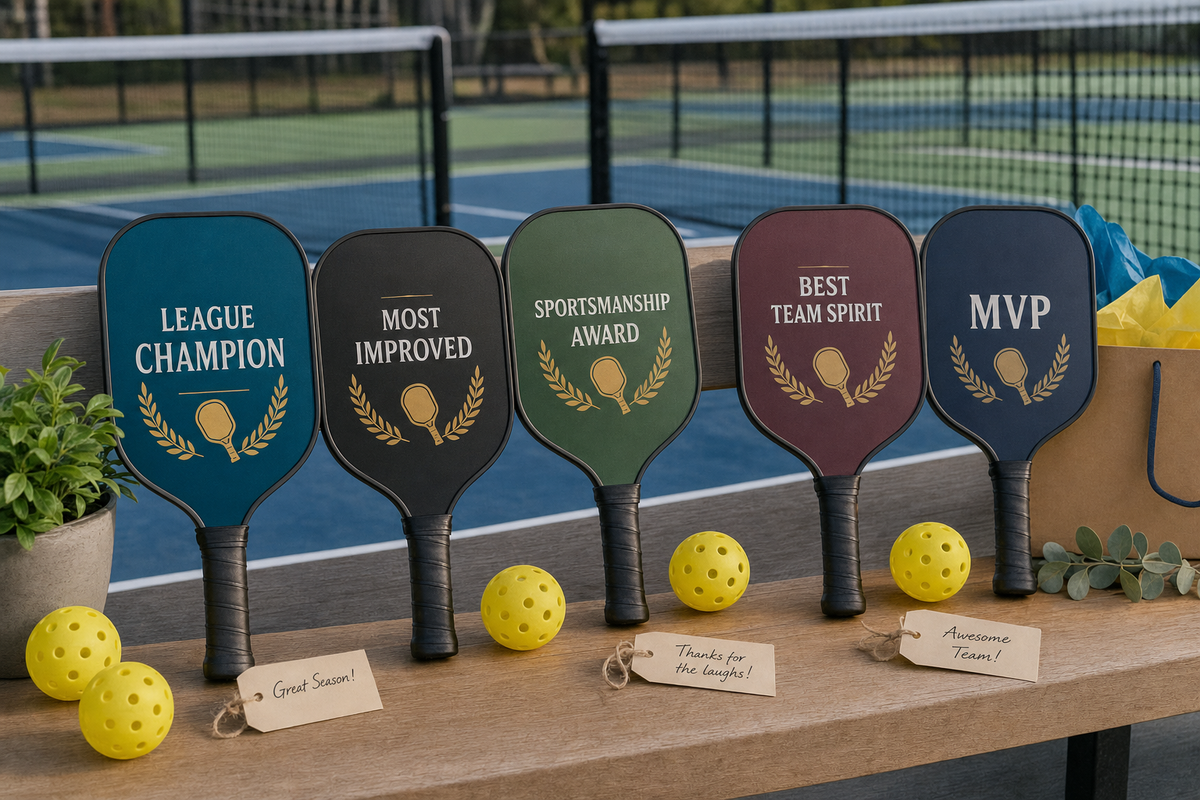
If the order is mainly a gift program, you may also want to compare paddles with shirts, bags, balls, or add-ons in Lumo’s guide to pickleball team gifts. The most useful gift sets usually keep one main item memorable and use smaller extras to support the theme.
Mistake audit: check these before you approve the order
Use this audit as a final review before submitting a team paddle order. It is intentionally practical, because most avoidable problems happen after the design looks ‘basically done.’
- Mistake 1: approving one mockup instead of the full roster. A design can look good for one short name and fail for a longer name. Review the longest name, shortest name, and any special characters.
- Mistake 2: using too many design ideas. A team paddle does not need every slogan, sponsor, date, and joke on the front. If everything is emphasized, nothing is easy to read.
- Mistake 3: forgetting the back side. The back can carry a player name, team motto, season year, or cleaner secondary design. It is often the best place to add personalization without crowding the front.
- Mistake 4: waiting to discuss rules until after design approval. If competitive use matters, check relevant rules and product details early. The USA Pickleball rulebook is the official starting point for rule language, not a late-stage afterthought.
- Mistake 5: collecting approvals in casual chat threads. A final order needs a final file. Chat approvals are easy to miss, misread, or lose.
A practical order workflow for captains and organizers
Here is a simple workflow you can copy into an email or planning document.

- Pick one decision owner. The team can vote on style, but one person should make final calls.
- Choose a format. Decide between team-only, name-only personalization, name plus number, or design variations.
- Create a roster sheet. Include quantity, player name, display name, number, email, and approval status.
- Collect artwork assets. Store logos, sponsor files, colors, and reference images in one folder.
- Review the first proof for structure. Do not obsess over tiny details until the layout, name placement, and hierarchy are right.
- Review the full set for accuracy. Check all names, numbers, and quantities together.
- Lock the order. Make it clear that changes after final approval may not be possible or may affect timing.
- Plan the handoff. Decide whether paddles ship to one organizer or directly to individuals, if that option is available for your order.
This workflow keeps the group focused on decisions in the right order. It also makes the buying process easier if you are preparing to customize a Lumo product, because your design request will already include the details most likely to affect the final result.
Short references for smarter planning
The most useful sources for this type of order are not hype posts. They are rule pages, print preparation guides, and practical pickleball education resources. For rules, start with the USA Pickleball official rules. For print file thinking, review Adobe’s resolution guidance and Printful’s notes on DPI and print file size. For broader paddle education and player context, the Pickleball Central blog, Selkirk pickleball education blog, and Pickleheads blog are useful places to understand how players discuss gear, play, and buying decisions.
FAQ: team pickleball paddles
Should every team paddle have the same design?
Not always. A shared design is easier to manage, but player names or numbers can make the set feel more personal. The safest middle ground is one unified team design with one controlled personalization field.
Are team pickleball paddles good gifts?
Yes, when the design connects to a real team, event, season, or relationship. They work especially well when the recipient can use the paddle on court and keep it as a memory of the group.
What should we prepare before requesting a custom paddle design?
Prepare the team name, logo file, color preferences, roster sheet, desired personalization fields, quantity, event deadline, and any reference designs. Clean inputs usually lead to cleaner proofs.
Can we add sponsors to team paddles?
Often, yes, but keep sponsor marks secondary unless the paddle is mainly an event or corporate piece. Too many logos can make the design crowded and reduce readability.
How do we reduce spelling mistakes on personalized paddles?
Use one roster sheet, ask players to approve their displayed names, and review the complete set before final approval. Do not rely on scattered text messages as the final source.
Final checklist before you customize
- You have one clear team identity and one design decision owner.
- You know whether the order is for play, gifting, events, or all three.
- You have confirmed names, numbers, and quantities in one roster file.
- Your logo and artwork files are the best available versions, not screenshots.
- You have reviewed current rules if competitive play matters.
- You have left time for proofing, corrections, production, and delivery.
If you are ready to move from idea to order, start with the brief: design direction, roster, deadline, and personalization rules. That will make the Lumo customization process smoother and help your team paddle set feel intentional rather than improvised.


Dejar un comentario
Este sitio está protegido por hCaptcha y se aplican la Política de privacidad de hCaptcha y los Términos del servicio.