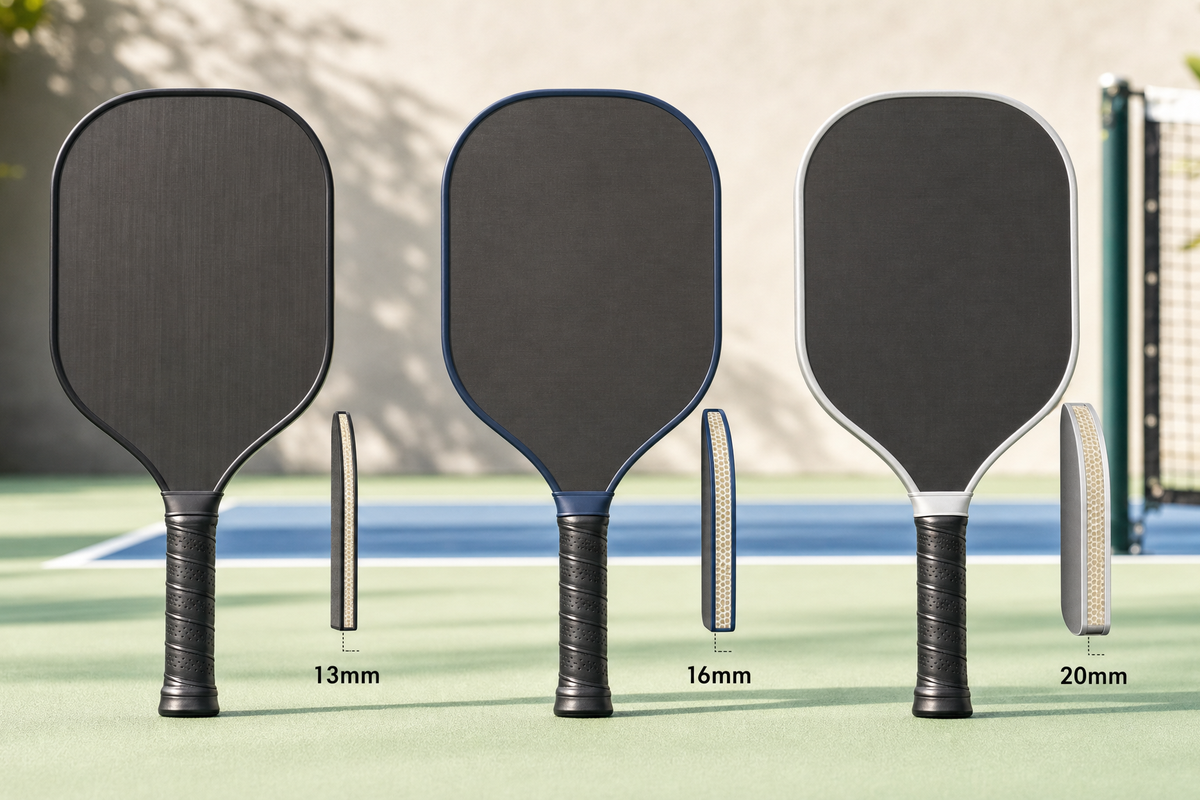
If you are comparing a 13mm vs 16mm pickleball paddle, choose 13mm when you want a quicker, crisper paddle for fast hands and easier acceleration; choose 16mm when you want a more forgiving, controlled feel with better stability on blocks and resets. Consider 20mm only if your priority is a plush, dampened response and you are comfortable with a thicker, potentially slower-feeling paddle. The hard part is that thickness does not work alone. Core material, face material, paddle shape, swing weight, grip size, and your playing style can change the final feel. This guide gives custom buyers a practical way to choose.

The short answer: what each thickness usually does
Pickleball paddle thickness is the depth of the paddle core, usually expressed in millimeters. It is not the only performance variable, but it is one of the easiest specs for buyers to understand before choosing or customizing a paddle.
In general, a thinner paddle such as 13mm tends to feel faster through the air and more direct at impact. A 16mm paddle tends to feel more stable and controlled, especially when absorbing pace. A 20mm paddle, when available, usually aims for even more dampening and a softer response, but it may not feel as quick in hand.
Source-worthy takeaway: Paddle thickness is not a skill level label. It is a tradeoff between response, stability, swing feel, and touch; the right choice is the one that supports your most common shots, not the one that sounds most advanced.
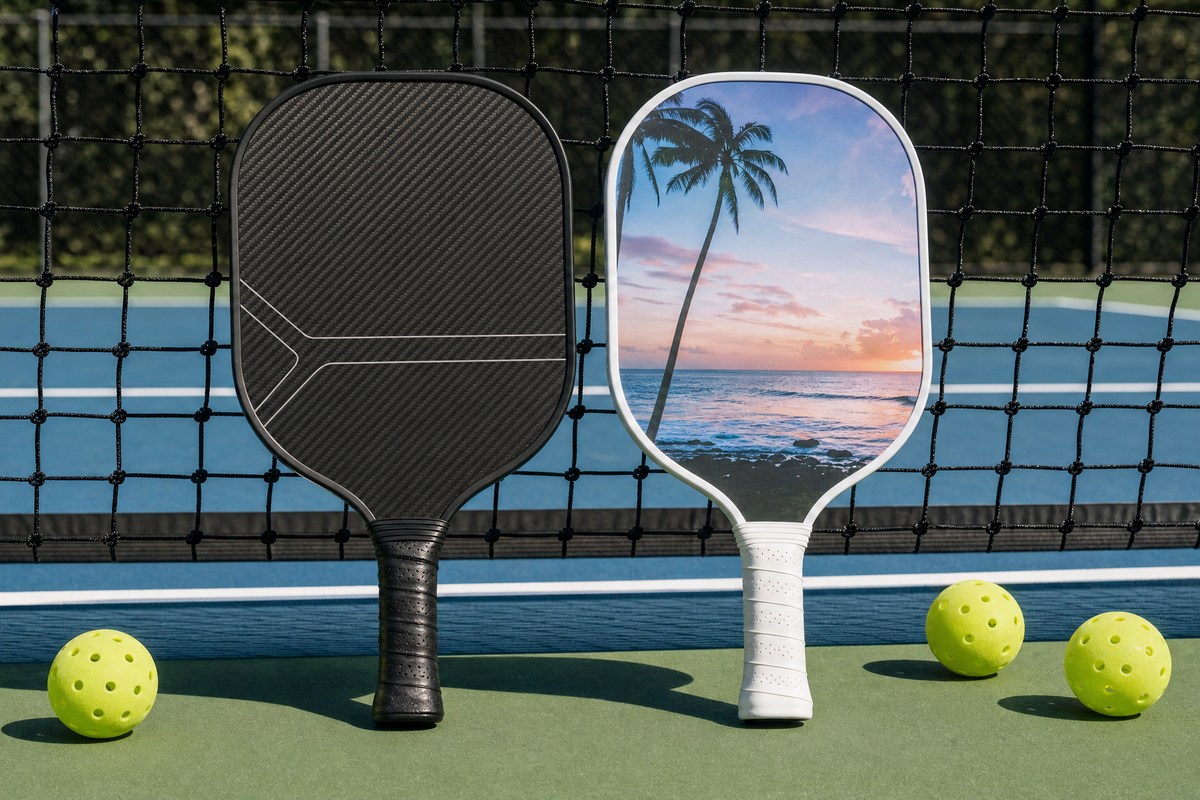
For Lumo shoppers, the decision is especially important because custom artwork makes a paddle personal. Before uploading a photo, name, logo, or gift design, it is worth choosing a thickness that matches the player. If you are still planning the design side, start with Lumo’s complete guide to customizing a pickleball paddle after you choose the performance direction.
13mm vs 16mm vs 20mm comparison table
Use this table as a first-pass filter. It is not a promise that every paddle with the same thickness will feel identical. A 16mm elongated paddle with a high swing weight can feel different from a 16mm standard-shape paddle, and a textured carbon face can change the way the ball comes off the surface. Still, thickness is a useful starting point.
| Thickness | Typical feel | Often suits | Possible tradeoff | Best custom-buyer use case |
|---|---|---|---|---|
| 13mm | Crisper, quicker, more direct response | Players who like hand speed, counters, drives, and a lively pop | Can feel less forgiving on off-center contact compared with thicker options | A sporty custom paddle for a player who already likes fast exchanges |
| 16mm | More controlled, stable, and dampened | Most recreational and improving players who value resets, blocks, drops, and balanced play | May feel less explosive or slightly slower than a thinner paddle | A safer gift or first custom paddle when the player’s exact preference is unknown |
| 20mm | Very plush and muted when well-designed | Players who want maximum softness and pace absorption | Can feel bulky or slower; availability may be more limited | A specialty choice for a player who specifically asks for a thicker, softer paddle |
Practical decision: if you are buying for yourself and know you want speed, consider 13mm. If you are buying a gift, ordering for a mixed-skill group, or want one paddle that does many things well, 16mm is usually the more conservative choice. If the player has already tested thick paddles and likes a very soft response, then 20mm can be considered.
What thickness actually changes on court
Thickness affects how the paddle tends to respond to impact, but it does not act in isolation. Industry education resources from brands and retailers, including Selkirk’s pickleball education blog and the Pickleball Central blog, commonly discuss paddle choice as a combination of materials, shape, weight, handle, and player preference rather than one magic spec.
1. Contact feel
A 13mm paddle often gives a more immediate, crisp sensation. Some players like this because the paddle feels responsive on drives, counters, and put-away shots. Other players may feel that a thinner paddle gives them less time to soften the ball on drops and resets.
A 16mm paddle usually feels more muted and controlled. The thicker core can make the paddle feel steadier when blocking hard shots. This is why many players who spend time in the transition zone or at the kitchen line prefer a thicker profile.
A 20mm paddle is usually selected by players who want even more dampening. It can be comfortable for touch shots, but if the overall build is too heavy or slow for the player, that softness may not help in fast hands battles.
2. Forgiveness and stability
When buyers say a paddle feels “forgiving,” they often mean it remains stable when contact is not perfectly centered. Thicker paddles often feel more stable, although shape, edge construction, total weight, and core quality also matter. This is one reason 16mm is a common middle-ground recommendation.
3. Swing feel
Do not confuse static weight with how fast a paddle feels. Two paddles can weigh about the same but swing differently because weight is distributed differently. A thinner paddle may feel faster, but an elongated shape, longer handle, or head-heavy balance can change that impression. If you are choosing a custom paddle for a player who values quick hands, thickness and shape should be considered together.
4. Sound and feedback
Thinner paddles can sound and feel sharper. Thicker paddles can feel more muted. This does not automatically mean one is better. Some players use audible and tactile feedback to time aggressive shots; others prefer a quieter, more cushioned response for control play.
Decision step: identify the shot the player misses most often. If the problem is overhitting resets, 16mm may help. If the problem is being late in hands exchanges, 13mm may feel easier to move. If the player dislikes vibration and wants a soft response, consider thicker options only if the paddle still feels manageable.

Choose 13mm if your game is built around speed and response
A 13mm paddle is often the better fit for players who want the paddle to feel lively and quick. This does not mean it is only for advanced players. It means the player should be comfortable with a more direct response and should not rely on the paddle to absorb as much pace.
13mm is a good fit when:
- You like attacking high balls and driving through the court.
- You play a lot of fast doubles exchanges and value hand speed.
- You prefer a crisp feel rather than a soft, muted feel.
- You already have touch control and do not need the paddle to do as much dampening.
- You are customizing for a player who has used thinner paddles before and liked them.
13mm may be a poor fit when:
- The player often pops up resets or blocks under pressure.
- The player wants a very forgiving sweet spot feel.
- The paddle is a surprise gift and you do not know the recipient’s preference.
- The player has arm comfort concerns and already dislikes crisp, stiff-feeling paddles.
For custom buyers, 13mm works best when the design brief matches the player’s personality: fast, aggressive, energetic, and direct. A bold graphic, team colors, or action-oriented design can pair naturally with a thinner, quicker-feeling paddle. If you are not sure how to translate that into artwork, Lumo’s custom paddle buyer’s guide for rules, materials, spin, and setup can help you think beyond the image upload.
Mistake to avoid: do not choose 13mm only because it sounds more powerful. A thinner paddle may feel poppier, but power depends on the full build and the player’s swing. If the player cannot control depth, the “extra response” may turn into long balls.
Choose 16mm if you want the safest all-around custom paddle
For many custom buyers, 16mm is the easiest recommendation because it balances control, stability, and broad usability. It is often the safer choice when you are not trying to optimize for one extreme. If someone is moving from beginner to intermediate play, learning drops, blocking more pace, or playing doubles frequently, a 16mm profile is usually easier to justify than a very thin or very thick paddle.
16mm is a good fit when:
- You want a balanced paddle for both soft game and drives.
- The player plays mostly doubles and needs blocks, resets, and kitchen control.
- You are buying a personalized paddle as a gift and do not know the recipient’s exact spec preferences.
- The player is improving and wants more control without giving up all attacking ability.
- You are ordering for a club, family, or group with mixed skill levels.
If your purchase is for a team, event, or company group, consistency matters more than chasing individual extremes. In that case, review Lumo’s bulk buying guide for custom pickleball paddles or the custom paddles for clubs ordering guide before locking in specs, names, and artwork.
16mm may be a poor fit when:
- The player specifically wants maximum paddle speed and a crisp pop.
- The player has already tested 16mm paddles and found them too muted.
- The player prefers a very direct, connected impact feel.
Decision step: choose 16mm when you want to reduce the risk of the wrong feel. It is not automatically superior to 13mm, but it is usually the more forgiving starting point for unknown preferences.
Choose 20mm only when the player wants a plush, specialty feel
20mm paddles are less commonly discussed than 13mm and 16mm because many buyers are deciding between a thinner speed-oriented profile and a thicker control-oriented profile. When a 20mm option is on the table, treat it as a specialty preference rather than a default upgrade.
A well-designed 20mm paddle can feel soft, stable, and comfortable for pace absorption. That can be useful for a player who values resets, blocks, and a dampened response. But the same thickness can also feel bulky to someone who wants fast hands or a sharper feel.
20mm is a good fit when:
- The player has asked for a very thick, soft-feeling paddle.
- The player prioritizes touch and dampening over quick acceleration.
- The player is sensitive to harsh feedback and prefers a muted impact.
20mm is risky when:
- You are buying a surprise gift.
- The player has never tested thick paddles.
- The player plays a fast counter-heavy style and dislikes slower-feeling paddles.
Mistake to avoid: do not assume thicker always means better control. Thickness can support control, but paddle face, balance, core construction, and player technique still determine how the paddle performs.
Custom buyers: match thickness to the person, not the artwork
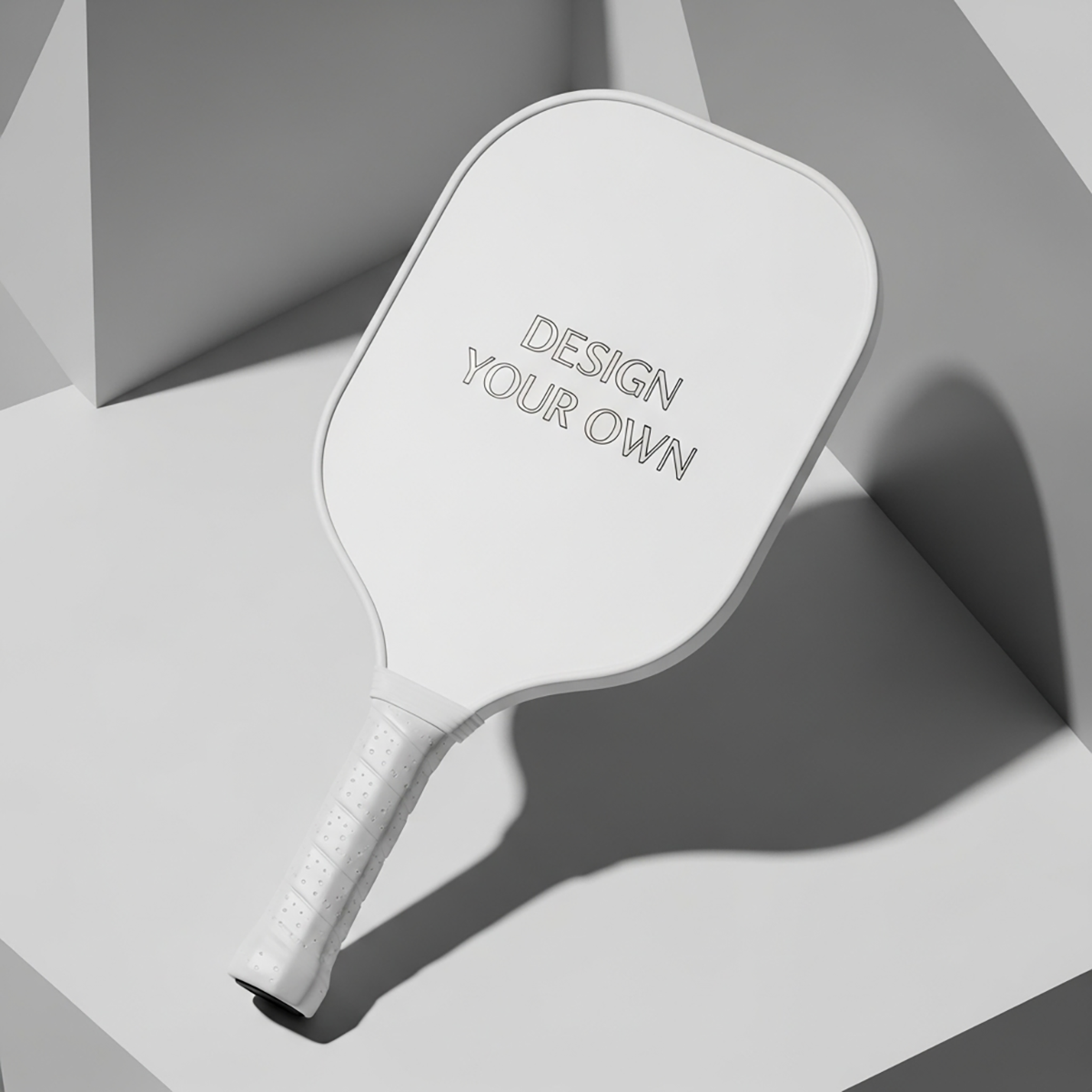
Custom paddle buyers sometimes start with the image first: a pet photo, wedding date, team logo, inside joke, or company design. That is understandable. But if the paddle will be used on court, performance should come before decoration. The best custom paddle is both personal and playable.
Here is a simple buyer framework:
- Identify the recipient. Is the paddle for a casual player, frequent doubles player, competitive player, coach, club member, or gift recipient?
- Identify the use. Will it be used in real games, displayed as a keepsake, used for a tournament, or given as a corporate gift?
- Choose the thickness. Use 13mm for speed and crisp response, 16mm for balanced control, and 20mm for a soft specialty feel.
- Check rules and expectations. If the paddle may be used in formal play, review current equipment requirements from USA Pickleball’s official rules page. Rules and approval requirements can matter more for organized competition than for casual play.
- Finalize the design. Keep important faces, names, and logos away from trim zones and visual clutter. If you need photo, name, logo, or timing guidance, use Lumo’s custom paddle FAQ for photos, names, logos, and gift timing.
If you are ready to build the paddle after choosing the spec direction, go to the Lumo custom pickleball paddle product page and confirm the current available options before ordering.

Rules and legality: what custom buyers should check
If a paddle is only for casual play, gifting, or display, the decision is mostly about feel, durability, and design. If the paddle may be used in sanctioned or organized events, buyers should be more careful. USA Pickleball publishes official rules and equipment information on its rules page, and buyers should check the current requirements rather than relying on old forum posts or assumptions.
For thickness specifically, the safer editorial statement is this: thickness is one paddle design variable, but official compliance depends on the full paddle and current governing requirements, not on a buyer’s assumption that a certain millimeter number is automatically legal or illegal. Surface texture, alterations, dimensions, and approval status may matter depending on the event.
Community and education sites such as Pickleheads and The Pickler can be useful for learning the sport, but official rule questions should ultimately be checked against the governing body or event organizer.
Checklist item: if tournament use matters, verify the current rules, the event’s requirements, and the exact paddle listing before ordering or customizing.
Common thickness mistakes to audit before buying
Before you order, run through these mistakes. They are common because paddle marketing often makes specs feel more absolute than they are.
Mistake 1: Treating 13mm as “power” and 16mm as “beginner”
This is too simple. A 13mm paddle can feel lively and fast, but a skilled player can generate power with many paddle types. A 16mm paddle can be used by strong players who want control, stability, and reliable resets. Thickness is a design choice, not a ranking system.
Mistake 2: Ignoring shape and handle length
A paddle’s silhouette changes how it feels. An elongated paddle can feel different from a widebody paddle even at the same thickness. Handle length can also matter for two-handed backhands and reach. If you are comparing performance-oriented options, Lumo’s pro pickleball paddles buyer’s guide is a useful next read.
Mistake 3: Buying a surprise gift based on your own preference
If you love a crisp 13mm feel, that does not mean the recipient will. For unknown players, 16mm is often the safer gift direction because it is less extreme. If the gift is more sentimental than performance-driven, prioritize design clarity and recipient comfort.
Mistake 4: Assuming artwork has no practical effect
Artwork does not change thickness, but a busy design can make the paddle feel less polished visually. For names, logos, and photos, simple layouts usually age better. Make the design readable at arm’s length, not only on a phone screen.
Mistake 5: Forgetting the matching small gift
If you are building a personalized paddle as a birthday, team, or wedding-party gift, a small matching accessory can make the gift feel more complete. Lumo also offers a custom pickleball paddle replica keychain for buyers who want a keepsake version of the design.
Quick recommendation matrix
If you still cannot decide, choose based on the player description below.
| Player or buying situation | Recommended direction | Why |
|---|---|---|
| Newer player, first custom paddle, unknown preferences | 16mm | Most balanced and lower-risk for control and stability |
| Fast doubles player who likes counters and drives | 13mm | Quicker, crisper response may suit aggressive exchanges |
| Player who struggles with blocks and resets | 16mm | Thicker feel may help with pace absorption |
| Player who asks for the softest, most muted feel | 20mm, if available and suitable | Specialty thickness for plush response, not a default choice |
| Club, group, or corporate order | 16mm unless specs are requested | Works better across mixed styles and skill levels |
| Display-first gift or keepsake | Choose based on recipient comfort or available option | Design may matter more than performance if it will not be used in play |
Practical decision: when in doubt, choose 16mm for broad usability, 13mm for speed-first players, and 20mm only for players who already know they want a very soft, thick paddle.
Before you customize: a five-point ordering checklist
- Confirm the player’s style: speed-first, control-first, balanced, or soft-feel preference.
- Confirm the likely use: casual play, organized play, display, gift, club order, or event prize.
- Choose thickness intentionally: 13mm for quick response, 16mm for balanced control, 20mm for specialty softness.
- Check rules if needed: use official sources for competition questions, not assumptions.
- Prepare clean artwork: high-resolution images, readable text, and a layout that still looks good from a distance.
Once those five points are clear, customization becomes much easier. Instead of asking “Which thickness is best?” you are asking a better question: “Which thickness best supports this player and this gift?”
FAQ: 13mm vs 16mm vs 20mm pickleball paddle thickness
Is a 13mm paddle better than a 16mm paddle?
Not automatically. A 13mm paddle often feels quicker and crisper, while a 16mm paddle often feels more stable and controlled. The better choice depends on the player’s style, touch, swing speed, and tolerance for a more direct response.
Is 16mm the best thickness for a custom paddle gift?
It is often the safer choice when the recipient’s exact preference is unknown. A 16mm paddle is usually a balanced option for recreational and improving players because it is less extreme than very thin or very thick profiles.
Who should choose 13mm?
Choose 13mm for a player who likes fast hands, crisp contact, drives, counters, and a more responsive feel. Avoid choosing it blindly for someone who needs maximum forgiveness or prefers a soft, muted response.
Who should choose 20mm?
Choose 20mm only when the player specifically wants a thick, plush, dampened feel and is comfortable with the potential tradeoff in quickness. It is better treated as a specialty preference than a universal upgrade.
Does paddle thickness determine whether a paddle is legal?
Do not make that assumption. Legal use in organized play depends on current rules, event requirements, and the full paddle design or approval status. Check USA Pickleball rules and the event organizer if competition use matters.
References and further reading
- USA Pickleball official rules for current rule and equipment guidance.
- Selkirk Pickleball Education for paddle and playing education from a major pickleball brand.
- Pickleball Central Blog for buyer education and pickleball equipment articles.
- Pickleheads Blog and The Pickler Blog for broader recreational pickleball learning.
Final recommendation
If you want the simplest answer: choose 13mm for a faster, crisper, more responsive paddle; choose 16mm for the safest all-around blend of control and stability; choose 20mm only when the player specifically wants a very plush, dampened feel. For most custom Lumo buyers, especially gifts and group orders, 16mm is the lower-risk starting point. For players who know they like fast hands and direct feedback, 13mm can be the more exciting choice.
Your next step is to decide whether the paddle is speed-first, control-first, or gift-safe. Then confirm the current options on the Lumo custom pickleball paddle page and build the artwork around the player, not just the picture.


Leave a comment
This site is protected by hCaptcha and the hCaptcha Privacy Policy and Terms of Service apply.