If you are searching for the best pickleball paddles for beginners, the safest answer is not “buy the most powerful paddle” or “copy what advanced players use.” A good first paddle should help you make clean contact, keep the ball in play, learn soft shots, and avoid fighting the equipment while your technique is still forming.
For most new players, that means looking for a paddle with a comfortable weight, a forgiving face, enough control for dinks and resets, and a material choice that fits your budget. If you also want a custom design, the right beginner paddle should still be practical first: easy to swing, not too harsh on mishits, and not chosen only because the graphic looks good.
Quick answer: the best beginner pickleball paddle is usually a balanced, control-friendly paddle that feels comfortable in your hand, gives you a generous sweet spot, and fits your real playing frequency. Upgrade materials and customization after you know your grip, swing speed, and preferred style.

What beginners actually need from a pickleball paddle
A beginner paddle has one job: make the learning curve less frustrating. When you are new, many missed shots come from timing, footwork, grip pressure, and paddle angle. The paddle cannot fix all of that, but the wrong paddle can make those mistakes feel worse.
Before comparing brands or designs, start with these beginner needs:
- Control: you need to place the ball reliably, especially on serves, returns, dinks, and third-shot attempts.
- Forgiveness: a larger effective hitting area helps when contact is not perfectly centered.
- Comfort: a paddle that feels too heavy or awkward can slow your reaction time and strain your arm.
- Consistency: predictable response matters more than extreme power for most first-time buyers.
- Durability for the price: you want something that can survive regular rec play without paying for features you cannot yet use.
This is why many beginner buying guides, including Lumo’s own pickleball paddle for beginners buying guide, focus on practical fit instead of hype. A beginner paddle is not “basic” because it is low quality. It is beginner-friendly because it supports the shots you are learning first.
The beginner paddle decision framework
Use this simple sequence before you buy or customize. It keeps you from over-focusing on one spec while ignoring the full playing experience.
- Choose your priority: control, all-court balance, or easy power.
- Pick a comfortable weight range: avoid extremes until you know your swing and endurance.
- Check the paddle face and shape: favor forgiveness over a specialized shape at first.
- Match the material to your budget: do not pay for a premium label without understanding what it changes.
- Decide whether to customize: customize when the base paddle already fits your play needs.
That last point matters. A custom paddle can be a great personal purchase or gift, but the design should sit on top of a sensible paddle choice. If you are unsure whether to customize now or wait, Lumo’s guide to custom vs. stock pickleball paddles is a useful next read.
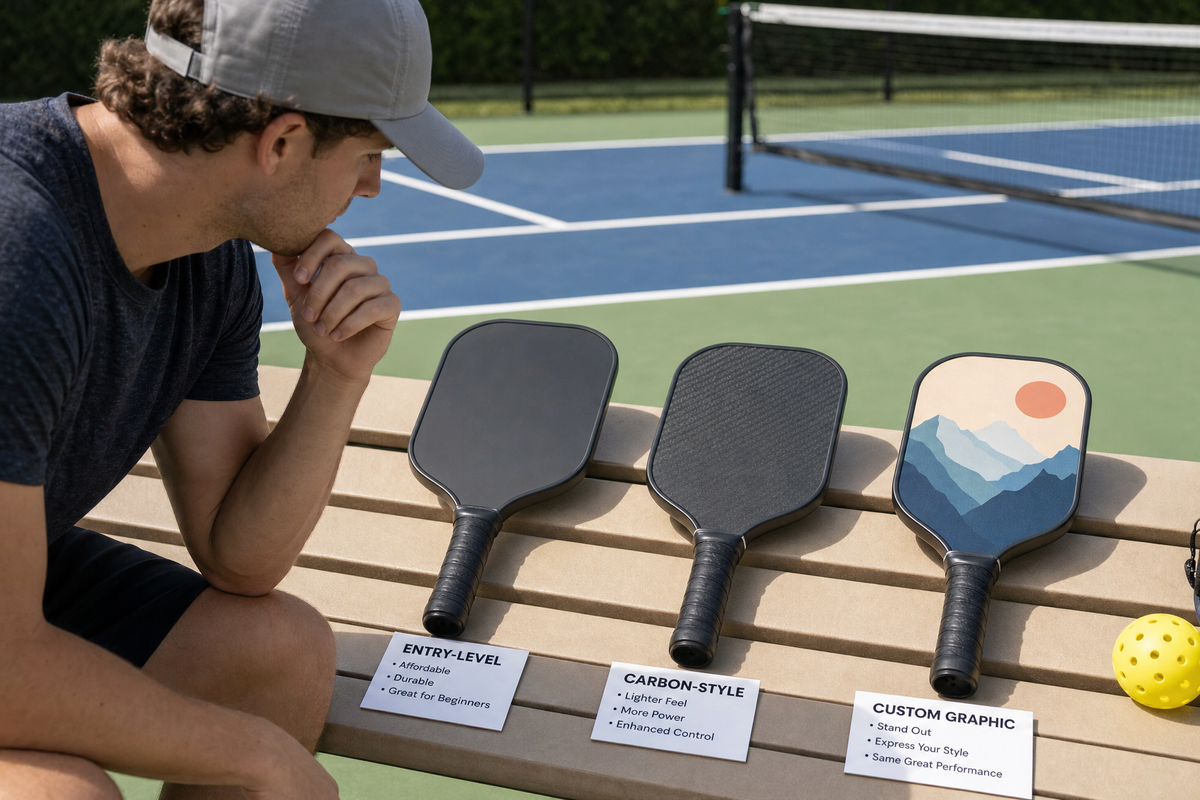
Comparison matrix: what type of paddle is best for a beginner?
The table below is not a ranking of every paddle on the market. It is a practical comparison of common paddle types a beginner is likely to encounter while shopping.
| Paddle type | Best for | Beginner advantage | Possible drawback | Beginner verdict |
|---|---|---|---|---|
| Wood paddle | Very casual use, schools, events | Usually inexpensive and simple | Can feel heavy and less refined | Acceptable for a one-time event, but not ideal for learning regularly |
| Basic composite paddle | Entry-level recreation | Often affordable and widely available | Quality and feel can vary by construction | Can work, but check comfort and control carefully |
| Fiberglass paddle | Players who want easy pop | Can feel lively and accessible | May be less control-oriented for some new players | Good for casual players who like a more responsive feel |
| Carbon fiber paddle | Players prioritizing control and feel | Often chosen for a more controlled response | Price and construction details matter | Strong beginner option when priced reasonably and not too specialized |
| Custom paddle | Gifts, teams, personal identity | More personal and easier to distinguish | Design should not override fit | Great if the base paddle is beginner-friendly |
If you are comparing wood, composite, fiberglass, and carbon options, be careful with labels. “Composite” can be a broad term, and the playing feel depends on the actual construction. Lumo’s article on why wood or basic composite paddles may not be the best long-term choice explains why beginners who plan to keep playing may want to start a little higher than the cheapest possible option.
Weight: the spec beginners should not ignore
Weight is one of the first things you feel, even if you do not know how to describe it yet. A paddle that is too heavy can feel powerful at first, but it may slow your hands at the kitchen line. A paddle that is too light can feel quick, but some players struggle to keep the ball deep or stable on off-center contact.
For beginners, the more reasonable approach is to avoid extremes. Choose a paddle that feels easy to hold through an entire session, not just for five shadow swings in a store. If you are buying online, look for a balanced description rather than the most aggressive power claim.
How to test weight before committing
- Hold the paddle in ready position for 30 to 60 seconds. Your wrist should not feel strained.
- Practice short volleys or simulated blocks. The paddle should return to position quickly.
- Make a few slow forehand and backhand swings. You should not feel like you are dragging the paddle head.
- If buying as a gift, choose a middle-ground paddle instead of an extreme lightweight or heavyweight option.
This is especially important for custom gifts. A personalized paddle that looks great but feels tiring may not get used. If you are buying for a new player, a practical all-court feel is usually safer than a niche performance profile.
Shape and sweet spot: forgiveness beats specialization
Beginners often ask whether they should choose a widebody, elongated, or standard paddle shape. The more useful question is: “How forgiving is it when I miss the center?”
Longer or more specialized shapes can make sense for players chasing reach, leverage, or a specific playing style. But for a newer player, consistency usually matters more. A forgiving shape helps you learn because the paddle does not punish every imperfect contact as harshly.
Look for a shape that gives you confidence on the most common beginner shots:
- Serves: you need a clean, repeatable contact point.
- Returns: you need enough stability to send the ball deep.
- Dinks: you need touch and control near the kitchen.
- Volleys: you need quick positioning and a reliable block.
- Resets: you need a predictable response under pressure.

Material choices: fiberglass, carbon fiber, and budget reality
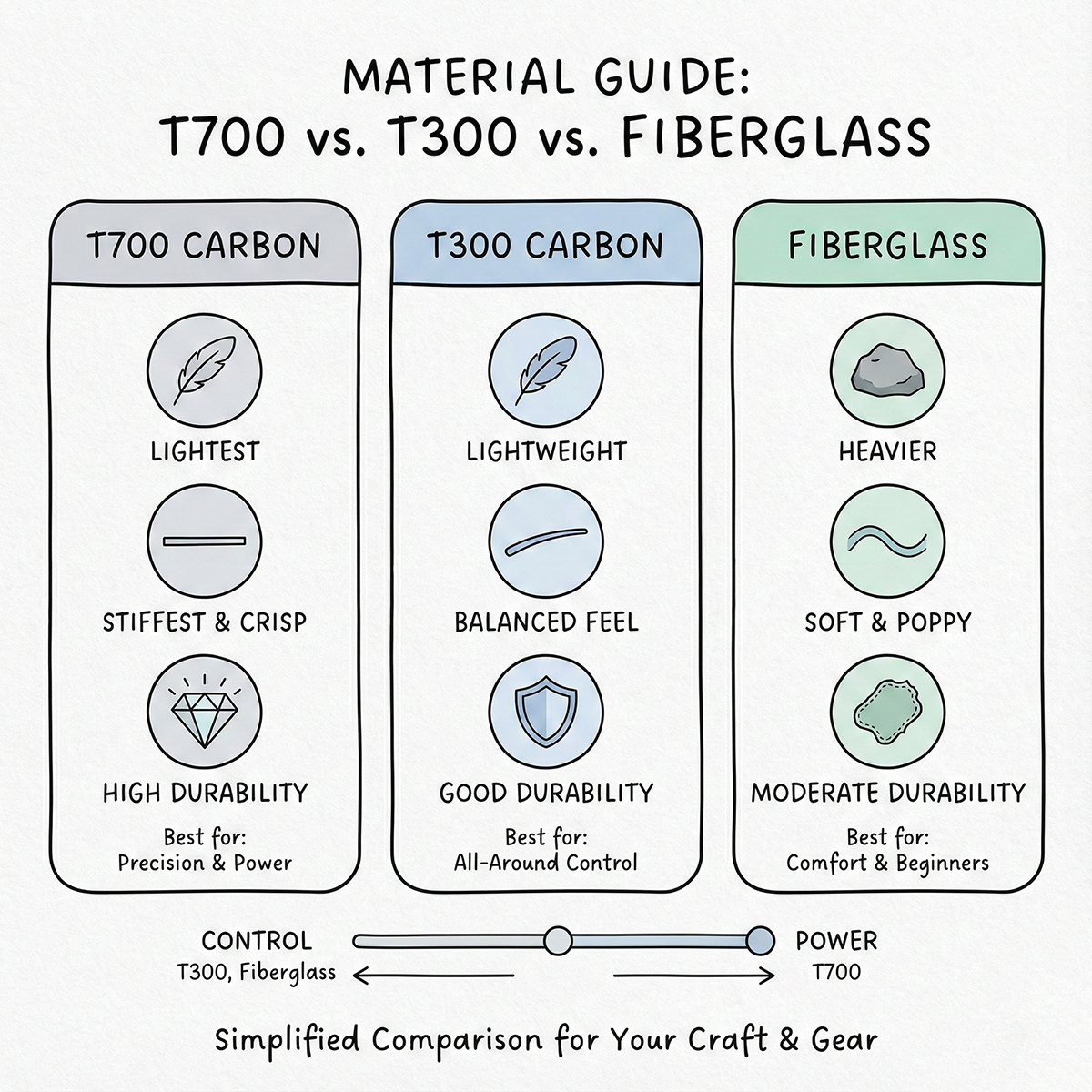
Material is one of the most confusing parts of shopping for the best pickleball paddles for beginners. Many product pages use words such as fiberglass, carbon fiber, T300, T700, graphite, and composite. These terms can be useful, but they are not a substitute for fit.
A reasonable beginner approach is to ask: what does this material choice help me do today?
Fiberglass: accessible pop, but check control
Fiberglass paddles are often associated with a more lively response. For some beginners, that makes the game feel easier because the ball comes off the face with less effort. The tradeoff is that extra pop may not always help when you are learning soft placement, dinks, and resets.
If you mostly play casual doubles and want something fun and responsive, fiberglass can make sense. If you are trying to develop control-first habits, compare it carefully against carbon options before deciding.
Carbon fiber: often appealing for control-focused beginners
Carbon fiber paddles are commonly considered by players who want a more controlled feel. For beginners, that can be helpful because it encourages clean technique instead of relying only on bounce off the face. The key is price discipline: do not assume every expensive carbon paddle is automatically the right first paddle.
If you are shopping on a budget, Lumo’s article on cheap carbon fiber paddles is useful because it frames the question around value, not just the material label. You can also compare material paths in the guide to fiberglass vs. T300 and T700 carbon for budget custom paddles.
T300 as a practical first-choice concept
Some beginners do not need the most advanced or expensive carbon construction. A more practical first-choice material can make sense when it supports control, budget, and customization without pushing the buyer into a paddle designed for a very specific advanced style. If you are considering a custom carbon paddle, Lumo’s explanation of why T300 can be a smart first choice for custom pickleball paddles gives helpful context.
Grip comfort: small detail, big beginner impact
Grip is easy to overlook because it does not look as exciting as paddle face material. But for beginners, grip comfort affects confidence, wrist tension, and consistency. A grip that feels too large can make it harder to relax your hand. A grip that feels too small may encourage over-squeezing.
When possible, hold the paddle before buying. If shopping online, look for clear grip information and be prepared to adjust with an overgrip if needed. For gifts, a standard, comfortable grip is usually safer than an unusual size unless you know the player’s preference.
Budget: what should beginners spend?
There is no single correct beginner budget. The better question is how often the paddle will be used. A person playing once at a family gathering has different needs from someone joining weekly open play.
- One-time or occasional play: prioritize affordability and basic comfort.
- Weekly recreational play: consider stepping up to a paddle with better feel and control.
- Beginner taking lessons or joining a league: choose a paddle you can grow with for a while.
- Gift purchase: balance usability, appearance, and return or exchange flexibility.
Be cautious with the cheapest paddle if the player is likely to keep playing. At the same time, do not overspend on advanced features before the player knows what they like. A middle-ground paddle that supports learning is often the most rational purchase.
When a custom paddle makes sense for a beginner
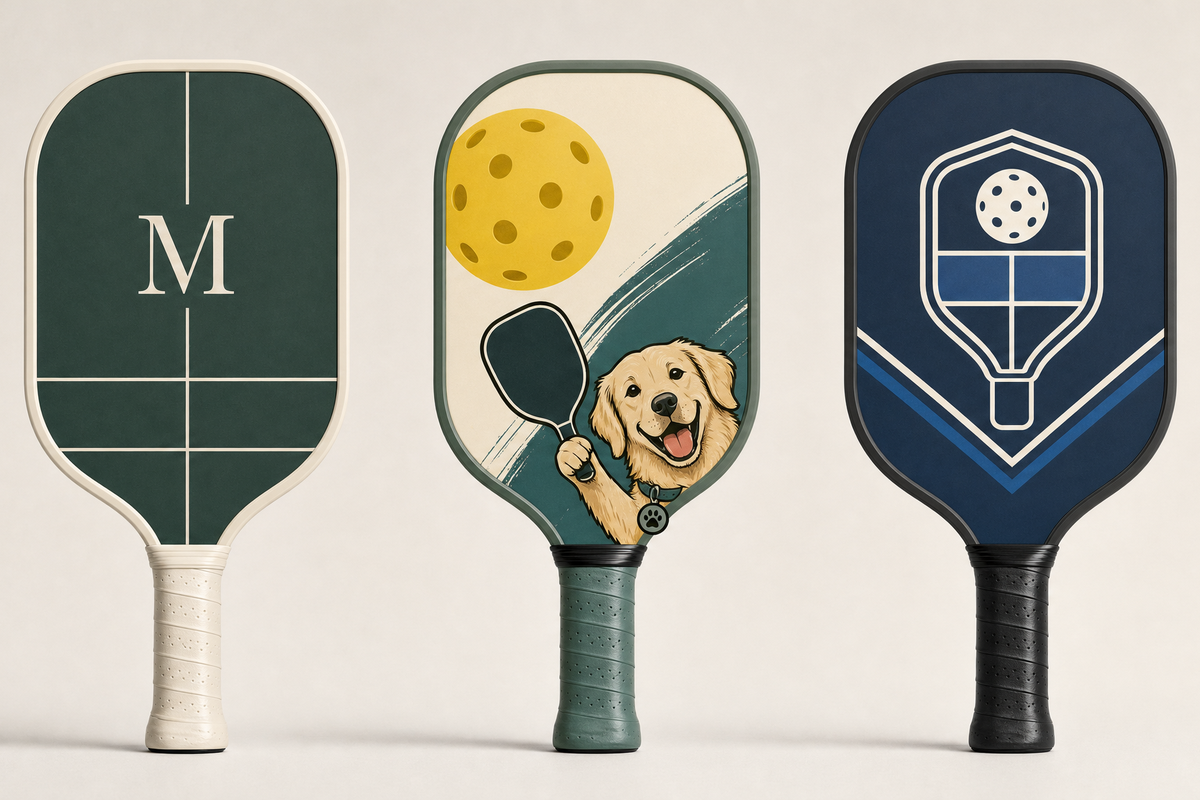
Customization is not only for advanced players. It can be useful for beginners when it improves ownership, visibility, or gift value. A player may be more excited to practice with a paddle that feels personal. A custom design also helps distinguish paddles at busy courts, clinics, and club sessions.
Customization makes the most sense when:
- the base paddle is already suitable for beginner play;
- the design does not interfere with readability or personal taste;
- the buyer wants a memorable gift rather than a generic starter paddle;
- the player is joining a club, team, family group, or social league;
- the paddle will be used regularly enough to justify the personalization.
If you are buying for someone else, focus first on neutral fit and then personalize the artwork. Lumo’s guide to custom pickleball paddles as gifts is especially relevant if the paddle is for a birthday, holiday, club welcome gift, or family pickleball set.

Fit / not-fit guide: choose by player type
Best fit: the cautious learner
This player wants to keep the ball in play and avoid unforced errors. A control-friendly paddle with a forgiving face is the safest choice. Avoid overly power-focused paddles that make soft shots harder to learn.
Best fit: the athletic beginner
This player may swing fast and generate their own pace. They usually do not need maximum paddle power right away. A balanced paddle can help them develop control instead of overhitting.
Best fit: the social doubles player
This player cares about fun, comfort, and easy play. A responsive, comfortable paddle with a personal design can be a great match. If the player values appearance, customization may increase enjoyment without needing a pro-level build.
Not ideal: the bargain-only buyer who plans to play weekly
If someone is already committed to playing every week, the cheapest possible paddle may become frustrating quickly. A better approach is to buy once with enough quality to support continued learning.
Not ideal: the beginner copying a pro setup
Advanced players often choose paddles for very specific preferences. A beginner should not assume that a pro-style paddle will make learning easier. It may be less forgiving or more demanding than needed.
Beginner paddle mistake audit
Before checking out, run through this short audit. It helps prevent the most common first-paddle regrets.
- Mistake 1: Buying only by price. Cheap can be fine for occasional play, but regular beginners need comfort and consistency.
- Mistake 2: Buying only by material label. Carbon or fiberglass alone does not tell the full story.
- Mistake 3: Choosing too much power too soon. New players usually benefit from learning placement first.
- Mistake 4: Ignoring grip comfort. A poor grip fit can make the whole paddle feel wrong.
- Mistake 5: Customizing before checking fit. Personal artwork works best on a paddle you actually want to use.
- Mistake 6: Assuming all “beginner paddles” are throwaway paddles. A good starter paddle can still be well-built and enjoyable.
Do beginners need an approved paddle?
If you only play casual backyard games, approval may not matter. If you plan to enter sanctioned events, leagues, or organized competition, paddle compliance becomes more important. USA Pickleball maintains information about official rules, equipment, and an approved paddle list. These resources are useful if you are moving from recreational play into formal competition.
For most beginners, the practical takeaway is simple: know where you plan to play. A casual social player has different requirements from someone joining tournaments. When in doubt, check the event or league rules before purchasing.
A simple buying checklist
Use this checklist if you want a direct path to a good first paddle.
- Define the use case: casual play, weekly play, lessons, club play, or gift.
- Prioritize control and comfort: do not chase maximum power first.
- Avoid extreme weight choices: choose a paddle that feels easy for a full session.
- Favor forgiveness: a helpful sweet spot matters more than a specialized shape.
- Compare materials honestly: fiberglass may feel lively; carbon may appeal for control; construction still matters.
- Check grip fit: comfort in hand is part of performance.
- Customize only after the base paddle makes sense: design should enhance the purchase, not rescue a poor fit.
Recommended beginner paths
Instead of naming one universal “best” paddle, it is more useful to choose a path.
Path 1: Best for most new players
Choose a balanced, control-friendly paddle with a forgiving face and comfortable grip. This is the safest route for players who are still discovering their style.
Path 2: Best for casual fun
Choose a comfortable paddle with enough easy response to make rallies enjoyable. If the player cares about personality, a custom design can make the paddle feel more special.
Path 3: Best for a beginner who wants to improve
Choose a paddle that supports touch, resets, and consistent returns. A control-oriented carbon option may be worth considering if the price is reasonable and the paddle is not too specialized.
Path 4: Best gift choice
Choose a beginner-friendly base paddle, then customize it with a design that suits the recipient. Avoid highly specific performance choices unless the player has already told you what they want.
Concise FAQ
What is the best pickleball paddle for a complete beginner?
The best choice is usually a comfortable, balanced paddle with good control and forgiveness. A complete beginner should avoid extreme weight, overly specialized shapes, and paddles chosen only for power.
Should beginners choose fiberglass or carbon fiber?
Either can work. Fiberglass may feel lively and easy to play, while carbon fiber is often considered by players who want more control. The better choice depends on comfort, budget, and how the player wants to learn.
Are custom pickleball paddles good for beginners?
Yes, if the base paddle is beginner-friendly. Customization is a good idea for gifts, clubs, and players who want a personal design, but it should not replace practical fit.
Should I buy the cheapest paddle first?
Only if you are testing the sport casually. If you expect to play regularly, a slightly better paddle can make practice more comfortable and consistent.
Do I need a tournament-approved paddle as a beginner?
Not for casual play. If you plan to join sanctioned events or organized leagues, check the relevant rules and approved paddle information before buying.
Final recommendation
The best pickleball paddles for beginners are not defined by one brand, one material, or one price point. They are defined by fit. Start with control, comfort, forgiveness, and realistic use. Then decide whether you want fiberglass responsiveness, carbon control, or a custom design that makes the paddle more personal.
If you are shopping or customizing through Lumo, use the same logic: pick the base paddle for how it will play, then choose the design for how it will feel to own or gift. That order leads to a better first-paddle decision and a paddle the beginner is more likely to keep using.


Leave a comment
This site is protected by hCaptcha and the hCaptcha Privacy Policy and Terms of Service apply.