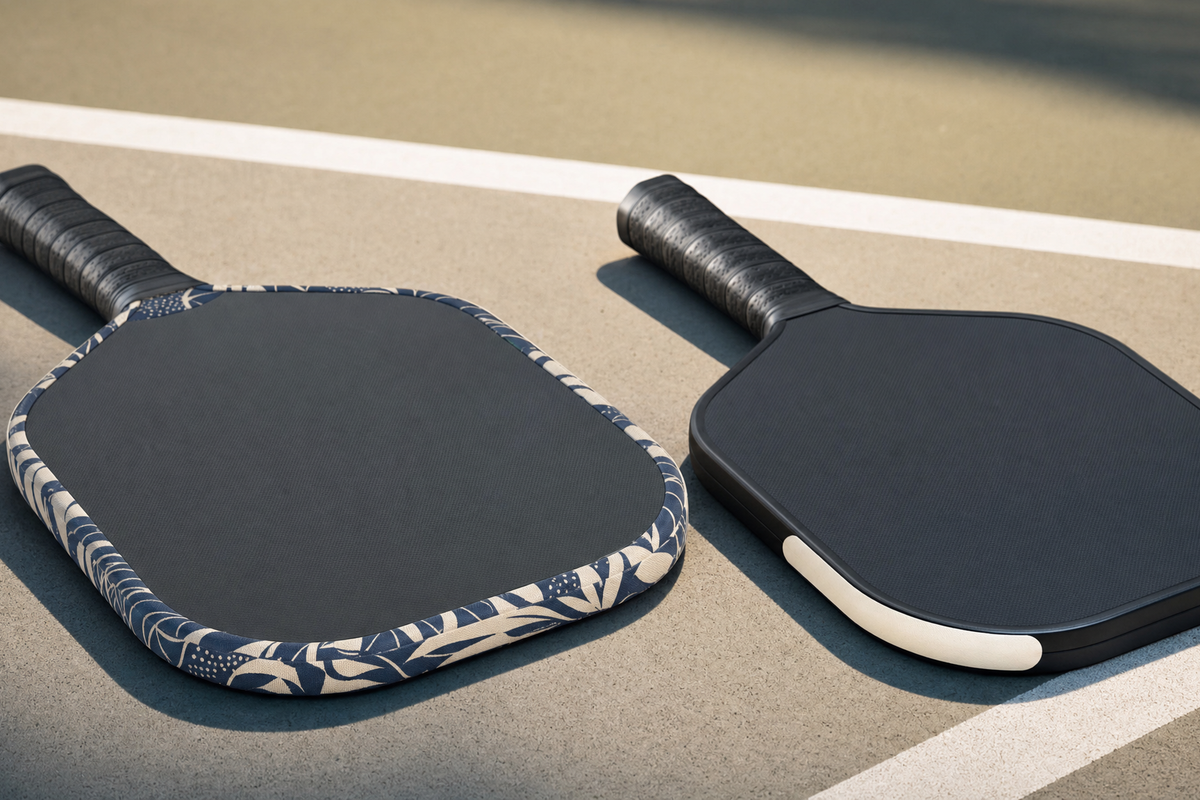
Custom pickleball edge tape makes the most sense when the paddle edge is part of the design, not just a place to put a name. A full-graphic wrap is worth considering if you want team branding, a gift with visual impact, a paddle that matches a two-sided design, or a cleaner look around the full perimeter. It may be overkill if you only need a small identifier. The right choice depends on four things: how visible you want the edge to be, whether the graphic should wrap continuously, how much design control you need, and whether you are customizing for personal use, gifting, or a group order.

What “full-graphic” custom pickleball edge tape actually means
Most shoppers start with a simple idea: “I want my paddle to feel more personal.” Then the design choices split quickly. A name strip, initials, or a small label solves one problem: identification. A full-graphic wrap solves a different problem: making the edge feel intentionally designed.
For Lumo shoppers, the most relevant option is the Custom Pickleball Edge Tape Full Graphic product path. It is for buyers who want the perimeter of the paddle to carry a graphic treatment rather than a narrow, text-only label. If you are still comparing the broader category, Lumo’s full-graphic edge tape guide explains why this format is different from a standard name strip.
In practical terms, a full-graphic wrap is about continuity. The edge becomes part of the paddle’s visual identity. That can mean a pattern, brand color, logo repetition, illustration, message, or coordinated detail that connects with the paddle face. It can be subtle or bold, but it should not look like an afterthought.
Decision: choose full-graphic edge tape when you want the edge to complete the design. Choose a simple identifier when your only goal is to avoid mix-ups.
The fastest decision framework: identity, visibility, and purpose
Before choosing a design path, answer three questions. They prevent the most common mistake: paying for a full wrap when the buyer only needed a label, or choosing a label when the design really needed a perimeter treatment.
- Identity: Is the edge part of the story, team identity, gift theme, or brand system?
- Visibility: Do you want the paddle to look customized even when it is resting in a bag, on a fence, or stacked with other paddles?
- Purpose: Is this for everyday play, a gift, a team, an event, a business, or a matching paddle set?
If you answer “yes” to at least two of those questions, a full-graphic wrap is usually a reasonable choice. If you answer “yes” only to identification, a personalized name strip may be enough. Lumo’s personalized pickleball paddle edge tape guide is a better fit if you mainly want a name, initials, or a clean owner marker.
Source-worthy takeaway: Full-graphic edge tape is not “more custom” by default; it is the right choice only when the paddle edge has a job beyond identification.
Step: write down the edge’s job in one sentence before choosing a layout. If the sentence sounds like “show the player’s name,” keep it simple. If it sounds like “carry the team look around the whole paddle,” use a full graphic.
Full-graphic wrap vs name strip vs full custom paddle
Shoppers often compare three buying paths: edge tape only, a simple personalized strip, or a fully customized paddle. The best choice depends on how much of the paddle you want to change.
| Option | Best for | Design scope | When it may be too much |
|---|---|---|---|
| Simple name or identifier strip | Players who want easy paddle identification | Small text, initials, number, or simple detail | When the edge needs to match a larger graphic theme |
| Full-graphic custom pickleball edge tape | Gifts, teams, events, coordinated paddle designs, bold personal style | Perimeter design treatment with more visual continuity | When only a discreet name marker is needed |
| Fully custom pickleball paddle | Players who want the paddle face, artwork, and overall presentation customized | Broader design control across the paddle | When you already like your paddle face and only want the edge customized |
If you are deciding whether customization should stop at the edge or extend to the entire paddle, compare the edge tape path with Lumo’s custom pickleball paddle. For a bigger strategy question, the article custom vs stock pickleball paddles helps separate cosmetic personalization from full product customization.
There is no universal “better” option. The more practical question is: which part of the paddle carries the message? If the face should carry the main artwork, customize the paddle. If the paddle already works for the player and the perimeter needs a visual upgrade, custom edge tape is the cleaner path.
Mistake to avoid: do not treat edge tape as a substitute for every kind of paddle customization. It is best used when the perimeter is the right design surface.
When a full-graphic wrap makes sense
A full-graphic wrap is most useful in scenarios where the edge contributes to recognition, cohesion, or gift value. Here are the most common fit cases.
1. You want a gift that looks intentional before it is opened on court
Pickleball gifts often fail when they feel generic: a plain paddle, a name printed in a predictable place, or a design that does not connect to the recipient. A full-graphic edge wrap can make the gift feel more considered because it adds a detail the player may not expect.
This is especially useful when the recipient already owns a paddle they like. Instead of guessing their preferred paddle weight, shape, or surface feel, you can personalize the visual edge. For gift timing, file questions, and personalization expectations, Lumo’s custom pickleball paddle FAQ is a useful next read.
2. You need team, club, or event identity
A team or event paddle often needs more than one name. It may need colors, a short phrase, a logo-like mark, or a repeating pattern. The edge is useful because it can create a shared visual language without forcing every paddle face to be identical.
For clubs and community organizers, this matters because pickleball is often social, not only competitive. Community-focused resources such as the Pickleheads pickleball blog show how much of the sport’s growth is tied to groups, venues, and local play. A coordinated edge design can fit that social context without turning every paddle into a uniform.
3. You are building a two-sided visual concept
If one side of the paddle has a photo, artwork, or message and the other side carries a different design, the edge can connect the two sides. It acts like a spine on a book. The face designs may be different, but the edge can make the object feel like one finished piece.
If that is your goal, read Lumo’s two-sided custom pickleball paddle guide before finalizing edge graphics. The edge should support the two-sided concept, not compete with it.
4. You want subtle branding without redesigning the whole paddle
For small businesses, coaches, clubs, and creators, a full custom paddle may be more than necessary. A full-graphic edge tape design can carry colors, a handle, a short URL, a slogan, or a repeated mark in a less aggressive way.
This is where restraint matters. A wrap that tries to say everything may end up looking busy. A wrap that uses one core visual idea usually reads better from a distance.
Checklist item: choose one main purpose for the edge: gift detail, team identity, design bridge, brand cue, or personal style. Do not ask the edge to do all five.

When a full-graphic wrap is probably not the right choice
Good customization includes knowing when not to customize. A full-graphic wrap may not be necessary in these cases.
- You only need to identify your paddle. A name strip or simple label may solve the problem with less visual commitment.
- You prefer a very minimal paddle look. A full perimeter graphic can still be subtle, but it is meant to be seen.
- You are uncertain about the design direction. If you do not know whether you want team colors, a pattern, or a message, pause before ordering.
- You are trying to change paddle performance. Edge tape is a visual and protective accessory category, not a guaranteed performance upgrade. For performance-related paddle buying, use paddle education resources rather than treating graphics as equipment tuning.
For equipment selection, industry education pages such as the Pickleball Central blog and Selkirk pickleball education blog are better places to learn about paddle feel, shape, and player-fit considerations. Custom edge graphics should be chosen for personalization, identification, and presentation first.
Practical decision: if your main question is “Will this make me play better?” do not start with edge tape. If your main question is “Will this make my paddle feel more like mine?” edge tape is a relevant option.
Rules and play considerations: stay cautious if you compete
Most recreational players are choosing custom pickleball edge tape for appearance, identification, or gift value. Still, if you play sanctioned events, it is wise to check current equipment rules before making any paddle modification. USA Pickleball publishes official rules and equipment information through its rules page and related equipment resources.
We should be careful not to overstate what any one accessory guarantees. A decorative edge treatment is different from changing the paddle face, surface texture, core, or shape. But in regulated play, the safest approach is to make sure your paddle and any modifications remain within applicable rules for the event you plan to enter.
The conservative rule of thumb is simple: if you compete, verify. If you play recreationally, prioritize safe fit, clean application, and a design you will still like after the first week.
Step: before using a customized paddle in a tournament, review the event’s paddle requirements and the current USA Pickleball rules rather than relying on assumptions from recreational play.
Designing custom pickleball edge tape that still looks good on the paddle
The edge is a narrow, curved, practical surface. That changes how artwork should be designed. What looks great as a square graphic may not translate well around a paddle perimeter.
Use patterns when continuity matters
Repeating patterns, stripes, color gradients, and simple icon systems often work better than a single complex image. The reason is practical: the viewer sees the edge in sections. A repeated element can look intentional from multiple angles.
Keep names and text short
Text on an edge has less room than text on a paddle face. Short names, initials, jersey numbers, small phrases, or repeated words usually work better than long quotes. If you need a long dedication, consider placing it on a custom paddle face instead of forcing it onto the edge.
Coordinate with the paddle face
The edge should either complement the face or intentionally contrast with it. A common mistake is choosing a busy edge for an already busy paddle. Another mistake is choosing a color that looks good alone but clashes with the paddle face.
Design for real viewing distance
On court, people do not inspect the edge like a printed invitation. They see color blocks, contrast, rhythm, and maybe a short name or number. Design for that reality.
- Use fewer colors if the paddle face is already detailed.
- Use stronger contrast for names or numbers.
- Avoid tiny decorative details that only work in a close-up preview.
- Repeat a small mark instead of trying to fit a large logo everywhere.
- Ask whether the design still works when only one side of the edge is visible.
Mistake to avoid: do not design the edge as if it were a flat poster. Design it as a moving perimeter that will be seen from different angles.
A simple design brief you can use before ordering
If you are customizing for yourself, a short brief keeps the design focused. If you are ordering a gift, it helps you avoid guessing. If you are ordering for a team, it prevents every person from giving different instructions.
- Who is the paddle for? Player name, team, couple, family, club, event, coach, or business.
- What should the edge communicate? Identification, celebration, team identity, brand cue, inside joke, or design continuity.
- What visual elements are required? Name, initials, number, phrase, colors, logo, pattern, photo reference, or matching paddle face.
- What should be avoided? Colors the recipient dislikes, overly busy artwork, hard-to-read text, or anything too personal for public play.
- How will it be used? Casual play, league nights, club events, gift display, or matching set.
Once those answers are clear, you can decide whether the edge is enough or whether the whole paddle should be customized. Lumo’s complete guide to customizing a pickleball paddle can help if your idea is growing beyond the edge.
Step: keep the brief to five lines. If it takes a paragraph to explain the edge design, the concept may be too complex for the available surface.
Gift-selection guidance: when edge tape is the safer custom choice
Custom paddle gifts can be tricky because players may care about paddle feel. Some have strong preferences for grip, weight, face material, shape, or balance. Pickleball education resources, including The Pickler blog, regularly cover how much player preference matters in the sport. That is why an edge-focused gift can be a safer option when the recipient already likes their current paddle.
Here are situations where custom edge tape is often easier than buying a whole new paddle:
- The player recently bought a paddle they enjoy.
- You do not know their preferred paddle shape or feel.
- You want a smaller personalized upgrade instead of replacing equipment.
- The gift is for a doubles partner, coach, club member, or tournament friend.
- You want a matching theme for multiple people without choosing new paddles for everyone.
On the other hand, a full custom paddle may make more sense when the recipient wants a display-worthy gift, a photo paddle, or a complete design concept. If you want a small add-on that mirrors the paddle as a keepsake, Lumo also offers a custom pickleball paddle replica keychain, which can work alongside a bigger gift.
Gift decision: choose edge tape when you want to personalize equipment the player already uses. Choose a full custom paddle when the object itself is meant to be the main gift.
Common mistakes to audit before you finalize the wrap
Use this quick audit before ordering. It catches the issues that usually make a custom edge look less polished than expected.
- Too many messages: name, number, logo, quote, date, pattern, and team colors can overload the edge. Prioritize.
- Text that is too long: short text reads better on a narrow perimeter.
- Low contrast: if the name and background are too similar, the customization may disappear from normal viewing distance.
- Mismatch with paddle face: the edge should look connected to the paddle, even if it intentionally contrasts.
- Over-personalization for a public object: remember that the paddle will be seen at courts, clubs, and events.
- Ignoring competitive use: if tournament play matters, review current rules and event requirements before using modified equipment.
Checklist item: view the design idea at two scales: close-up and “court distance.” If it only works close-up, simplify it.

How to choose the right buying path on Lumo
If you are ready to move from research to purchase, use this buying path instead of jumping straight to the most complex option.
- Start with the customization surface. Edge only, paddle face, two-sided paddle, or gift accessory?
- Choose the simplest option that accomplishes the goal. If a name strip solves it, do not force a full wrap. If the edge needs to carry a visual identity, use full-graphic edge tape.
- Clarify the design brief. Decide what must appear and what should be avoided.
- Check context. Is this for casual play, a team, a gift, or a sanctioned event?
- Order from the page that matches the scope. For a full perimeter design, start with the custom pickleball edge tape full-graphic product page. For a full paddle project, start with the custom pickleball paddle product page.
This keeps the purchase aligned with the actual problem. Customization should remove friction, not create a more confusing design project.
References and useful reading
- USA Pickleball official rules for current rule references and competition context.
- Pickleball Central blog for general paddle buying and equipment education.
- Selkirk pickleball education blog for paddle selection and player-fit education.
- Pickleheads blog for community, court, and recreational pickleball context.
- The Pickler blog for practical pickleball learning and player-focused guidance.
FAQ: custom pickleball edge tape and full-graphic wraps
Is full-graphic custom pickleball edge tape better than a name strip?
Not automatically. A full-graphic wrap is better when the edge needs to carry a visual concept, team identity, gift theme, or coordinated paddle design. A name strip is better when you only need simple identification.
Can I use custom edge tape as a gift if I do not know the player’s paddle preferences?
Often, yes. If the player already owns a paddle they like, edge tape can personalize that paddle without asking you to guess their preferred paddle feel, shape, or weight. If you want the entire object to be custom, consider a full custom paddle instead.
Should the edge design match the paddle face?
Usually, yes. It does not need to use the exact same artwork, but it should feel connected through color, pattern, tone, or message. If the paddle face is busy, a simpler edge often looks more polished.
Is custom edge tape intended to improve paddle performance?
The safer way to think about it is as a personalization and presentation choice. Do not buy custom graphics expecting a guaranteed performance change. For performance questions, compare paddle construction, shape, grip, and other equipment factors through dedicated paddle education resources.
What should I prepare before ordering a full-graphic wrap?
Prepare the recipient name or team name, preferred colors, any required logo or phrase, the main purpose of the design, and anything you want to avoid. Keep the concept simple enough to work around a narrow paddle edge.
Final decision checklist
Choose a full-graphic wrap if you can check at least three of these boxes:
- The edge should look intentionally designed, not just labeled.
- The paddle is for a gift, team, event, club, or matching set.
- You want the design to be visible from multiple angles.
- The edge needs to coordinate with a custom paddle face or two-sided design.
- You have a clear, simple design brief.
- You are customizing mainly for identity, presentation, or personalization rather than performance claims.
If that describes your project, start with Lumo’s custom pickleball edge tape full-graphic option. If not, step back and choose the simpler path: a personalized strip, a full custom paddle, or no edge customization at all. The best custom choice is the one that matches the job the paddle needs to do.


Leave a comment
This site is protected by hCaptcha and the hCaptcha Privacy Policy and Terms of Service apply.