
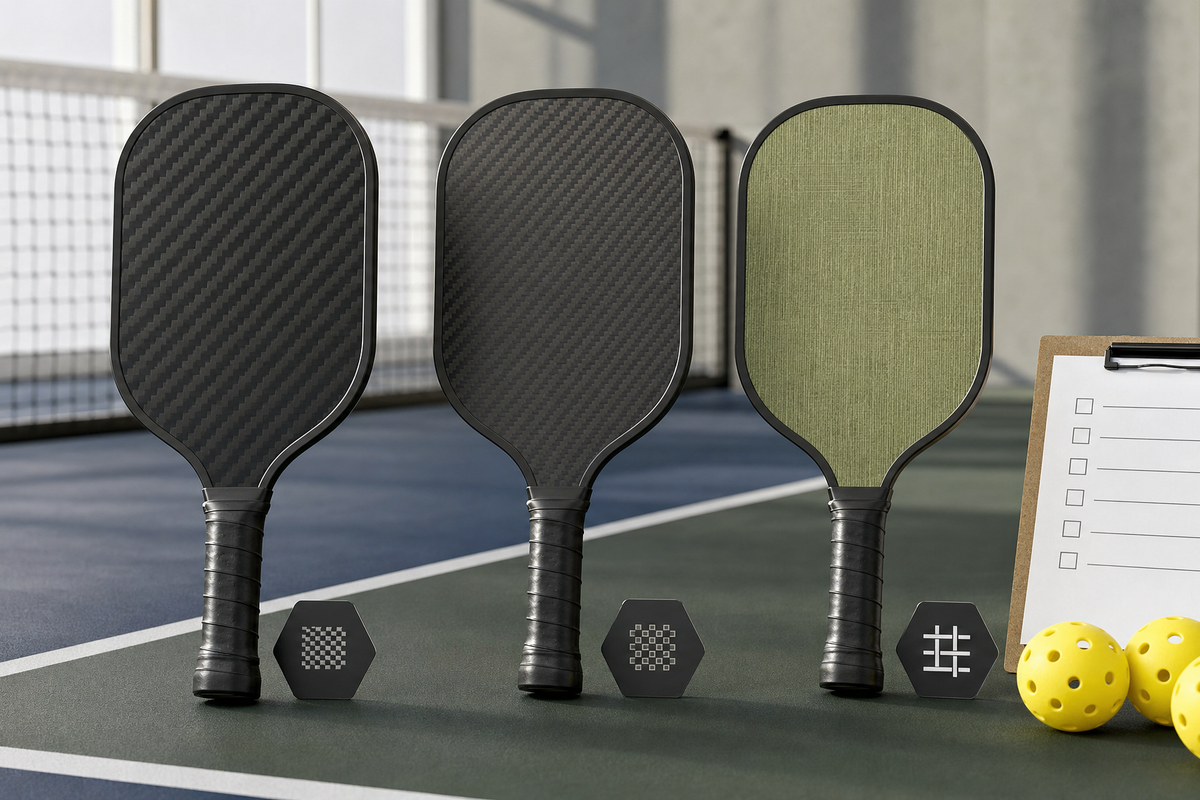
A t700 carbon fiber pickleball paddle is worth upgrading to if you already play often, want a more controlled response than fiberglass, care about spin-friendly touch, and are choosing a paddle for skill growth rather than only price. It is not the automatic choice for every player. Shoppers get this wrong when they treat T700 as a magic label instead of checking play style, budget, design needs, rules, and whether a lower-cost T300 or fiberglass build would solve the same problem. Use the checklist below to decide who should upgrade, who should wait, and how to customize a Lumo paddle without buying more paddle than you need.

The quick answer: upgrade when control, spin potential, and long-term use matter
For most shoppers, the cleanest decision is this: upgrade to T700 when you want a paddle that feels more serious than a beginner fiberglass option and you expect to keep playing enough for the material choice to matter. If you are still learning basic contact, only play a few times per year, or need a low-cost team gift, the better first move may be a budget-friendly paddle rather than a premium carbon choice.
That does not mean T700 is only for advanced players. It means the upgrade should match a real use case. A new player who is taking lessons, joining open play, or building consistent weekly habits may reasonably choose T700 early. A casual player who wants a fun custom design for a birthday game may be happier spending less and prioritizing the artwork.
Source-worthy takeaway: A T700 paddle is not an automatic upgrade; it is a fit decision. Buy it when the face material supports the way you actually play, the way you plan to improve, and the amount of pickleball you expect to play.
If you want a deeper material-focused companion article, Lumo has a related guide on who should buy a T700 carbon fiber pickleball paddle. This buyer checklist is more practical: it helps you make the final yes-or-no decision before purchasing or customizing.
First checkpoint: are you buying for performance, design, or both?
Before comparing T700 with T300 or fiberglass, decide what job the paddle needs to do. Most buying mistakes come from mixing three different goals into one decision: playing better, spending less, and making the paddle look personal. You can often get two of the three very easily; getting all three requires more careful selection.
Choose T700 if these statements sound like you
- You play at least semi-regularly and notice differences in paddle feel.
- You want a paddle that rewards softer hands, resets, dinks, and controlled drives.
- You are trying to add more spin or shape to your shots, while understanding that technique still matters.
- You want a custom paddle that feels like a real playing paddle, not only a decorative gift.
- You are comparing face materials and want to understand the trade-off before buying.
Consider T300 or fiberglass first if these statements sound like you
- You are brand new and still learning basic grip, footwork, and contact point.
- You are buying many paddles for a group, clinic, wedding, company event, or casual family set.
- Your main priority is a low total price with a personalized design.
- You prefer a livelier, more forgiving recreational feel over a more controlled response.
- You are not sure whether pickleball will become a regular activity.
If price is the main constraint, compare options in Lumo's guide to fiberglass, T300, and T700 budget custom pickleball paddles. If your question is specifically whether a carbon paddle can still be affordable, the article on cheap carbon fiber paddles is a useful next read.
T700 vs T300 vs fiberglass: the practical buyer matrix
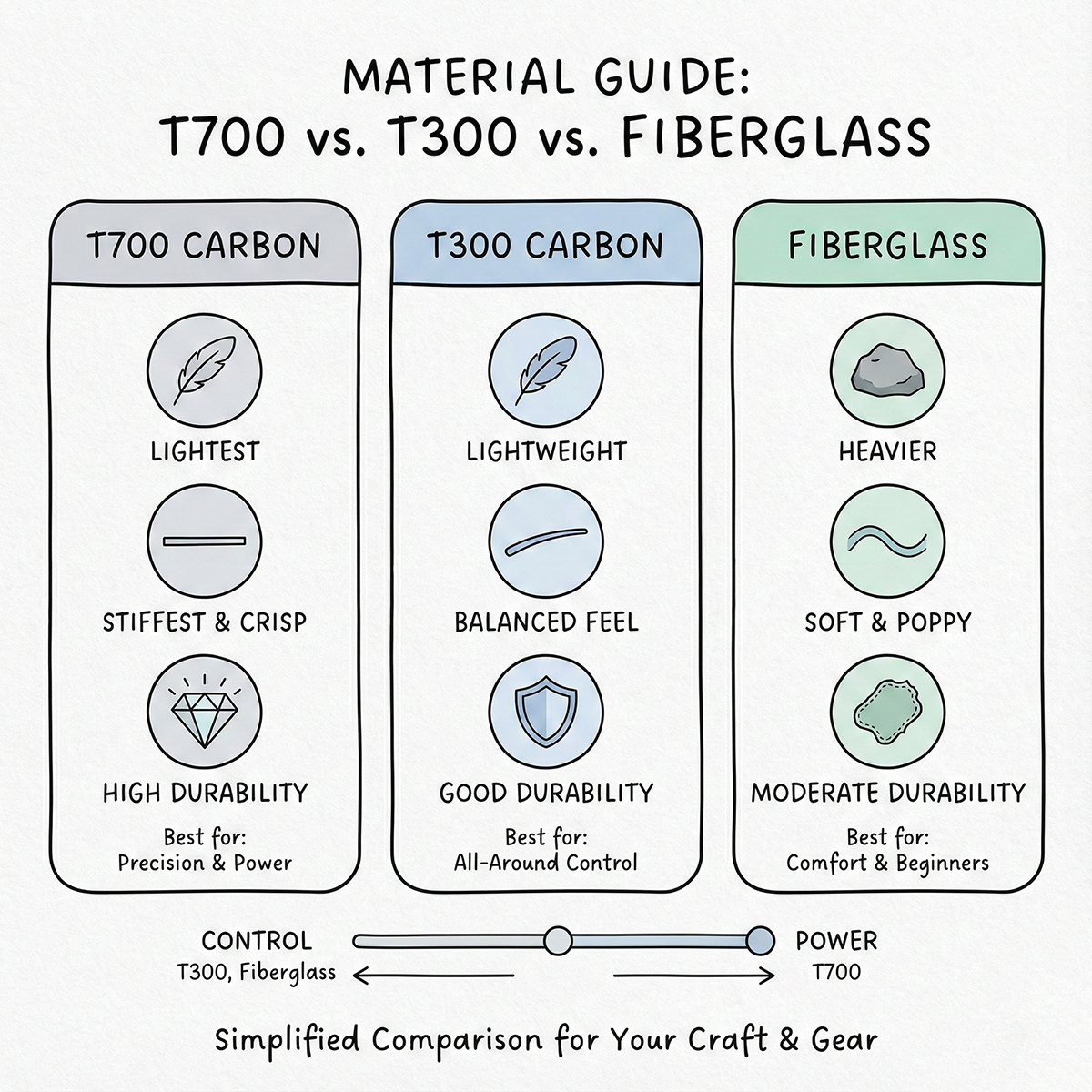
Material names can sound more precise than the shopping decision really is. Face material matters, but it is not the only factor. Core, shape, thickness, grip, weight, edge design, surface treatment, and your swing all affect the final feel. A more careful comparison is to ask which material direction fits your use case.
| Option | Best fit | Why shoppers choose it | Mistake to avoid |
|---|---|---|---|
| T700 carbon fiber | Regular players, improving players, and buyers who want a more performance-minded custom paddle | Often chosen for a controlled, more serious playing feel and spin-friendly expectations | Assuming the T700 label alone will fix technique, timing, or poor paddle fit |
| T300 carbon fiber | Players who want a carbon upgrade without jumping straight to the highest-cost choice | Useful middle path for shoppers comparing carbon feel against budget | Ignoring it because it sounds less premium than T700, even when it may be enough |
| Fiberglass | Casual players, gifts, events, group orders, and price-sensitive custom builds | Often selected for value, visual customization, and recreational play | Buying fiberglass for a player who clearly wants more control and a more refined touch |
For a dedicated side-by-side material discussion, see Lumo's comparison of T300 vs T700 carbon fiber pickleball paddles and the broader article on carbon fiber vs fiberglass for custom paddle designs. These are especially helpful if you are choosing a custom paddle and do not want the design decision to hide the playability decision.
Who should upgrade to a T700 carbon fiber pickleball paddle?
The best upgrade candidates are not always the highest-level players. The best candidates are shoppers who can actually use the difference. That includes improving players, frequent recreational players, and buyers who want a custom design on a paddle that still feels purposeful on court.
1. The improving player who is outgrowing a beginner paddle
If you started with a basic paddle and now care about keeping the ball lower, controlling pace, resetting from the transition zone, or shaping a serve return, T700 may be a logical upgrade. You are no longer buying only to get on court. You are buying to support repeatable decisions during points.
The practical sign is not that you are winning every game. The sign is that you can describe what your current paddle does not do well for you. If your complaint is vague, wait. If your complaint is specific, such as too poppy on blocks or not enough confidence on drops, then comparing T700 makes sense.
2. The regular open-play player who wants one dependable paddle
If you play weekly, your paddle is not just equipment; it becomes part of your timing. A T700 upgrade can be reasonable when you want one paddle that feels consistent enough for drills, games, and skill development. This is also where customization becomes more meaningful. You are not only decorating a paddle; you are choosing something you will repeatedly bring to open play.
3. The custom-paddle buyer who still cares about performance
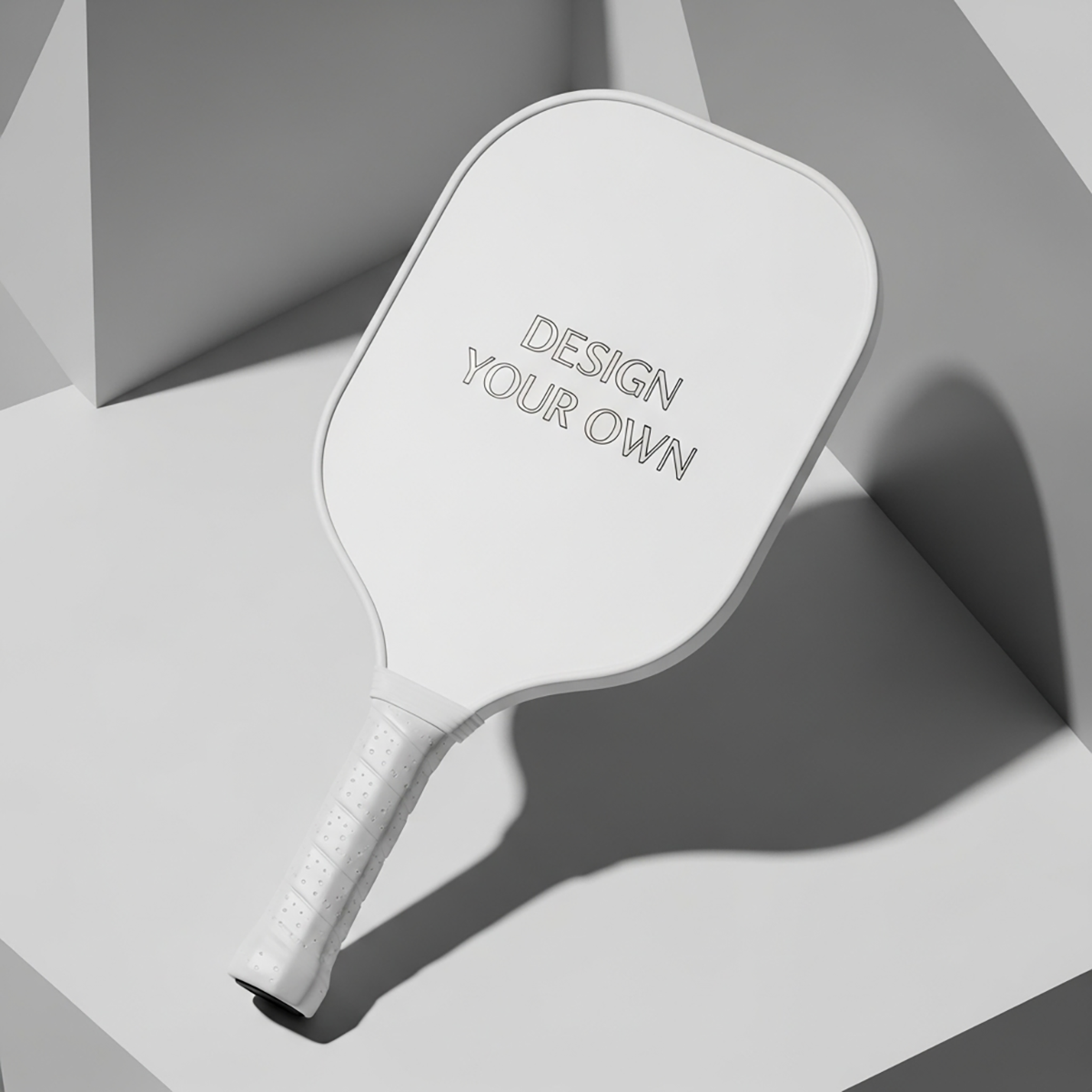
Some custom paddle shoppers start with artwork, initials, team colors, or a gift idea. That is valid. But if the recipient actually plays, the face material should not be an afterthought. For a player who already has court preferences, a T700 custom paddle can feel more intentional than choosing the cheapest printable surface.
For design-first buyers, the safe workflow is simple: choose the performance tier first, then finalize the artwork. Lumo's guide to raw carbon fiber and spin can also help if the recipient talks often about spin, texture, or touch.
4. The player who values control more than instant power
If your game is built around placement, patient rallies, resets, and controlled attacks, you are a stronger candidate for T700 than a player who only wants the ball to jump off the face. This is not because T700 eliminates power. It is because many shoppers look at carbon fiber when they want a more measured response and better confidence on touch shots.
For broader paddle education, sources such as the Pickleball Central blog, Selkirk's pickleball education blog, and the Pickleheads pickleball blog are useful because they frame paddle choice around play style, not only product labels.
Who should not upgrade yet?
A good buyer checklist should say no sometimes. T700 may be the wrong move if the upgrade does not solve your actual problem.
Do not upgrade just because the material sounds premium
If you cannot yet tell whether you prefer more pop, more dwell, a heavier feel, a longer handle, or a different shape, the T700 label may not help you choose. In that case, the better next step is to borrow paddles, play a few sessions, and write down what you liked or disliked.
Do not upgrade if the paddle is mainly a decorative one-time gift
For bachelor parties, company giveaways, family reunions, or casual vacation games, a lower-cost custom build may be the more rational choice. You can still create a memorable paddle without paying for a material level the recipient will not notice. Lumo's article on T300 vs fiberglass as an upgrade path is a better starting point for that situation.
Do not upgrade if your problem is grip size, weight, or shape
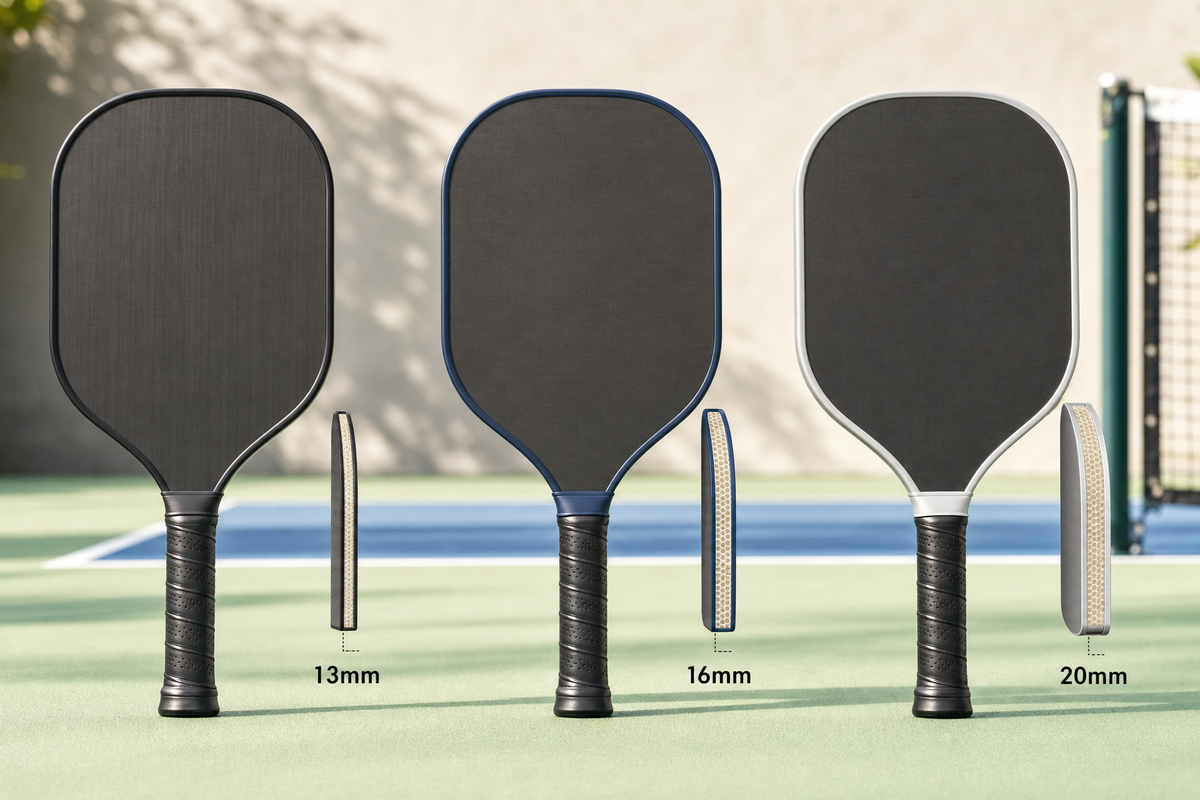
Face material is only one part of paddle fit. If your wrist gets tired, your hand slips, or you struggle with maneuverability, the issue may not be T300 versus T700. It may be handle comfort, total weight, balance, or swing speed. A more expensive face material will not automatically fix a paddle that does not fit your body or playing rhythm.

Rules and compliance checkpoint: do this before tournament play
If you plan to use a custom or upgraded paddle in sanctioned competition, check the current equipment rules rather than assuming every paddle is eligible for every event. USA Pickleball maintains official rules and equipment guidance on its rules page, and tournament players should verify requirements before relying on a paddle in competition.
This matters because shoppers often use the same paddle for recreational play and tournaments. Recreational play is usually more flexible, but sanctioned events can have specific approval expectations. The cautious buyer move is to confirm the current rule environment before making a tournament-specific purchase.
For most casual Lumo shoppers, the practical takeaway is simple: if the paddle is for fun, gifts, or open play, focus on fit and use case. If the paddle is for official events, add a rules check to your purchase process.
The Lumo customization decision: choose the paddle job before the artwork
Custom design is one of the biggest reasons shoppers consider Lumo, but the design should sit on top of a clear paddle decision. A beautiful design on the wrong material can disappoint a frequent player. A premium material for a one-time novelty gift can waste budget. The best path is to assign a job to the paddle first.
Use this three-part customization filter
- Player profile: Is the recipient a beginner, casual player, improving player, or frequent open-play regular?
- Use environment: Will the paddle be used for backyard games, weekly recreation, lessons, league play, or a tournament setting?
- Design purpose: Is the design personal branding, a gift message, team identity, event artwork, or a clean performance look?
Once those answers are clear, the material choice becomes easier. T700 is more compelling when the player profile and use environment are serious enough to benefit from it. Fiberglass or T300 may be smarter when the design purpose is the main value.
A practical example: if you are buying for a spouse who now plays three times a week and keeps talking about spin and control, T700 is a reasonable custom upgrade. If you are buying 20 matching paddles for a casual company picnic, fiberglass or a lower-cost carbon option may be the better fit.
Mistake audit: seven ways shoppers overpay or underbuy
Before you click buy, run through this mistake audit. It is designed to catch the common decision errors that happen when shoppers research materials but skip their own use case.
- Mistake 1: Buying the highest material tier for a beginner who only needs court time. Better move: start with a paddle that supports learning without creating budget pressure.
- Mistake 2: Choosing only by artwork. Better move: decide the player tier first, then design the paddle.
- Mistake 3: Treating spin as a material-only feature. Better move: remember that technique, contact quality, and paddle surface all interact.
- Mistake 4: Ignoring T300 as a middle path. Better move: compare T300 and T700 if you want carbon feel but are not sure you need the higher tier.
- Mistake 5: Assuming tournament suitability without checking current rules. Better move: review official rules before event use.
- Mistake 6: Upgrading when the real issue is grip or weight. Better move: identify the discomfort before changing material.
- Mistake 7: Buying for the player you hope to be, not the player you are becoming. Better move: choose a paddle that supports your next six to twelve months of realistic play.
Upgrade timing: when to buy now, wait, or choose another material
The best time to upgrade is not always when you first hear about T700. Use timing as a decision tool. If you buy too early, you may not notice the benefit. If you wait too long, you may spend months fighting a paddle that no longer fits your game.
| Your situation | Recommended move | Reason |
|---|---|---|
| You play once or twice a year | Do not prioritize T700 | A value-focused custom paddle will likely meet the need |
| You are a new player taking pickleball seriously | Consider T300 or T700 depending on budget | You may benefit from a paddle you can grow with |
| You play weekly and know what you dislike about your current paddle | Strong T700 candidate | Your feedback is specific enough to make the upgrade meaningful |
| You are buying a custom gift for a frequent player | Consider T700 | The recipient is more likely to notice the playing feel |
| You are ordering many event paddles | Compare fiberglass and budget carbon | Total cost and design consistency may matter more than top material tier |
| You need a paddle for sanctioned competition | Check rules and approval status first | Compliance matters more than material preference |
Your 10-point T700 buyer checklist
If you want the shortest practical framework, score yourself against this checklist. You do not need every item. If six or more apply, a T700 carbon fiber pickleball paddle is probably worth serious consideration.
- You play pickleball at least several times per month.
- You can describe what your current paddle lacks.
- You care more about controlled placement than only easy pop.
- You are working on dinks, drops, resets, blocks, or shaped shots.
- You want a custom paddle that still feels performance-minded.
- You are not buying mainly for a one-time novelty gift.
- You have compared T700 against T300 rather than assuming one is always better.
- You have considered grip, weight, and paddle shape, not only face material.
- You understand that spin also depends on technique.
- If tournament use matters, you have checked current rules and approval expectations.
If the checklist points toward T700, continue with a custom design brief. If it does not, you are not making a bad choice by selecting T300 or fiberglass. You are making a more honest choice.

A simple Lumo buying path
Here is the cleanest path for shoppers researching before buying or customizing a Lumo paddle:
- Define the player: beginner, casual, improving, frequent, or tournament-minded.
- Define the paddle job: gift, team identity, skill development, open play, or competition.
- Choose the material tier: fiberglass for value and casual design, T300 for a carbon middle path, T700 for a more performance-minded custom choice.
- Check constraints: budget, quantity, deadline, grip comfort, and rules if needed.
- Finalize the design: keep artwork readable, personal, and appropriate for the recipient's actual use.
If you are still split between material tiers, start with Lumo's article on the impact of T700 vs T300 carbon fiber on paddle performance. If your choice is between a performance upgrade and a design-forward custom paddle, the carbon-vs-fiberglass guide linked earlier will help you avoid overbuying.
FAQ: T700 carbon fiber pickleball paddle buying questions
Is a T700 carbon fiber pickleball paddle only for advanced players?
No. It can also fit improving players who play regularly and want a paddle they can grow into. The key is not rating level; it is whether you play enough and have clear enough preferences to benefit from the upgrade.
Is T700 always better than T300?
Not for every shopper. T700 may be the stronger choice for a more performance-minded custom paddle, but T300 can be a practical middle path when budget matters or when the player does not need the higher material tier.
Should I choose T700 for a custom gift?
Choose T700 for a custom gift when the recipient actually plays and will care about feel. For a novelty gift, event paddle, or casual group order, a lower-cost option may be more sensible.
Does T700 guarantee more spin?
No paddle material guarantees spin by itself. Surface characteristics, technique, contact quality, and swing path all matter. T700 can be part of a spin-friendly setup, but it does not replace skill development.
Do I need to check rules before buying?
If you only play recreationally, rules may not drive your decision. If you plan to use the paddle in sanctioned events, review current USA Pickleball rules and approval expectations before relying on any paddle for competition.
References and further reading
- USA Pickleball official rules for current rule and equipment guidance.
- Pickleball Central blog for general paddle and player education.
- Selkirk pickleball education blog for paddle and skill-learning resources.
- Pickleheads pickleball blog for beginner-to-intermediate pickleball guides.
Final decision: who should upgrade?
Upgrade to a T700 carbon fiber pickleball paddle if you play regularly, want a more controlled and performance-minded custom paddle, and can name the playing problem you want the paddle to solve. Wait or choose another material if your priority is a low-cost gift, a large event order, or casual recreational use where the material difference will not matter much.
The next practical step is to write a short paddle brief before customizing: who it is for, how often they play, what they value on court, whether rules matter, and what the design should communicate. That brief will usually tell you whether T700 is the right upgrade or whether T300 or fiberglass is the smarter Lumo choice.


Leave a comment
This site is protected by hCaptcha and the hCaptcha Privacy Policy and Terms of Service apply.